Oronsky Bryan, Scicinski Jan, Kim Michelle M, Cabrales Pedro, Salacz Michael E, Carter Corey A, Oronsky Neil, Lybeck Harry, Lybeck Michelle, Larson Christopher, Reid Tony R, Oronsky Arnold
EpicentRx, Inc, Mountain View, CA 94040, USA.
Department of Radiation Oncology, University of Michigan, Ann Arbor, MI 48109, USA.
Biomolecules. 2016 Jul 4;6(3):32. doi: 10.3390/biom6030032.
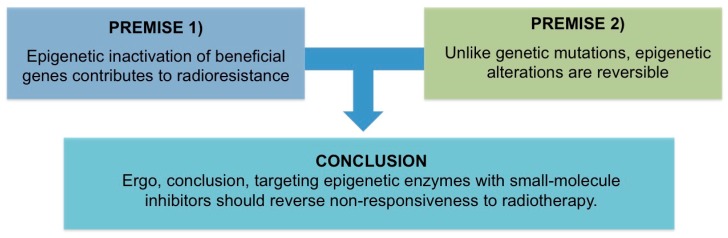
First introduced during the late 1800s, radiation therapy is fundamental to the treatment of cancer. In developed countries, approximately 60% of all patients receive radiation therapy (also known as the sixty percenters), which makes radioresistance in cancer an important and, to date, unsolved, clinical problem. Unfortunately, the therapeutic refractoriness of solid tumors is the rule not the exception, and the ubiquity of resistance also extends to standard chemotherapy, molecularly targeted therapy and immunotherapy. Based on extrapolation from recent clinical inroads with epigenetic agents to prime refractory tumors for maximum sensitivity to concurrent or subsequent therapies, the radioresistant phenotype is potentially reversible, since aberrant epigenetic mechanisms are critical contributors to the evolution of resistant subpopulations of malignant cells. Within the framework of a syllogism, this review explores the emerging link between epigenetics and the development of radioresistance and makes the case that a strategy of pre- or co-treatment with epigenetic agents has the potential to, not only derepress inappropriately silenced genes, but also increase reactive oxygen species production, resulting in the restoration of radiosensitivity.
放射治疗最早于19世纪末被引入,是癌症治疗的基础。在发达国家,约60%的癌症患者接受放射治疗(这些患者也被称为“60%群体”),这使得癌症中的放射抗性成为一个重要且至今尚未解决的临床问题。不幸的是,实体瘤的治疗难治性是普遍现象而非个别情况,这种抗性还普遍存在于标准化疗、分子靶向治疗和免疫治疗中。基于近期临床研究中使用表观遗传药物使难治性肿瘤对同步或后续治疗达到最大敏感性的推断,放射抗性表型可能是可逆的,因为异常的表观遗传机制是恶性细胞抗性亚群演变的关键因素。在三段论的框架内,本综述探讨了表观遗传学与放射抗性发展之间新出现的联系,并论证了用表观遗传药物进行预处理或联合治疗的策略不仅有可能解除不适当沉默基因的抑制,还能增加活性氧的产生,从而恢复放射敏感性。