• 文献检索
  • 文档翻译
  • 深度研究
  • 学术资讯
  • Suppr Zotero 插件Zotero 插件
  • 邀请有礼
  • 套餐&价格
  • 历史记录
应用&插件
Suppr Zotero 插件Zotero 插件浏览器插件Mac 客户端Windows 客户端微信小程序
定价
高级版会员购买积分包购买API积分包
服务
文献检索文档翻译深度研究API 文档MCP 服务
关于我们
关于 Suppr公司介绍联系我们用户协议隐私条款
关注我们

Suppr 超能文献

核心技术专利:CN118964589B侵权必究
粤ICP备2023148730 号-1Suppr @ 2026

文献检索

告别复杂PubMed语法,用中文像聊天一样搜索,搜遍4000万医学文献。AI智能推荐,让科研检索更轻松。

立即免费搜索

文件翻译

保留排版,准确专业,支持PDF/Word/PPT等文件格式,支持 12+语言互译。

免费翻译文档

深度研究

AI帮你快速写综述,25分钟生成高质量综述,智能提取关键信息,辅助科研写作。

立即免费体验

家庭,情境分析中被忽略的层面:厘清印度尼西亚约二十年间家庭和地区对体重指数变化的相对影响。

Households, the omitted level in contextual analysis: disentangling the relative influence of households and districts on the variation of BMI about two decades in Indonesia.

作者信息

Vaezghasemi Masoud, Ng Nawi, Eriksson Malin, Subramanian S V

机构信息

Unit of Epidemiology and Global Health, Department of Public Health and Clinical Medicine, Umeå University, SE-901 87, Umeå, Sweden.

Umeå Center for Global Health Research, Umeå University, Umeå, Sweden.

出版信息

Int J Equity Health. 2016 Jul 7;15(1):102. doi: 10.1186/s12939-016-0388-7.

DOI:10.1186/s12939-016-0388-7
PMID:27388459
原文链接:https://pmc.ncbi.nlm.nih.gov/articles/PMC4936007/
Abstract

BACKGROUND

Most of the research investigating the effect of social context on individual health outcomes has interpreted context in terms of the residential environment. In these studies, individuals are nested within their neighbourhoods or communities, disregarding the intermediate household level that lies between individuals and their residential environment. Households are an important determinant of health yet they are rarely included at the contextual level in research examining association between body mass index (BMI) and the social determinants of health. In this study, our main aim was to provide a methodological demonstration of multilevel analysis, which disentangles the simultaneous effects of households and districts as well as their associated predictors on BMI over time.

METHODS

Using both two- and three-level multilevel analysis, we utilized data from all four cross-sections of the Indonesian Family life Survey (IFLS) 1993 to 2007-8.

RESULTS

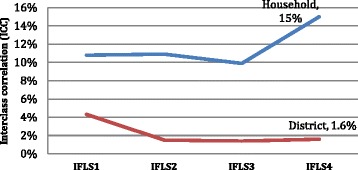
We found that: (i) the variation in BMI attributable to districts decreased from 4.3 % in 1993 to 1.5 % in 1997-98, and remained constant until 2007-08, while there was an alarming increase in the variation of BMI attributable to households, from 10 % in 2000 to 15 % in 2007-08; (ii) ignoring the household level did not change the relative variance contribution of districts on BMI, but ignoring the district level resulted in overestimation of household effects, and (iii) households' characteristics (socioeconomic status, size, and place of residence) did not attenuate the variation of BMI at the household-level.

CONCLUSIONS

Estimating the relative importance of multiple social settings allows us to better understand and unpack the variation in clustered or hieratical data in order to make valid and robust inferences. Our findings will help direct investment of limited public health resources to the appropriate context in order to reduce health risk (variation in BMI) and promote population health.

摘要

背景

大多数研究社会环境对个体健康结果影响的研究都从居住环境的角度来解释环境。在这些研究中,个体嵌套于其邻里或社区之中,而忽略了介于个体与其居住环境之间的中间家庭层面。家庭是健康的重要决定因素,但在研究体重指数(BMI)与健康的社会决定因素之间的关联时,它们很少被纳入背景层面进行考量。在本研究中,我们的主要目的是提供一个多水平分析的方法示范,该分析能够理清家庭和地区的同时效应以及它们相关的预测因素随时间对BMI的影响。

方法

我们使用两水平和三水平多水平分析,利用了1993年至2007 - 2008年印度尼西亚家庭生活调查(IFLS)所有四个横截面的数据。

结果

我们发现:(i)归因于地区的BMI变异从1993年的4.3%降至1997 - 1998年的1.5%,并一直保持到2007 - 2008年,而归因于家庭的BMI变异则惊人地增加,从2000年的10%增至2007 - 2008年的15%;(ii)忽略家庭层面并未改变地区对BMI的相对方差贡献,但忽略地区层面会导致对家庭效应的高估,以及(iii)家庭特征(社会经济地位、规模和居住地点)并未减弱家庭层面BMI的变异。

结论

估计多个社会环境的相对重要性使我们能够更好地理解和剖析聚类或分层数据中的变异,以便做出有效且可靠的推断。我们的研究结果将有助于将有限的公共卫生资源投入到适当的环境中,以降低健康风险(BMI的变异)并促进人群健康。
https://cdn.ncbi.nlm.nih.gov/pmc/blobs/b48b/4936007/3ddfffa60c5b/12939_2016_388_Fig3_HTML.jpg
https://cdn.ncbi.nlm.nih.gov/pmc/blobs/b48b/4936007/6cb06fd1e8a9/12939_2016_388_Fig1_HTML.jpg
https://cdn.ncbi.nlm.nih.gov/pmc/blobs/b48b/4936007/ec5662affae3/12939_2016_388_Fig2_HTML.jpg
https://cdn.ncbi.nlm.nih.gov/pmc/blobs/b48b/4936007/3ddfffa60c5b/12939_2016_388_Fig3_HTML.jpg
https://cdn.ncbi.nlm.nih.gov/pmc/blobs/b48b/4936007/6cb06fd1e8a9/12939_2016_388_Fig1_HTML.jpg
https://cdn.ncbi.nlm.nih.gov/pmc/blobs/b48b/4936007/ec5662affae3/12939_2016_388_Fig2_HTML.jpg
https://cdn.ncbi.nlm.nih.gov/pmc/blobs/b48b/4936007/3ddfffa60c5b/12939_2016_388_Fig3_HTML.jpg

相似文献

1
Households, the omitted level in contextual analysis: disentangling the relative influence of households and districts on the variation of BMI about two decades in Indonesia.家庭,情境分析中被忽略的层面:厘清印度尼西亚约二十年间家庭和地区对体重指数变化的相对影响。
Int J Equity Health. 2016 Jul 7;15(1):102. doi: 10.1186/s12939-016-0388-7.
2
The relative importance of households as a source of variation in child malnutrition: a multilevel analysis in India.家庭作为儿童营养不良变异来源的相对重要性:印度的多层次分析。
Int J Equity Health. 2021 Oct 12;20(1):225. doi: 10.1186/s12939-021-01563-7.
3
The effect of gender and social capital on the dual burden of malnutrition: a multilevel study in Indonesia.性别与社会资本对营养不良双重负担的影响:印度尼西亚的一项多层次研究。
PLoS One. 2014 Aug 25;9(8):e103849. doi: 10.1371/journal.pone.0103849. eCollection 2014.
4
Do neighbourhood socioeconomic circumstances not matter for weight status among Australian men? Multilevel evidence from a household survey of 14 691 adults.澳大利亚男性的体重状况与邻里社会经济环境无关吗?来自一项对14691名成年人的家庭调查的多层次证据。
BMJ Open. 2015 Sep 16;5(9):e007052. doi: 10.1136/bmjopen-2014-007052.
5
A brief conceptual tutorial on multilevel analysis in social epidemiology: investigating contextual phenomena in different groups of people.社会流行病学中多层分析的简要概念教程:探究不同人群中的背景现象。
J Epidemiol Community Health. 2005 Sep;59(9):729-36. doi: 10.1136/jech.2004.023929.
6
A multilevel study of the associations between economic and social context, stage of adolescence, and physical activity and body mass index.一项关于经济与社会环境、青春期阶段以及身体活动和体重指数之间关联的多层次研究。
Pediatrics. 2007 Feb;119 Suppl 1:S84-91. doi: 10.1542/peds.2006-2089M.
7
Associations between neighbourhood characteristics, body mass index and health-related behaviours of adolescents in the Kiel Obesity Prevention Study: a multilevel analysis.《基尔肥胖预防研究中青少年的邻里特征、体重指数与健康相关行为之间的关联:多层次分析》
Eur J Clin Nutr. 2011 Jun;65(6):711-9. doi: 10.1038/ejcn.2011.21. Epub 2011 Mar 30.
8
Inter-individual inequality in BMI: An analysis of Indonesian Family Life Surveys (1993-2007).体重指数的个体间不平等:对印度尼西亚家庭生活调查(1993 - 2007年)的分析
SSM Popul Health. 2016 Oct 1;2:876-888. doi: 10.1016/j.ssmph.2016.09.013. eCollection 2016 Dec.
9
Trend in age at menarche and its association with body weight, body mass index and non-communicable disease prevalence in Indonesia: evidence from the Indonesian Family Life Survey (IFLS).初潮年龄趋势及其与印度尼西亚体重、体重指数和非传染性疾病患病率的关系:来自印度尼西亚家庭生活调查(IFLS)的证据。
BMC Public Health. 2022 Mar 31;22(1):628. doi: 10.1186/s12889-022-12995-3.
10
Body mass index gain, fast food, and physical activity: effects of shared environments over time.体重指数增加、快餐与体育活动:共享环境随时间的影响
Obesity (Silver Spring). 2006 Apr;14(4):701-9. doi: 10.1038/oby.2006.80.

引用本文的文献

1
Low physical activity is associated with adverse health outcome and higher costs in Indonesia: A national panel study.低体力活动与印度尼西亚不良健康结果及更高成本相关:一项全国性面板研究。
Front Cardiovasc Med. 2022 Dec 16;9:972461. doi: 10.3389/fcvm.2022.972461. eCollection 2022.
2
The relative importance of households as a source of variation in child malnutrition: a multilevel analysis in India.家庭作为儿童营养不良变异来源的相对重要性:印度的多层次分析。
Int J Equity Health. 2021 Oct 12;20(1):225. doi: 10.1186/s12939-021-01563-7.
3
Impact of non-communicable disease multimorbidity on health service use, catastrophic health expenditure and productivity loss in Indonesia: a population-based panel data analysis study.

本文引用的文献

1
The Impact of Ignoring the Level of Nesting Structure in Nonparametric Multilevel Latent Class Models.忽略非参数多级潜在类别模型中嵌套结构水平的影响。
Educ Psychol Meas. 2016 Oct;76(5):824-847. doi: 10.1177/0013164415618240. Epub 2015 Nov 26.
2
The double burden of malnutrition in Indonesia: Social determinants and geographical variations.印度尼西亚营养不良的双重负担:社会决定因素与地理差异
SSM Popul Health. 2015 Nov 18;1:16-25. doi: 10.1016/j.ssmph.2015.10.002. eCollection 2015 Dec.
3
The Consequence of Ignoring a Level of Nesting in Multilevel Analysis: A Comment.
印度尼西亚非传染性疾病共病对卫生服务利用、灾难性卫生支出和生产力损失的影响:一项基于人群的面板数据分析研究
BMJ Open. 2021 Feb 17;11(2):e041870. doi: 10.1136/bmjopen-2020-041870.
4
Household and area-level social determinants of multimorbidity: a systematic review.家庭和地区层面的多重疾病社会决定因素:系统评价。
J Epidemiol Community Health. 2021 Mar;75(3):232-241. doi: 10.1136/jech-2020-214691. Epub 2020 Nov 6.
5
Concerned and Conscious, but DefenselessThe intersection of gender and generation in child malnutrition in Indonesia: a qualitative grounded theory study.关注与意识,却无能为力:印度尼西亚儿童营养不良中的性别与代际交叉问题:一项定性扎根理论研究。
Glob Health Action. 2020 Dec 31;13(1):1744214. doi: 10.1080/16549716.2020.1744214.
6
Chronic disease concordance within Indian households: A cross-sectional study.印度家庭中的慢性病一致性:一项横断面研究。
PLoS Med. 2017 Sep 29;14(9):e1002395. doi: 10.1371/journal.pmed.1002395. eCollection 2017 Sep.
7
Improving the performance of community health workers in Swaziland: findings from a qualitative study.提高斯威士兰社区卫生工作者的绩效:一项定性研究的结果。
Hum Resour Health. 2017 Sep 18;15(1):68. doi: 10.1186/s12960-017-0236-x.
忽视多层次分析中嵌套层次的后果:一则评论
Multivariate Behav Res. 2005 Oct 1;40(4):423-34. doi: 10.1207/s15327906mbr4004_2.
4
The Consequence of Ignoring a Level of Nesting in Multilevel Analysis.在多层次分析中忽略嵌套层次的后果。
Multivariate Behav Res. 2004 Jan 1;39(1):129-49. doi: 10.1207/s15327906mbr3901_5.
5
Inequalities in health: definitions, concepts, and theories.健康不平等:定义、概念与理论
Glob Health Action. 2015 Jun 24;8:27106. doi: 10.3402/gha.v8.27106. eCollection 2015.
6
Disentangling the relative influence of schools and neighborhoods on adolescents' risk for depressive symptoms.厘清学校和社区对青少年抑郁症状风险的相对影响。
Am J Public Health. 2015 Apr;105(4):732-40. doi: 10.2105/AJPH.2014.302374. Epub 2015 Feb 25.
7
Using cross-classified multilevel models to disentangle school and neighborhood effects: an example focusing on smoking behaviors among adolescents in the United States.使用交叉分类多层次模型来剖析学校和社区的影响:以美国青少年吸烟行为为例。
Health Place. 2015 Jan;31:224-32. doi: 10.1016/j.healthplace.2014.12.001. Epub 2015 Jan 9.
8
The effect of gender and social capital on the dual burden of malnutrition: a multilevel study in Indonesia.性别与社会资本对营养不良双重负担的影响:印度尼西亚的一项多层次研究。
PLoS One. 2014 Aug 25;9(8):e103849. doi: 10.1371/journal.pone.0103849. eCollection 2014.
9
Social capital and adolescent smoking in schools and communities: a cross-classified multilevel analysis.学校和社区中的社会资本与青少年吸烟:交叉分类多层次分析
Soc Sci Med. 2014 Oct;119:81-7. doi: 10.1016/j.socscimed.2014.08.018. Epub 2014 Aug 15.
10
Dual burden households and intra-household nutritional inequality in Indonesia.印度尼西亚的双重负担家庭和家庭内部营养不平等。
Econ Hum Biol. 2013 Dec;11(4):563-73. doi: 10.1016/j.ehb.2013.07.001. Epub 2013 Jul 12.