Jiang Kaiyu, Wong Laiping, Sawle Ashley D, Frank M Barton, Chen Yanmin, Wallace Carol A, Jarvis James N
Department of Pediatrics, University at Buffalo Jacobs School of Medicine and Biomedical Sciences, Clinical & Translational Research Center, 875 Ellicott St., Buffalo, NY, USA.
Irving Cancer institute, Columbia University College of Physicians and Surgeons, 1130 Saint Nicholas Ave., New York, NY, 10032, USA.
Arthritis Res Ther. 2016 Jul 7;18(1):157. doi: 10.1186/s13075-016-1059-1.
The Trial of Early Aggressive Therapy in Juvenile Idiopathic Arthritis (TREAT trial) was accompanied by a once-in-a-generation sample collection for translational research. In this paper, we report the results of whole blood gene expression analyses and genomic data-mining designed to cast light on the immunopathogenesis of polyarticular juvenile idiopathic arthritis (JIA).
TREAT samples and samples from an independent cohort were analyzed on Affymetrix microarrays and compared to healthy controls. Data from the independent cohort were used to validate the TREAT data. Pathways analysis was used to characterize gene expression profiles. Furthermore, we correlated differential gene expression with new information about functional regulatory elements within the genome to develop models of aberrant gene expression in JIA.
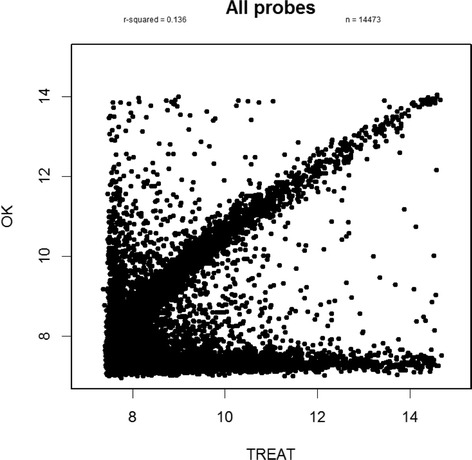
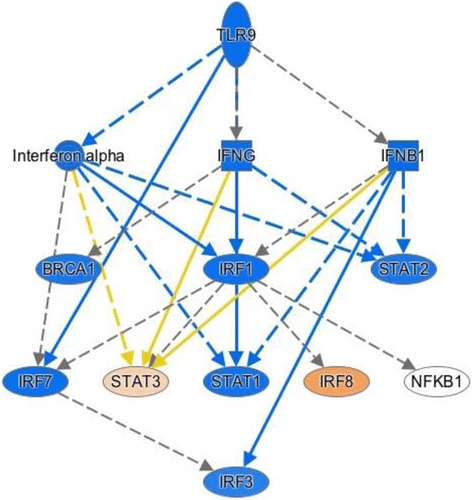
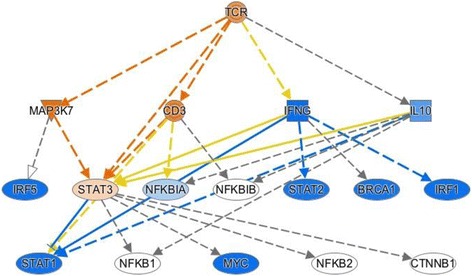
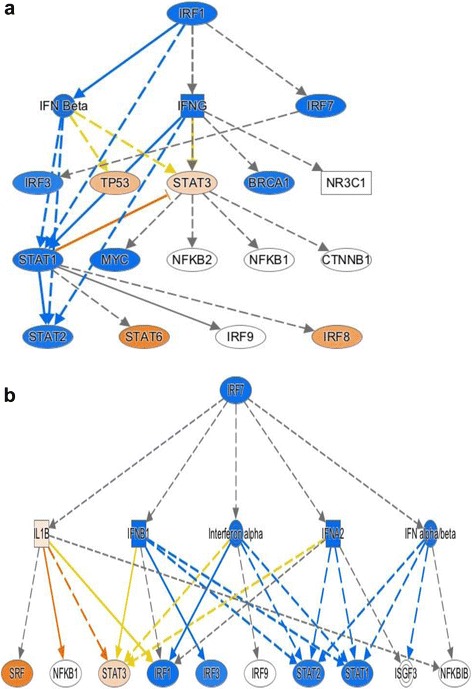
There was a strong concordance in gene expression between TREAT samples and the independent cohort. In addition, rheumatoid factor (RF)-positive and RF-negative patients showed only small differences on whole blood expression profiles. Analysis of the combined samples showed 158 genes represented by 176 probes that showed differential expression between TREAT subjects at baseline and healthy controls. None of the differentially expressed genes were encoded within linkage disequilibrium blocks containing single nucleotide polymorphisms known to be associated with risk for JIA. Functional analysis of these genes showed functional associations with multiple processes associated with innate and adaptive immunity, and appeared to reflect overall suppression of STAT1-3/interferon response factor-mediated pathways.
Despite their limitations, whole blood expression profiles clearly distinguish children with polyarticular JIA from healthy controls. Whole blood expression profiles identify several immunologic pathways of biologic relevance that will need to be pursued in homogeneous cell populations in order to clarify mechanisms of pathogenesis.
ClinicalTrials.gov registry #NCT00443430 , originally registered 2 March 2007 and last updated 30 May 2013.
青少年特发性关节炎早期积极治疗试验(TREAT试验)伴随着为转化研究而进行的一代仅有一次的样本采集。在本文中,我们报告了全血基因表达分析和基因组数据挖掘的结果,旨在阐明多关节型青少年特发性关节炎(JIA)的免疫发病机制。
在Affymetrix微阵列上分析TREAT样本和来自独立队列的样本,并与健康对照进行比较。来自独立队列的数据用于验证TREAT数据。通路分析用于表征基因表达谱。此外,我们将差异基因表达与基因组内功能调控元件的新信息相关联,以建立JIA中异常基因表达的模型。
TREAT样本与独立队列之间在基因表达上有很强的一致性。此外,类风湿因子(RF)阳性和RF阴性患者在全血表达谱上仅显示出微小差异。对合并样本的分析显示,由176个探针代表的158个基因在TREAT受试者基线与健康对照之间表现出差异表达。差异表达的基因均未在包含已知与JIA风险相关的单核苷酸多态性的连锁不平衡区域内编码。对这些基因的功能分析显示与先天和适应性免疫相关的多个过程存在功能关联,并且似乎反映了STAT1 - 3/干扰素反应因子介导的通路的整体抑制。
尽管存在局限性,但全血表达谱能清楚地区分多关节型JIA患儿与健康对照。全血表达谱确定了几个具有生物学相关性的免疫通路,为阐明发病机制,需要在同质细胞群体中进一步研究。
ClinicalTrials.gov注册号#NCT00443430,最初于2007年3月2日注册,最后更新于2013年5月30日。