Brescia AnneMarie C, Simonds Megan M, McCahan Suzanne M, Sullivan Kathleen E, Rose Carlos D
Pediatric Rheumatology, Nemours/AI DuPont Hospital for Children, 1600 Rockland Road, Wilmington, DE, 19803, USA.
Nemours Biomedical Research, 1600 Rockland Road, Wilmington, DE, USA.
Pediatr Rheumatol Online J. 2018 Jan 8;16(1):3. doi: 10.1186/s12969-017-0217-6.
Our intent was to identify differences between the transcriptome of fibroblast-like synoviocytes (FLS) in oligoarticular juvenile idiopathic arthritis (JIA) before extension when compared to persistent subtype of JIA, when the two are clinically indistinguishable. Additionally, we sought to determine if differences between the transcriptomes of FLS from extended-to-be and polyarticular course JIA could be detected. Our hypothesis was that intrinsic differences in the transcriptome of the FLS from extended-to-be JIA would distinguish them from persistent oligoarticular JIA, before the course is clinically apparent.
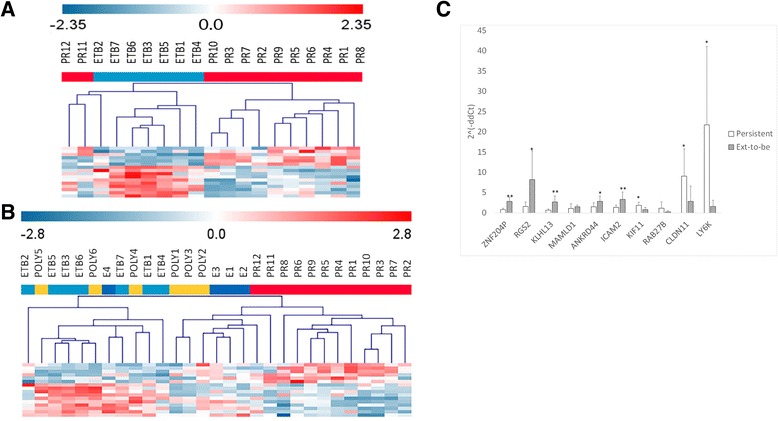
Global gene expression was defined in cultured FLS from 6 controls, 12 JIA with persistent course, 7 JIA prior to extension (extended-to-be), 4 JIA with extended course and 6 polyarticular onset, using Affymetrix Human GeneChips 133plus2.0.
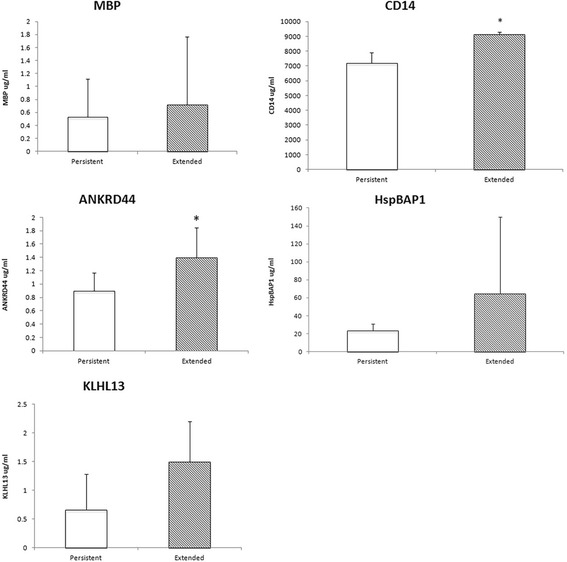
Bioconductor Linear Models for Microarray Analysis revealed 22 probesets with differential expression between persistent and extended-to-be FLS at 15% FDR, however only 2 probesets distinguished extended-to-be from extended and none distinguished extended-to-be and polyarticular at 15% FDR. Differences in extended and polyarticular gene expression profiles were not detected. Confirmation of select genes was done on the RNA level by RT-qPCR and on the protein level in synovial fluid by ELISA.
The transcriptome of FLS from extended-to-be juvenile idiopathic arthritis is distinct from persistent course before a clinical distinction can be made. Additionally, the transcriptome of extended-to-be and polyarticular course, including those who have already extended, are indistinguishable. These gene expression data suggest that FLS already reflect a polyarticular behavior early in disease course, suggesting that extended-to-be may be "latent polyarticular" at onset. These differences can be used to develop early biomarkers of disease course, allowing for better-informed treatment decisions.
我们的目的是确定在少关节型幼年特发性关节炎(JIA)扩展前,其成纤维样滑膜细胞(FLS)的转录组与JIA持续型的转录组之间的差异,因为这两种类型在临床上难以区分。此外,我们试图确定是否能够检测出扩展型JIA和多关节型JIA的FLS转录组之间的差异。我们的假设是,在临床病程明显之前,扩展型JIA的FLS转录组的内在差异将使其与持续性少关节型JIA区分开来。
使用Affymetrix Human GeneChips 133plus2.0对来自6名对照、12名持续性病程JIA、7名扩展前JIA(即将扩展型)、4名扩展型病程JIA和6名多关节起病JIA的培养FLS进行全基因表达分析。
微阵列分析的生物导体线性模型显示,在15%错误发现率(FDR)时,有22个探针集在持续性和即将扩展型FLS之间存在差异表达,但在15% FDR时,只有2个探针集能区分即将扩展型与扩展型,没有探针集能区分即将扩展型和多关节型。未检测到扩展型和多关节型基因表达谱的差异。通过RT-qPCR在RNA水平以及通过ELISA在滑液蛋白水平对选定基因进行了验证。
即将扩展型幼年特发性关节炎的FLS转录组在临床区分之前与持续性病程不同。此外,即将扩展型和多关节型病程(包括那些已经扩展的)的转录组无法区分。这些基因表达数据表明,FLS在疾病病程早期就已经反映出多关节行为,这表明即将扩展型在发病时可能是“潜在多关节型”。这些差异可用于开发疾病病程的早期生物标志物,从而做出更明智的治疗决策。