Berisha Bajram, Schams Dieter, Rodler Daniela, Sinowatz Fred, Pfaffl Michael W
Animal Physiology and Immunology Weihenstephan, Technical University of Munich, 85354 Freising, Germany.
J Reprod Dev. 2016 Oct 18;62(5):501-510. doi: 10.1262/jrd.2016-056. Epub 2016 Jul 11.
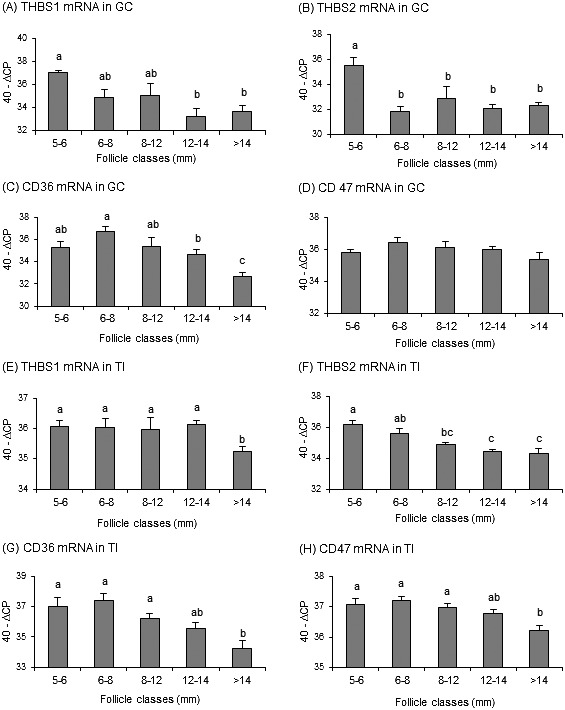
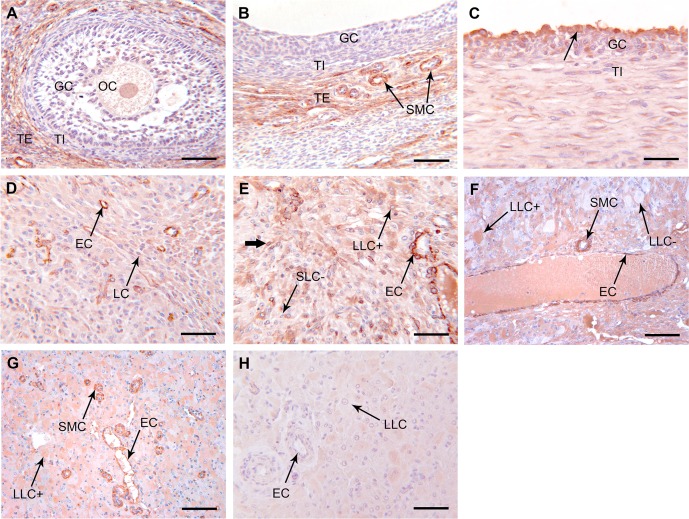
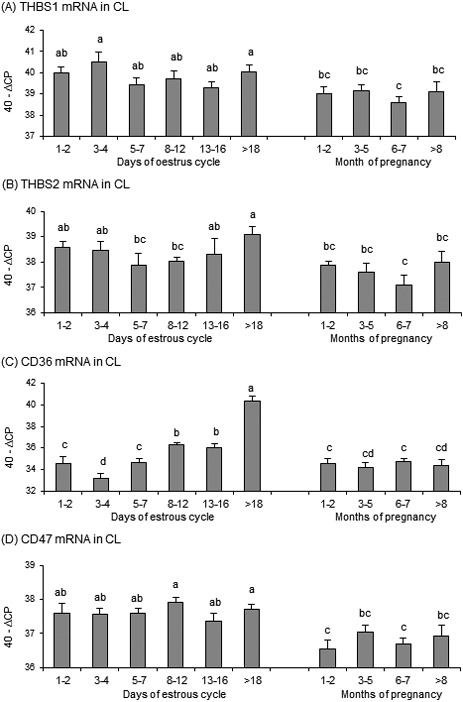
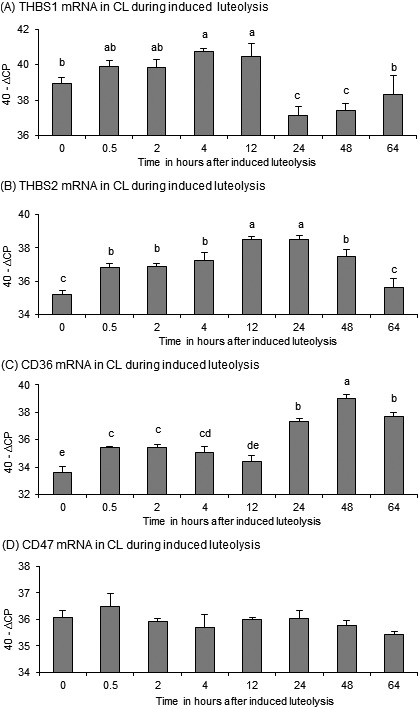
The aim of this study was to characterize the expression patterns and localization of the thrombospondin family members (THBS1, THBS2) and their receptors (CD36 and CD47) in bovine ovaries. First, the antral follicles were classified into 5 groups based on the follicle size and estradiol-17beta (E2) concentration in the follicular fluid (< 0.5, 0.5-5, 5-40, 40-180 and >180 E2 ng/ml). Second, the corpus luteum (CL) was assigned to the following stages: days 1-2, 3-4, 5-7, 8-12, 13-16 and >18 of the estrous cycle and of pregnancy (month 1-2, 3-4, 6-7 and > 8). Third, the corpora lutea were collected by transvaginal ovariectomy before and 0.5, 2, 4, 12, 24, 48 and 64 h after inducing luteolysis by injecting a prostaglandin F2alpha analog. The mRNA expression of examined factors was measured by RT-qPCR, steroid hormone concentration by EIA, and localization by immunohistochemistry. The mRNA expression of THBS1, THBS2, CD36, and CD47 in the granulosa cells and theca interna was high in the small follicles and reduced in the preovulatory follicles. The mRNA expression of THBS1, THBS2, and CD47 in the CL during the estrous cycle was high, but decreased significantly during pregnancy. After induced luteolysis, thrombospondins increased significantly to reach the maximum level at 12 h for THBS1, 24 h for THBS2, and 48 h for CD36. The temporal expression and localization pattern of the thrombospondins and their specific receptors in the antral follicles and corpora lutea during the different physiological phases of the estrous cycle and induced luteolysis appear to be compatible with their inhibitory role in the control of ovarian angiogenesis.
本研究的目的是描述血小板反应蛋白家族成员(THBS1、THBS2)及其受体(CD36和CD47)在牛卵巢中的表达模式和定位。首先,根据卵泡大小和卵泡液中雌二醇-17β(E2)浓度(<0.5、0.5 - 5、5 - 40、40 - 180和>180 E2 ng/ml)将有腔卵泡分为5组。其次,将黄体(CL)分为以下阶段:发情周期和妊娠期的第1 - 2天、3 - 4天、5 - 7天、8 - 12天、13 - 16天以及>18天(妊娠第1 - 2个月、3 - 4个月、6 - 7个月和>8个月)。第三,通过经阴道卵巢切除术在注射前列腺素F2α类似物诱导黄体溶解前以及诱导后0.5、2、4、12、24、48和64小时收集黄体。通过RT-qPCR检测所检测因子的mRNA表达,通过酶免疫分析检测类固醇激素浓度,通过免疫组织化学检测定位。颗粒细胞和卵泡内膜中THBS1、THBS2、CD36和CD47的mRNA表达在小卵泡中较高,而在排卵前卵泡中降低。发情周期中黄体中THBS1、THBS2和CD47的mRNA表达较高,但在妊娠期间显著降低。诱导黄体溶解后,血小板反应蛋白显著增加,THBS1在12小时达到最高水平,THBS2在24小时达到最高水平,CD36在48小时达到最高水平。在发情周期的不同生理阶段以及诱导黄体溶解过程中,有腔卵泡和黄体中血小板反应蛋白及其特异性受体的时间表达和定位模式似乎与其在控制卵巢血管生成中的抑制作用相一致。