J Cell Commun Signal. 2009 Dec;3(3-4):189-200. doi: 10.1007/s12079-009-0060-8. Epub 2009 Oct 2.
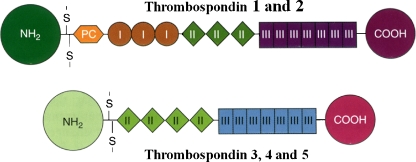
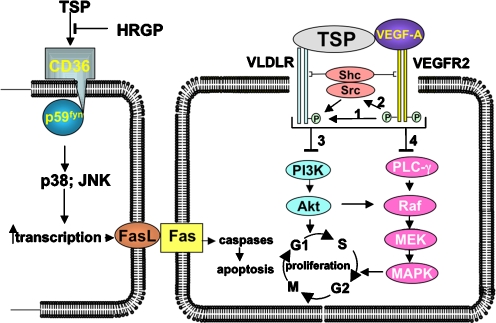
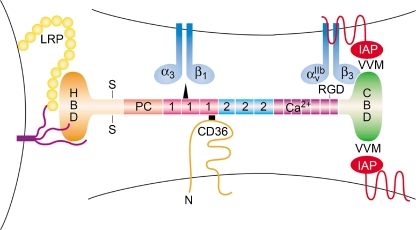
Thrombospondins (TSPs) -1 and -2 were among the first protein inhibitors of angiogenesis to be identified, a property that was subsequently attributed to the interactions of sequences in their type I repeats with endothelial cell-surface receptors. The interactions of TSPs-1 and -2 with cell-surface receptors, proteases, growth factors, and other bioactive molecules, coupled with the absence of direct structural functions that can be attributed to these matrix proteins, qualify them for inclusion in the category of 'matricellular proteins'. The phenotypes of TSP-1, TSP-2, and double TSP-1/2-null mice confirm the roles that these proteins play in the regulation of angiogenesis, and provide clues to some of the other important functions of these multi-domain proteins. One of these functions is the ability of TSP-1 to activate the latent TGFbeta1 complex, a property that is not shared by TSP-2. A major pathway by which TSP1 or TSP2 inhibits angiogenesis involves an interaction with CD 36 on endothelial cells, which leads to apoptosis of both the liganded and adjacent cells. However a homeostatic mechanism, which inhibits endothelial cell proliferation, and may be physiologically preferable under some circumstances, has also been elucidated, and involves interaction with the very low density lipoprotein receptor (VLDLR). The interaction of TSP1with its receptor, CD47, further inhibits angiogenesis by antagonizing nitric oxide signaling in endothelial and vascular smooth muscle cells. Paradoxically, there is also evidence that TSP-1 can function to promote angiogenesis. This apparent contradiction can be explained by the presence of sequences in different domains of the protein that interact with different receptors on endothelial cells. The anti-angiogenic function of TSPs has spurred interest in their use as anti-tumor agents. Currently, peptide mimetics, based on sequences in the type I repeats of TSPs that have been shown to have anti-angiogenic properties, are undergoing clinical testing.
血栓反应蛋白(TSPs)-1 和 -2 是最早被鉴定出来的血管生成蛋白抑制剂之一,其特性随后归因于它们的 I 型重复序列中的序列与内皮细胞表面受体的相互作用。TSPs-1 和 -2 与细胞表面受体、蛋白酶、生长因子和其他生物活性分子的相互作用,以及这些基质蛋白没有可以归因于它们的直接结构功能,使它们有资格被归入“基质细胞蛋白”类别。TSP-1、TSP-2 和双重 TSP-1/2 缺失小鼠的表型证实了这些蛋白质在调节血管生成中的作用,并为这些多功能蛋白的其他一些重要功能提供了线索。其中一个功能是 TSP-1 激活潜伏 TGFβ1 复合物的能力,而 TSP-2 则没有这种能力。TSP1 或 TSP2 抑制血管生成的主要途径涉及与内皮细胞上的 CD36 相互作用,这导致配体和相邻细胞的凋亡。然而,也已经阐明了一种抑制内皮细胞增殖的动态平衡机制,在某些情况下可能具有生理优势,该机制涉及与极低密度脂蛋白受体(VLDLR)的相互作用。TSP1 与其受体 CD47 的相互作用通过拮抗内皮细胞和血管平滑肌细胞中的一氧化氮信号进一步抑制血管生成。矛盾的是,也有证据表明 TSP-1 可以促进血管生成。这种明显的矛盾可以通过蛋白质不同结构域中与内皮细胞上不同受体相互作用的序列来解释。TSPs 的抗血管生成功能激发了人们对它们作为抗肿瘤药物的兴趣。目前,基于已显示出抗血管生成特性的 TSPs I 型重复序列的肽模拟物正在进行临床测试。