Liao Jen-Chung
Department of Orthopedic Surgery, Bone and Joint Research Center, Chang Gung Memorial Hospital, Chang Gung University, Taoyuan 333, Taiwan.
Int J Mol Sci. 2016 Jul 5;17(7):1073. doi: 10.3390/ijms17071073.
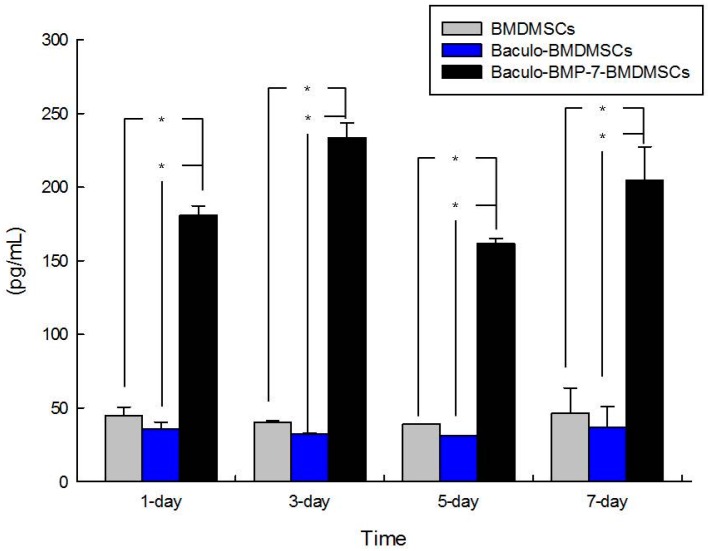
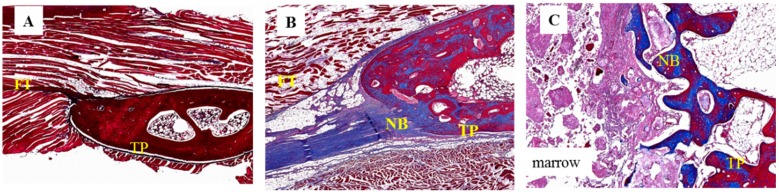
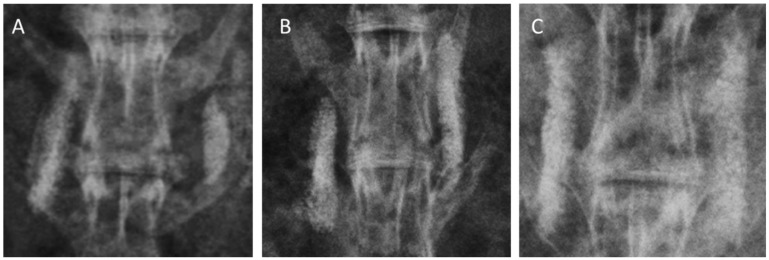
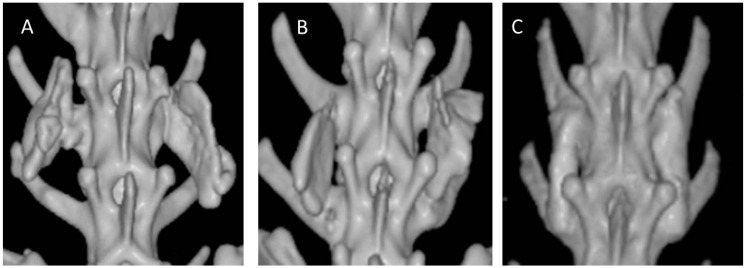
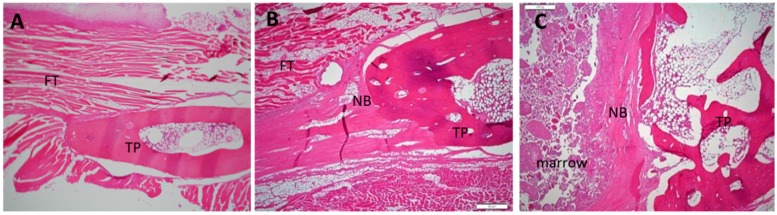
Previous studies have suggested that bone marrow-derived mesenchymal stem cells (BMDMSCs) genetically modified with baculoviral bone morphogenetic protein-2 (Bac-BMP-2) vectors could achieve successful fusion in a femur defect model or in a spinal fusion model. In this study, BMDMSCs expressing BMP-7 (Bac-BMP-7-BMDMSCs) were generated. We hypothesized that Bac-BMP-7-BMDMSCs could secrete more BMP-7 than untransduced BMDMSCs in vitro and achieve spinal posterolateral fusion in a rabbit model. Eighteen rabbits underwent posterolateral fusion at L4-5. Group I (n = 6) was implanted with collagen-β-tricalcium phosphate (TCP)-hydroxyapatite (HA), Group II (n = 6) was implanted with collagen-β-TCP-HA plus BMDMSCs, and Group III (n = 6) was implanted with collagen-β-TCP-HA plus Bac-BMP-7-BMDMSCs. In vitro production of BMP-7 was quantified with an enzyme-linked immunosorbent assay (ELISA). Spinal fusion was examined using computed tomography (CT), manual palpation, and histological analysis. ELISA demonstrated that Bac-BMP-7-BMDMSCs produced four-fold to five-fold more BMP-7 than did BMDMSCs. In the CT results, 6 fused segments were observed in Group I (50%, 6/12), 8 in Group II (67%, 8/12), and 12 in Group III (100%, 12/12). The fusion rate, determined by manual palpation, was 0% (0/6) in Group I, 0% (0/6) in Group II, and 83% (5/6) in Group III. Histology showed that Group III had more new bone and matured marrow formation. In conclusion, BMDMSCs genetically transduced with the Bac-BMP-7 vector could express more BMP-7 than untransduced BMDMSCs. These Bac-BMP-7-BMDMSCs on collagen-β-TCP-HA scaffolds were able to induce successful spinal fusion in rabbits.
先前的研究表明,用杆状病毒骨形态发生蛋白-2(Bac-BMP-2)载体进行基因改造的骨髓间充质干细胞(BMDMSC)在股骨缺损模型或脊柱融合模型中可实现成功融合。在本研究中,生成了表达BMP-7的BMDMSC(Bac-BMP-7-BMDMSC)。我们假设Bac-BMP-7-BMDMSC在体外比未转导的BMDMSC能分泌更多的BMP-7,并在兔模型中实现脊柱后外侧融合。18只兔接受了L4-5节段的后外侧融合术。第一组(n = 6)植入胶原-β-磷酸三钙(TCP)-羟基磷灰石(HA),第二组(n = 6)植入胶原-β-TCP-HA加BMDMSC,第三组(n = 6)植入胶原-β-TCP-HA加Bac-BMP-7-BMDMSC。用酶联免疫吸附测定(ELISA)对BMP-7的体外产生量进行定量。使用计算机断层扫描(CT)、手动触诊和组织学分析来检查脊柱融合情况。ELISA显示,Bac-BMP-7-BMDMSC产生的BMP-7比BMDMSC多四至五倍。在CT结果中,第一组观察到6个融合节段(50%,6/12),第二组8个(67%,8/12),第三组12个(100%,12/12)。通过手动触诊确定的融合率,第一组为0%(0/6),第二组为0%(0/6),第三组为83%(5/6)。组织学显示,第三组有更多的新骨形成和成熟骨髓。总之,用Bac-BMP-7载体进行基因转导的BMDMSC比未转导的BMDMSC能表达更多的BMP-7。这些置于胶原-β-TCP-HA支架上的Bac-BMP-7-BMDMSC能够在兔中诱导成功的脊柱融合。