Trias Emiliano, Ibarburu Sofía, Barreto-Núñez Romina, Babdor Joël, Maciel Thiago T, Guillo Matthias, Gros Laurent, Dubreuil Patrice, Díaz-Amarilla Pablo, Cassina Patricia, Martínez-Palma Laura, Moura Ivan C, Beckman Joseph S, Hermine Olivier, Barbeito Luis
Institut Pasteur de Montevideo, Mataojo 2020, Montevideo, 11.400, Uruguay.
Imagine Institute, Hôpital Necker, 24 boulevard du Montparnasse, 75015, Paris, France.
J Neuroinflammation. 2016 Jul 11;13(1):177. doi: 10.1186/s12974-016-0620-9.
In the SOD1(G93A) mutant rat model of amyotrophic lateral sclerosis (ALS), neuronal death and rapid paralysis progression are associated with the emergence of activated aberrant glial cells that proliferate in the degenerating spinal cord. Whether pharmacological downregulation of such aberrant glial cells will decrease motor neuron death and prolong survival is unknown. We hypothesized that proliferation of aberrant glial cells is dependent on kinase receptor activation, and therefore, the tyrosine kinase inhibitor masitinib (AB1010) could potentially control neuroinflammation in the rat model of ALS.
The cellular effects of pharmacological inhibition of tyrosine kinases with masitinib were analyzed in cell cultures of microglia isolated from aged symptomatic SOD1(G93A) rats. To determine whether masitinib prevented the appearance of aberrant glial cells or modified post-paralysis survival, the drug was orally administered at 30 mg/kg/day starting after paralysis onset.
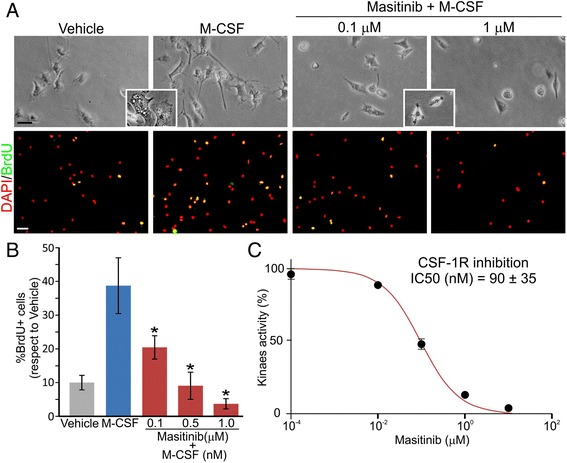
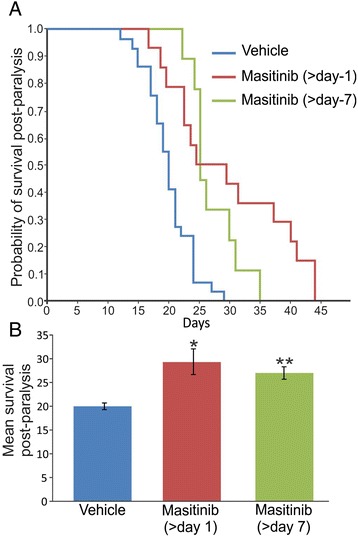
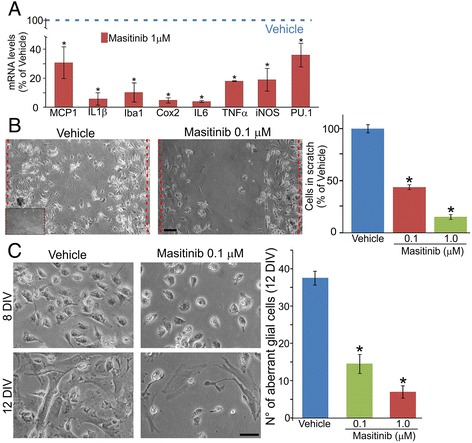
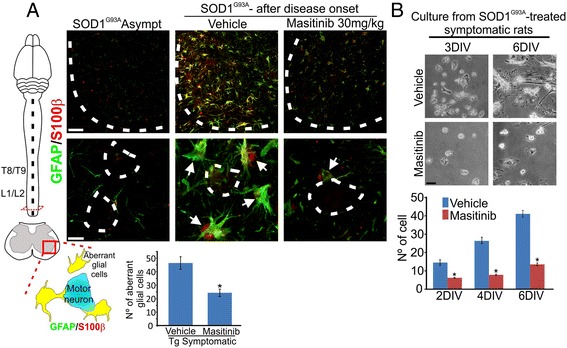
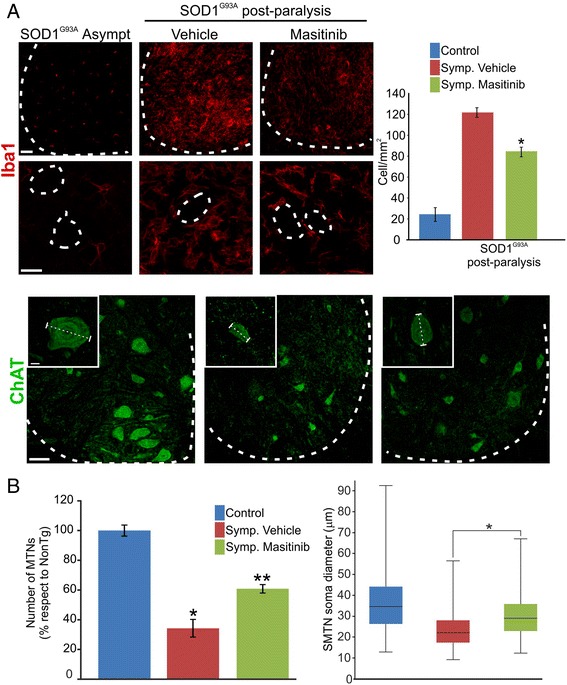
We found that masitinib selectively inhibited the tyrosine kinase receptor colony-stimulating factor 1R (CSF-1R) at nanomolar concentrations. In microglia cultures from symptomatic SOD1(G93A) spinal cords, masitinib prevented CSF-induced proliferation, cell migration, and the expression of inflammatory mediators. Oral administration of masitinib to SOD1(G93A) rats starting after paralysis onset decreased the number of aberrant glial cells, microgliosis, and motor neuron pathology in the degenerating spinal cord, relative to vehicle-treated rats. Masitinib treatment initiated 7 days after paralysis onset prolonged post-paralysis survival by 40 %.
These data show that masitinib is capable of controlling microgliosis and the emergence/expansion of aberrant glial cells, thus providing a strong biological rationale for its use to control neuroinflammation in ALS. Remarkably, masitinib significantly prolonged survival when delivered after paralysis onset, an unprecedented effect in preclinical models of ALS, and therefore appears well-suited for treating ALS.
在肌萎缩侧索硬化症(ALS)的SOD1(G93A)突变大鼠模型中,神经元死亡和快速的麻痹进展与在退化脊髓中增殖的活化异常胶质细胞的出现有关。此类异常胶质细胞的药理学下调是否会减少运动神经元死亡并延长生存期尚不清楚。我们假设异常胶质细胞的增殖依赖于激酶受体激活,因此,酪氨酸激酶抑制剂马西替尼(AB1010)可能控制ALS大鼠模型中的神经炎症。
在从有症状的老年SOD1(G93A)大鼠分离的小胶质细胞的细胞培养物中分析用马西替尼药理学抑制酪氨酸激酶的细胞效应。为了确定马西替尼是否能预防异常胶质细胞的出现或改变麻痹后的生存期,在麻痹发作后开始以30mg/kg/天的剂量口服给药。
我们发现马西替尼在纳摩尔浓度下选择性抑制酪氨酸激酶受体集落刺激因子1受体(CSF-1R)。在有症状的SOD1(G93A)脊髓的小胶质细胞培养物中,马西替尼可预防CSF诱导的增殖、细胞迁移和炎症介质的表达。相对于载体处理的大鼠,在麻痹发作后开始给SOD1(G93A)大鼠口服马西替尼可减少退化脊髓中异常胶质细胞的数量、小胶质细胞增生和运动神经元病理改变。在麻痹发作7天后开始的马西替尼治疗使麻痹后的生存期延长了40%。
这些数据表明马西替尼能够控制小胶质细胞增生以及异常胶质细胞的出现/扩张,从而为其用于控制ALS中的神经炎症提供了有力的生物学依据。值得注意的是,马西替尼在麻痹发作后给药时显著延长了生存期,这在ALS临床前模型中是前所未有的效果,因此似乎非常适合治疗ALS。