Chen Hong-Ru, Chuang Yung-Chun, Lin Yee-Shin, Liu Hsiao-Sheng, Liu Ching-Chuan, Perng Guey-Chuen, Yeh Trai-Ming
The Institute of Basic Medical Sciences, College of Medicine, National Cheng Kung University, Tainan City, Taiwan.
Department of Medical Laboratory Science and Biotechnology, College of Medicine, National Cheng Kung University, Tainan City, Taiwan.
PLoS Negl Trop Dis. 2016 Jul 13;10(7):e0004828. doi: 10.1371/journal.pntd.0004828. eCollection 2016 Jul.
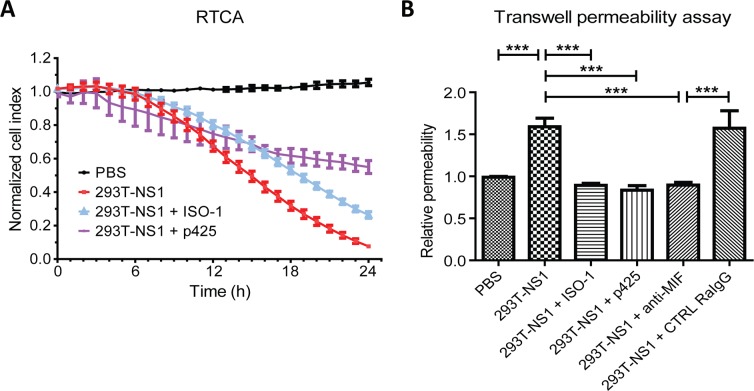
Dengue virus (DENV) is the most common mosquito-borne flavivirus; it can either cause mild dengue fever or the more severe dengue hemorrhagic fever (DHF) and dengue shock syndrome (DSS). One of the characteristic features of DHF/DSS is vascular leakage; although DENV nonstructural protein 1 (NS1) has been proved to induce vascular leakage after binding to Toll-like receptor 4, the down-stream mechanism has not yet been fully understood. In the sera of DENV-infected patients, the concentrations of DENV NS1 and inflammatory cytokine macrophage migration inhibitory factor (MIF) are positively correlated with disease severity, but whether DENV NS1 induces vascular leakage through MIF secretion remains unknown. We demonstrated that recombinant NS1 induced vascular leakage and MIF secretion both in human endothelial cell line HMEC-1 and in mice. Furthermore, these phenomena were inhibited in the presence of anti-NS1 antibodies both in vitro and in vivo. DENV NS1 also induced LC3-I to LC3-II conversion and p62 degradation in endothelial cell line, which indicated the formation of autophagy. To clarify whether MIF or autophagy mediated DENV NS1-induced vascular leakage, various inhibitors were applied. The results showed that DENV NS1-induced vascular leakage and VE-cadherin disarray were blocked in the presence of MIF inhibitors, anti-MIF-antibodies or autophagy inhibitors. An Atg5 knockdown clone further confirmed that autophagy formation of endothelial cells was required in NS1-induced vascular leakage. Furthermore, DENV NS1-induced LC3 puncta were also decreased in the presence of MIF inhibitors, indicating that MIF mediated DENV NS1-induced autophagy. Taken together, the results suggest a potential mechanism of DENV-induced vascular leakage and provide possible therapeutic targets against DHF/DSS.
登革病毒(DENV)是最常见的蚊媒黄病毒;它可引起轻度登革热或更严重的登革出血热(DHF)和登革休克综合征(DSS)。DHF/DSS的特征之一是血管渗漏;尽管已证明登革病毒非结构蛋白1(NS1)与Toll样受体4结合后可诱导血管渗漏,但其下游机制尚未完全明确。在登革病毒感染患者的血清中,DENV NS1和炎性细胞因子巨噬细胞移动抑制因子(MIF)的浓度与疾病严重程度呈正相关,但DENV NS1是否通过分泌MIF诱导血管渗漏仍不清楚。我们证明重组NS1在人内皮细胞系HMEC-1和小鼠中均诱导血管渗漏和MIF分泌。此外,在体外和体内存在抗NS1抗体时,这些现象均受到抑制。DENV NS1还在内皮细胞系中诱导LC3-I向LC3-II转化和p62降解,这表明自噬的形成。为了阐明MIF或自噬是否介导DENV NS1诱导的血管渗漏,应用了各种抑制剂。结果表明,在存在MIF抑制剂、抗MIF抗体或自噬抑制剂的情况下,DENV NS1诱导的血管渗漏和VE-钙黏蛋白紊乱受到阻断。Atg5基因敲低克隆进一步证实,NS1诱导的血管渗漏需要内皮细胞形成自噬。此外,在存在MIF抑制剂的情况下,DENV NS1诱导的LC3斑点也减少,表明MIF介导DENV NS1诱导的自噬。综上所述,这些结果提示了DENV诱导血管渗漏的潜在机制,并为抗DHF/DSS提供了可能的治疗靶点。