Winter Markus, Lodygin Dmitri, Verdoodt Berlinda, Hermeking Heiko
Experimental and Molecular Pathology, Institute of Pathology, Ludwig-Maximilians-Universität München, Munich, Germany.
Institute of Neuroimmunology and Institute for Multiple Sclerosis Research, University Medical Center Göttingen, Göttingen, Germany.
Oncotarget. 2016 Jul 26;7(30):46862-46870. doi: 10.18632/oncotarget.10478.
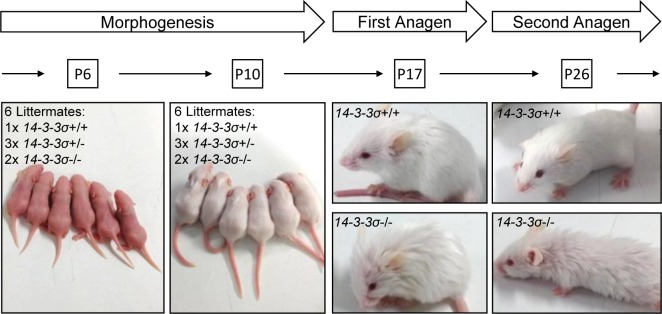
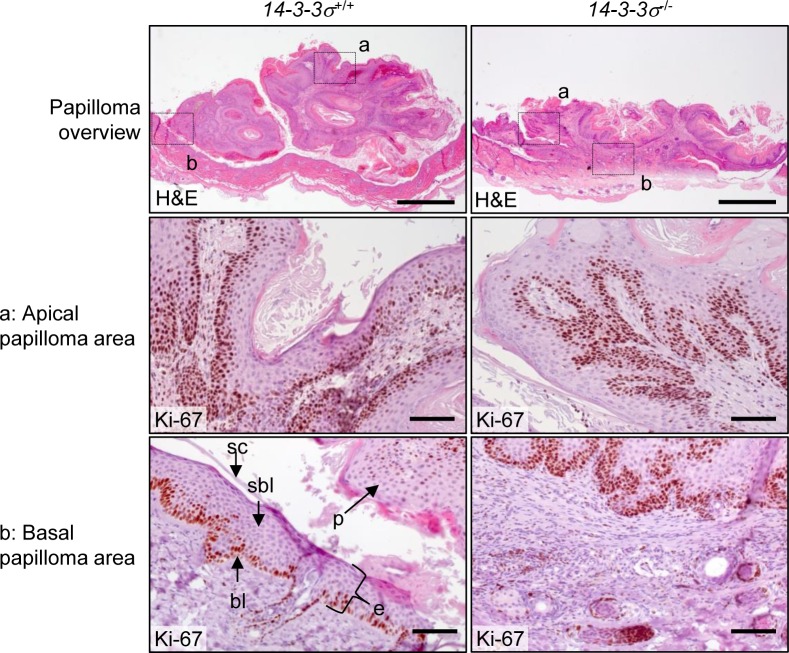
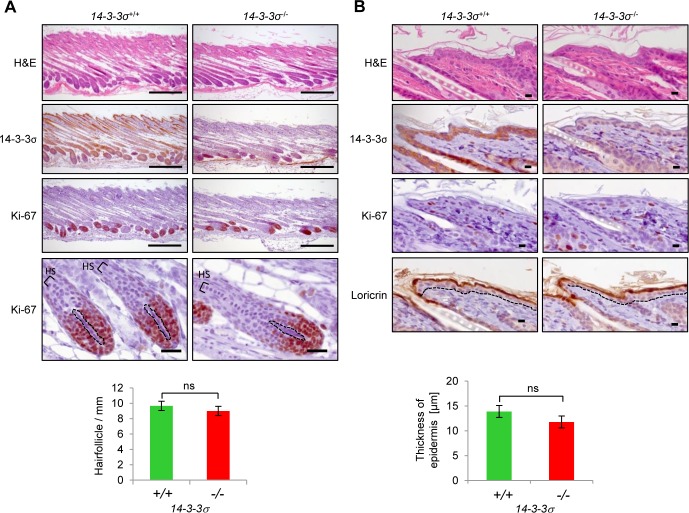
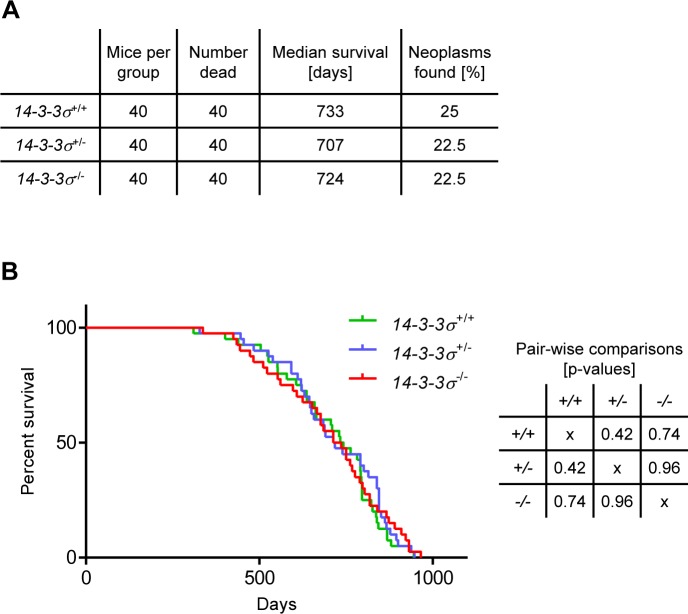
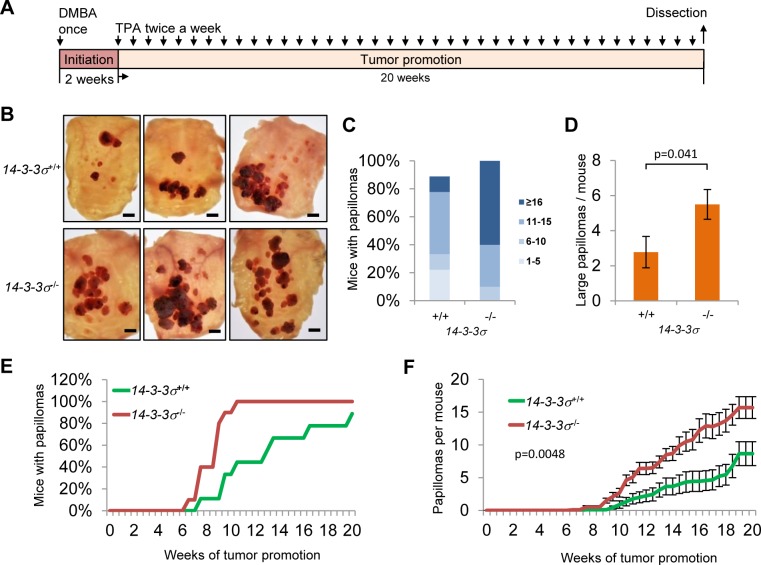
The p53-inducible cell cycle regulator 14-3-3σ exhibits tumor suppressive functions and is highly expressed in differentiating layers of the epidermis and hair follicles. 14-3-3σ/SFN/stratifin is frequently silenced in human epithelial cancers, and experimental down-regulation of 14-3-3σ expression immortalizes primary human keratinocytes. In the repeated-epilation (ER) mouse model, a heterozygous nonsense mutation of 14-3-3σ causes repeated hair-loss, hyper-proliferative epidermis, and spontaneous development of papillomas and squamous cell carcinomas in aging mice. Therefore, loss of 14-3-3σ function might contribute to epithelial tumor development. Here, we generated mice with loxP sites surrounding the single 14-3-3σ exon which allowed Cre-mediated deletion of the gene. 14-3-3σ-deficient mice are viable, but demonstrate a permanently disheveled fur. However, histological analyses of the skin did not reveal obvious defects in the hair follicles or the epidermis. Deletion of 14-3-3σ did not enhance spontaneous epidermal tumor development, whereas it increased the frequency and size of DMBA/TPA-induced papillomas. In conclusion, 14-3-3σ is dispensable for normal epidermal homeostasis but critical for suppression of chemically-induced skin carcinogenesis. In addition, these results suggest that the ER mutation of 14-3-3σ is not equivalent to loss of 14-3-3σ, but may represent a gain-of-function variant, which does not reflect the organismal function of wild-type 14-3-3σ.
p53诱导的细胞周期调节因子14-3-3σ具有肿瘤抑制功能,在表皮和毛囊的分化层中高度表达。14-3-3σ/SFN/stratifin在人类上皮癌中经常沉默,实验性下调14-3-3σ表达可使原代人角质形成细胞永生化。在反复拔毛(ER)小鼠模型中,14-3-3σ的杂合无义突变导致衰老小鼠反复脱发、表皮过度增殖以及乳头状瘤和鳞状细胞癌的自发发生。因此,14-3-3σ功能丧失可能促成上皮肿瘤的发生。在此,我们构建了在单个14-3-3σ外显子周围带有loxP位点的小鼠,这使得Cre介导的该基因缺失成为可能。14-3-3σ缺陷型小鼠是可存活的,但表现出毛发永久凌乱。然而,皮肤的组织学分析未发现毛囊或表皮有明显缺陷。14-3-3σ的缺失并未增强表皮肿瘤的自发发生,而增加了DMBA/TPA诱导的乳头状瘤的发生率和大小。总之,14-3-3σ对于正常表皮稳态是可有可无的,但对于抑制化学诱导的皮肤癌发生至关重要。此外,这些结果表明14-3-3σ的ER突变不等同于14-3-3σ的缺失,而可能代表一种功能获得性变体,它并不反映野生型14-3-3σ的机体功能。