Gong Qiuhong, Zhang Ping, Wang Jinping, An Yali, Gregg Edward W, Li Hui, Zhang Bo, Shuai Ying, Yang Wenying, Chen Yanyan, Liu Shuqian, Engelgau Michael M, Hu Yinghua, Bennett Peter H, Li Guangwei
Department of Endocrinology, Fuwai Hospital, Chinese Academy of Medical Sciences, Beijing, China.
Division of Diabetes Translation, Centers for Disease Control and Prevention, Atlanta, GA
Diabetes Care. 2016 Sep;39(9):1550-5. doi: 10.2337/dc16-0429. Epub 2016 Jul 13.
People with impaired glucose tolerance (IGT) have increased risk of mortality and a high risk of progression to diabetes, but the extent that the excess mortality is associated with IGT per se or is the result of subsequent diabetes is unclear.
We compared mortality before and after the development of diabetes among 542 persons with IGT initially who participated in a 6-year lifestyle diabetes prevention trial and were followed-up from 1986 to 2009.
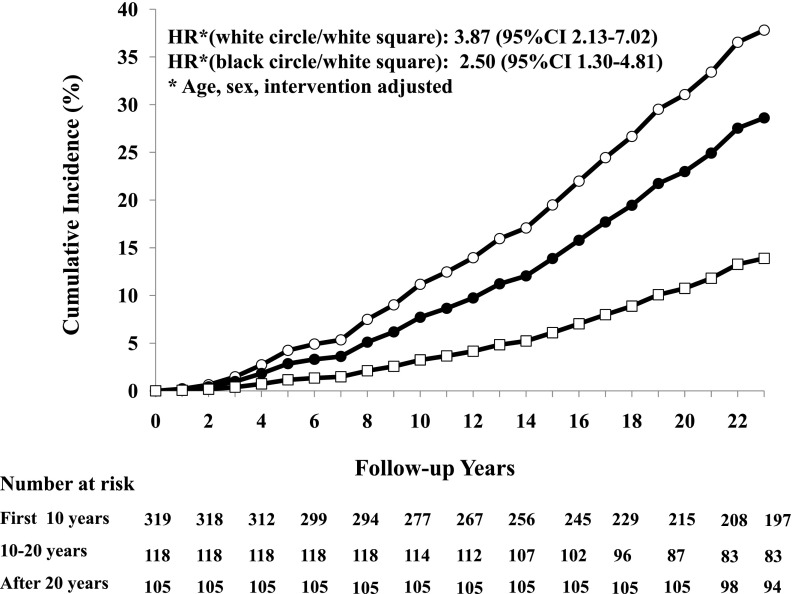
During the 23-year follow-up, 174 (32.1%) died, with an overall death rate of 15.9/1,000 person-years. The majority of deaths (74.7%; 130 of 174) occurred after progression to type 2 diabetes, with age-adjusted death rates of 11.1/1,000 person-years (95% CI 8.2-12.0) before and 19.4/1,000 person-years (95% CI 11.9-23.3) after the development of type 2 diabetes. The cumulative mortality was 37.8% (95% CI 33.1-42.2%) in participants who developed type 2 diabetes during first 10 years of follow-up, 28.6% (95% CI 21.6-35.0%) in those who progressed to type 2 diabetes in 10-20 years, and 13.9% (95% CI 7.0-20.3%) in those who did not develop to type 2 diabetes within 20 years. Time-dependent multivariate Cox proportional hazards analyses, with adjustment for baseline age, sex, intervention, and other potential confounding risk factors, showed that the development of type 2 diabetes was associated with a 73% higher risk of death (hazard ratio 1.73 [95% CI 1.18-2.52]).
As elsewhere, IGT is associated with increased risk of mortality in China, but much of this excess risk is attributable to the development of type 2 diabetes.
糖耐量受损(IGT)人群的死亡风险增加,且进展为糖尿病的风险较高,但这种额外的死亡风险在多大程度上与IGT本身相关,或是后续糖尿病的结果尚不清楚。
我们比较了542名最初患有IGT且参与了一项为期6年的生活方式糖尿病预防试验并于1986年至2009年进行随访的患者在糖尿病发生前后的死亡率。
在23年的随访期间,174人(32.1%)死亡,总死亡率为15.9/1000人年。大多数死亡(74.7%;174例中的130例)发生在进展为2型糖尿病之后,2型糖尿病发生前的年龄调整死亡率为11.1/1000人年(95%CI 8.2 - 12.0),发生后为19.4/1000人年(95%CI 11.9 - 23.3)。在随访的前10年内发展为2型糖尿病的参与者累积死亡率为37.8%(95%CI 33.1 - 42.2%),在10 - 20年内进展为2型糖尿病的参与者中为28.6%(95%CI 21.6 - 35.0%),在20年内未发展为2型糖尿病的参与者中为13.9%(95%CI 7.0 - 20.3%)。进行时间依赖性多变量Cox比例风险分析,并对基线年龄、性别、干预措施和其他潜在混杂风险因素进行调整后,结果显示2型糖尿病的发生与死亡风险高73%相关(风险比1.73 [95%CI 1.18 - 2.52])。
与其他地方一样,IGT在中国与死亡风险增加相关,但这种额外风险大多归因于2型糖尿病的发生。