Department of Ecology and Evolutionary Biology, University of Tennessee, Knoxville, TN 37996, USA.
Department of Mathematics, University of Tennessee, Knoxville, TN 37996, USA.
Sci Rep. 2016 Jul 14;6:29704. doi: 10.1038/srep29704.
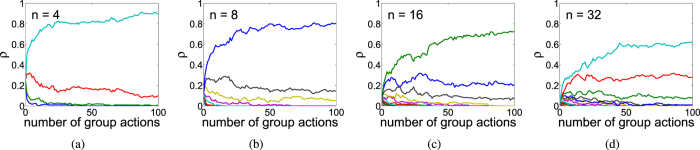
When group cohesion is essential, groups must have efficient strategies in place for consensus decision-making. Recent theoretical work suggests that shared decision-making is often the most efficient way for dealing with both information uncertainty and individual variation in preferences. However, some animal and most human groups make collective decisions through particular individuals, leaders, that have a disproportionate influence on group decision-making. To address this discrepancy between theory and data, we study a simple, but general, model that explicitly focuses on the dynamics of consensus building in groups composed by individuals who are heterogeneous in preferences, certain personality traits (agreeability and persuasiveness), reputation, and social networks. We show that within-group heterogeneity can significantly delay democratic consensus building as well as give rise to the emergence of informal leaders, i.e. individuals with a disproportionately large impact on group decisions. Our results thus imply strong benefits of leadership particularly when groups experience time pressure and significant conflict of interest between members (due to various between-individual differences). Overall, our models shed light on why leadership and decision-making hierarchies are widespread, especially in human groups.
当群体凝聚力至关重要时,群体必须有有效的策略来进行共识决策。最近的理论工作表明,共享决策通常是处理信息不确定性和个体偏好差异的最有效方法。然而,一些动物和大多数人类群体通过特定的个体,即领导者,来做出集体决策,这些领导者对群体决策有不成比例的影响。为了解决理论和数据之间的这种差异,我们研究了一个简单但通用的模型,该模型明确关注由在偏好、某些个性特征(随和性和说服力)、声誉和社交网络方面存在异质性的个体组成的群体中的共识建立动态。我们表明,群体内的异质性会显著延迟民主共识的建立,并导致非正式领导者的出现,即对群体决策有不成比例大影响的个体。因此,我们的结果意味着领导力具有很强的优势,特别是当群体面临时间压力和成员之间存在重大利益冲突(由于各种个体差异)时。总的来说,我们的模型阐明了为什么领导力和决策层次结构在人类群体中非常普遍。