Huang Eng-Yen, Lin Hao, Wang Chong-Jong, Chanchien Chan-Chao, Ou Yu-Che
Department of Radiation Oncology, Kaohsiung Chang Gung Memorial Hospital, Chang Gung University College of Medicine, Kaohsiung, Taiwan.
School of Traditional Chinese Medicine, Chang Gung University College of Medicine, Kaohsiung, Taiwan.
Cancer Med. 2016 Sep;5(9):2205-12. doi: 10.1002/cam4.794. Epub 2016 Jul 15.
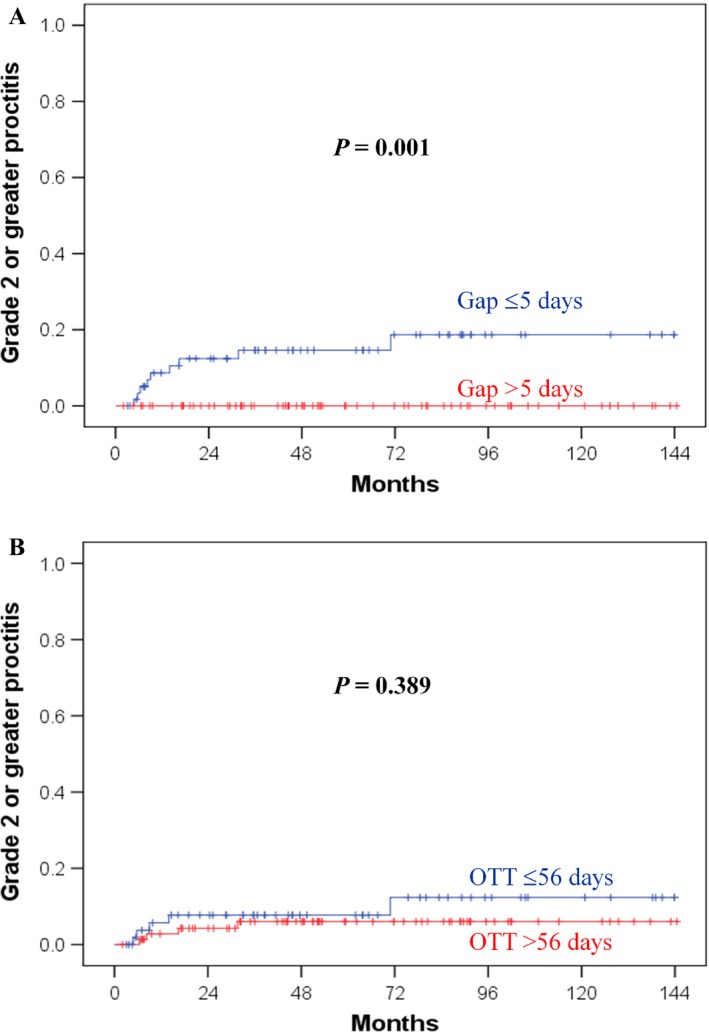
This study aimed to investigate the impact of treatment time-related factors on outcomes and radiation proctitis in patients undergoing concurrent chemoradiotherapy (CCRT) for cervical cancer. From September 2001 to December 2012, 146 patients with stage IIB cervical squamous cell carcinoma treated with CCRT were reviewed from a prospective cohort. Patients who received the same dose (45 Gy) of external beam radiation therapy (EBRT) were included in the analysis (n = 125). The same equivalent dose of 2 Gy (EQD2) of high-dose-rate intracavitary brachytherapy (HDR-ICBT) was delivered at either 4 fractions of 6 Gy or 6 fractions of 4.5 Gy. The effects of the overall treatment time (OTT) and interval between EBRT and HDR-ICBT on the cancer-specific survival (CSS), local recurrence (LR), and incidence of proctitis were compared. The treatment time-related factors did not adversely affect the CSS and LR rates. The multivariate analyses did not identify the OTT as an independent factor of CSS (P = 0.839) and LR (P = 0.856). However, OTT ≤56 days (P = 0.026) was identified as the only independent factor of overall proctitis. The 5-year Grade 2 or greater proctitis rates were 14.9% and 0% (P = 0.001) in patients with the EBRT to ICBT interval ≤5 days and >5 days, respectively. To reduce rectal damage without compromising prognosis, the gap between EBRT and HDR-ICBT should exceed 5 days in cervical cancer patients undergoing CCRT. Strictly limiting the OTT to 56 days may result in radiation proctitis without improvements in prognosis.
本研究旨在探讨治疗时间相关因素对宫颈癌同步放化疗(CCRT)患者的治疗结局及放射性直肠炎的影响。2001年9月至2012年12月,对146例接受CCRT治疗的IIB期宫颈鳞状细胞癌患者进行回顾性分析,这些患者来自一个前瞻性队列。分析纳入接受相同剂量(45 Gy)外照射放疗(EBRT)的患者(n = 125)。高剂量率腔内近距离放疗(HDR-ICBT)给予相同等效剂量2 Gy(EQD2),分4次给予,每次6 Gy或分6次给予,每次4.5 Gy。比较总治疗时间(OTT)以及EBRT与HDR-ICBT间隔时间对癌症特异性生存(CSS)、局部复发(LR)和直肠炎发生率的影响。治疗时间相关因素对CSS和LR率无不利影响。多因素分析未将OTT确定为CSS(P = 0.839)和LR(P = 0.856)的独立因素。然而,OTT≤56天(P = 0.026)被确定为总体直肠炎的唯一独立因素。EBRT至ICBT间隔时间≤5天和>5天的患者,5年2级及以上直肠炎发生率分别为14.9%和0%(P = 0.001)。为在不影响预后的情况下减少直肠损伤,接受CCRT的宫颈癌患者中,EBRT与HDR-ICBT之间的间隔应超过5天。将OTT严格限制在56天可能会导致放射性直肠炎,而预后并无改善。