Kennerly Susan, Boss Lisa, Yap Tracey L, Batchelor-Murphy Melissa, Horn Susan D, Barrett Ryan, Bergstrom Nancy
School of Nursing, University of North Carolina at Charlotte, Charlotte, NC 28223, USA.
School of Nursing, UT Health Houston, Houston, TX 77030, USA.
Healthcare (Basel). 2015 Sep 24;3(4):879-97. doi: 10.3390/healthcare3040879.
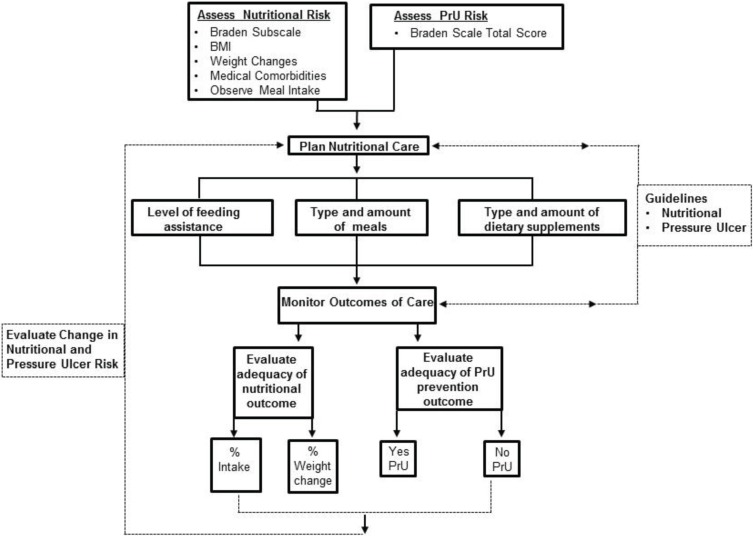
The Braden Scale for Pressure Sore Risk(©) is a screening tool to determine overall risk of pressure ulcer development and estimate severity of specific risk factors for individual residents. Nurses often use the Braden nutrition subscale to screen nursing home (NH) residents for nutritional risk, and then recommend a more comprehensive nutritional assessment as indicated. Secondary data analysis from the Turn for Ulcer ReductioN (TURN) study's investigation of U.S. and Canadian NH residents (n = 690) considered at moderate or high pressure ulcer (PrU) risk was used to evaluate the subscale's utility for identifying nutritional intake risk factors. Associations were examined between Braden Nutritional Risk subscale screening, dietary intake (mean % meal intake and by meal timing, mean number of protein servings, protein sources, % intake of supplements and snacks), weight outcomes, and new PrU incidence. Of moderate and high PrU risk residents, 61.9% and 59.2% ate a mean meal % of <75. Fewer than 18% overall ate <50% of meals or refused meals. No significant differences were observed in weight differences by nutrition subscale risk or in mean number protein servings per meal (1.4 (SD = 0.58) versus 1.3 (SD = 0.53)) for moderate versus high PrU risk residents. The nutrition subscale approximates subsequent estimated dietary intake and can provide insight into meal intake patterns for those at either moderate or high PrU risk. Findings support the Braden Scale's use as a preliminary screening method to identify focused areas for potential intervention.
压疮风险评估的Braden量表(©)是一种筛查工具,用于确定压疮发生的总体风险,并评估个体居民特定风险因素的严重程度。护士经常使用Braden营养子量表对养老院(NH)居民进行营养风险筛查,然后根据需要推荐更全面的营养评估。溃疡减少(TURN)研究对美国和加拿大NH居民(n = 690)进行的调查的二次数据分析,这些居民被认为有中度或高度压疮(PrU)风险,用于评估该子量表识别营养摄入风险因素的效用。研究了Braden营养风险子量表筛查、饮食摄入量(平均每餐摄入量及按用餐时间、蛋白质份数平均数、蛋白质来源、补充剂和零食摄入量百分比)、体重结果和新的PrU发病率之间的关联。在中度和高度PrU风险居民中,61.9%和59.2%的人平均每餐摄入量<75%。总体上,不到18%的人每餐摄入量<50%或拒绝进食。对于中度与高度PrU风险居民,在营养子量表风险的体重差异或每餐蛋白质份数平均数方面未观察到显著差异(分别为1.4(标准差 = 0.58)和1.3(标准差 = 0.53))。营养子量表近似于随后估计的饮食摄入量,并且可以为中度或高度PrU风险者的用餐摄入模式提供见解。研究结果支持将Braden量表用作初步筛查方法,以确定潜在干预的重点领域。