Novak Scott P, Glasheen Cristie, Roland Carl L
Behavioral Health Epidemiology, RTI International.
Clinical Sciences and Outcomes Evidence, Pfizer Inc., Durham, NC, USA.
Subst Abuse Rehabil. 2016 Jun 30;7:87-98. doi: 10.2147/SAR.S102251. eCollection 2016.
The primary aim of this work was to present the prevalence data from the National Epidemiologic Survey on Alcohol and Related Conditions (NESARC), a representative 3-year longitudinal survey (ages 18+ years) that captured information on patterns of self-reported pain interference and prescription pain reliever misuse. A second aim was to assess the degree to which the risk of various types of opioid misuse (onset, desistance, and incidence of dependence) was related to the longitudinal course of self-reported pain interference over the 3-year period.
We used a two-wave, nationally representative sample of adults (aged 18+ years) in which the baseline data were collected during 2001-2002 and a single follow-up was obtained ~3 years later (2004-2005 with 34,332 respondents with complete data on study variables for both waves).
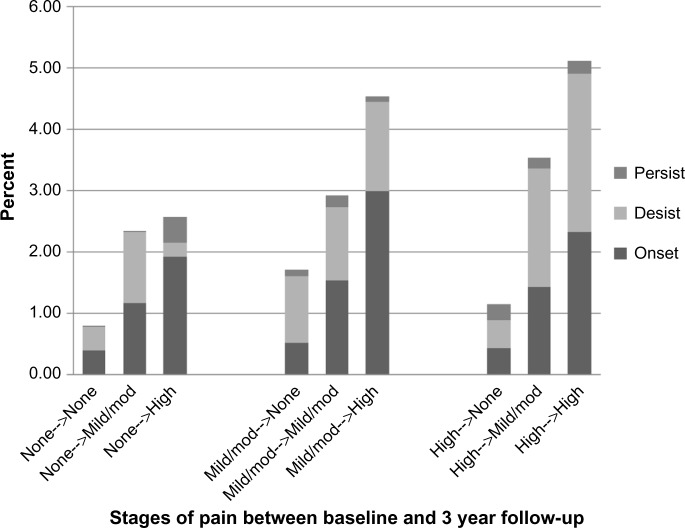
Our findings indicated that ~10% reported high pain interference in the past month at each wave. There was tremendous stability in levels of pain, with ~5% reporting consistent levels of high impairment over the 3-year study, a proxy for chronic pain. Levels of pain were more strongly associated with prescription pain reliever misuse concurrently rather than prospectively, and the association was largely linear, with the likelihood of misuse increasing with levels of pain. Finally, health service factors were also prominent predictors of onset, but not the outcomes, of desistance or transitions to problem use.
This study is the first to use a nationally representative sample with measures of pain and drug use history collected over an extended period. These results may help provide clinicians with an understanding that the risk of misuse is greatest when pain is active and may help guide the selection of appropriate intervention materials and monitor strategies for those at greatest risk.
本研究的主要目的是呈现全国酒精及相关疾病流行病学调查(NESARC)中的患病率数据。NESARC是一项具有代表性的为期3年的纵向调查(针对18岁及以上人群),收集了关于自我报告的疼痛干扰模式和处方止痛药滥用情况的信息。第二个目的是评估在3年期间,各种类型阿片类药物滥用风险(开始使用、停止使用和依赖发生率)与自我报告的疼痛干扰纵向过程之间的关联程度。
我们使用了一个两波的全国代表性成年人样本(18岁及以上),其中基线数据于2001 - 2002年收集,约3年后(2004 - 2005年)进行了一次随访(34332名受访者在两波中均有关于研究变量的完整数据)。
我们的研究结果表明,在每一波调查中,约10%的人报告在过去一个月有高度疼痛干扰。疼痛水平具有极大的稳定性,约5%的人在3年研究期间报告持续处于高度损伤水平,这是慢性疼痛的一个指标。疼痛水平与同时期而非前瞻性的处方止痛药滥用关联更强,且这种关联在很大程度上是线性的,滥用可能性随疼痛水平增加而上升。最后,卫生服务因素也是开始使用药物的显著预测因素,但不是停止使用或转变为问题使用的结果的预测因素。
本研究首次使用了具有全国代表性的样本,并在较长时间内收集了疼痛和药物使用史的测量数据。这些结果可能有助于让临床医生了解,当疼痛处于活跃状态时滥用风险最大,还可能有助于指导为高风险人群选择合适的干预材料和监测策略。