Hao Lingyun, Wei Xuewen, Guo Peng, Zhang Guangyi, Qi Suhua
Research Center for Biochemistry and Molecular Biology, and Jiangsu Key Laboratory of Brain Disease Bioinformation, Xuzhou Medical University, Xuzhou 221002, China.
Jiangsu Key Laboratory of Anesthesia and Analgesia Application Technology, Xuzhou 221002, China.
Int J Mol Sci. 2016 Jul 12;17(7):1100. doi: 10.3390/ijms17071100.
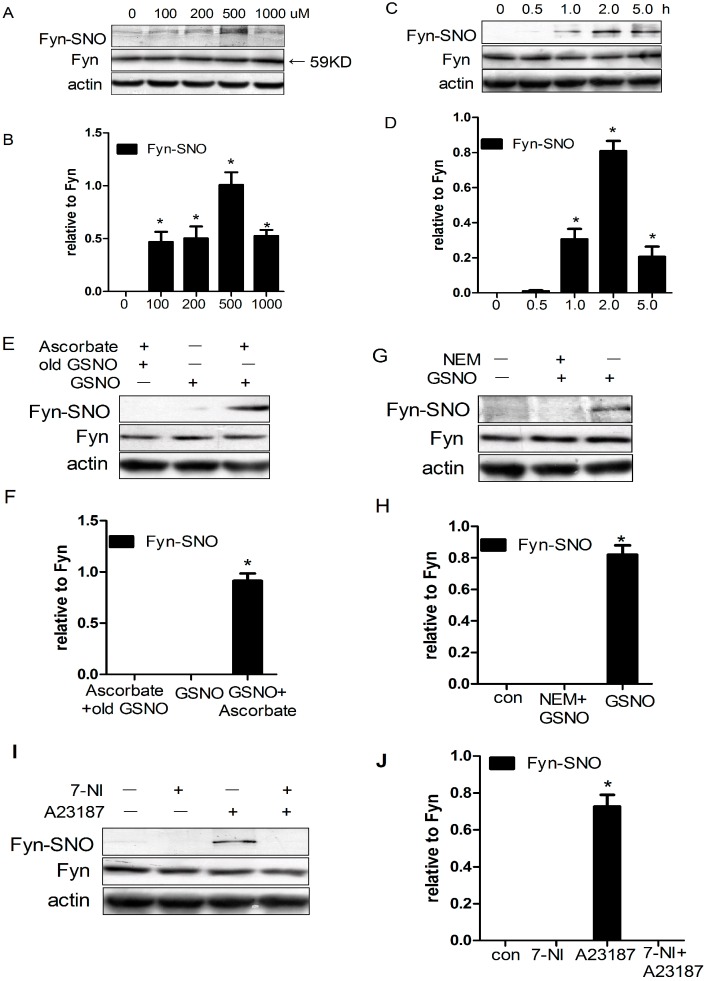
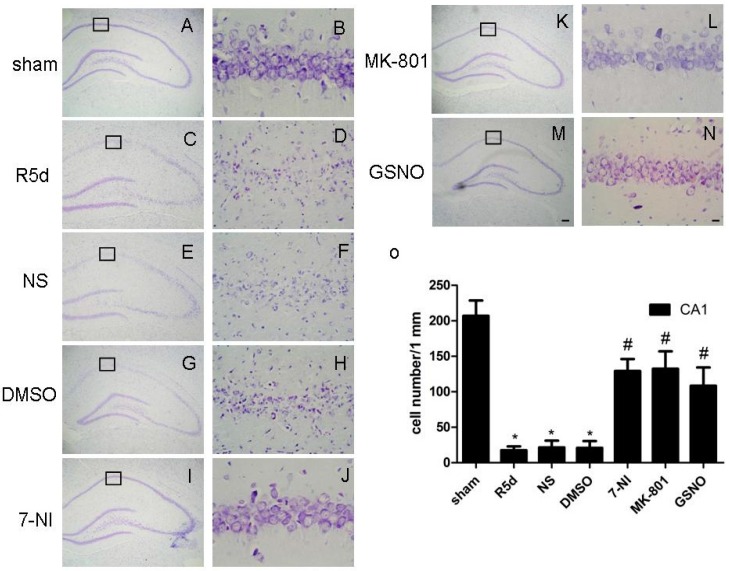
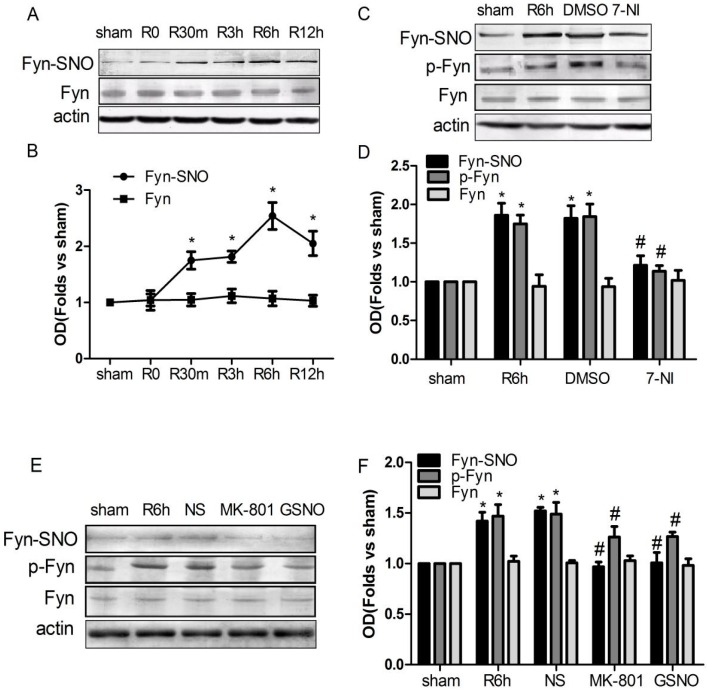
Nitric oxide (NO) can regulate signaling pathways via S-nitrosylation. Fyn can be post-translationally modified in many biological processes. In the present study, using a rat four-vessel-occlusion ischemic model, we aimed to assess whether Fyn could be S-nitrosylated and to evaluate the effects of Fyn S-nitrosylation on brain damage. In vitro, Fyn could be S-nitrosylated by S-nitrosoglutathione (GSNO, an exogenous NO donor), and in vivo, endogenous NO synthesized by NO synthases (NOS) could enhance Fyn S-nitrosylation. Application of GSNO, 7-nitroindazole (7-NI, an inhibitor of neuronal NOS) and hydrogen maleate (MK-801, the N-methyl-d-aspartate receptor (NMDAR) antagonist) could decrease the S-nitrosylation and phosphorylation of Fyn induced by cerebral ischemia/reperfusion (I/R). Cresyl violet staining validated that these compounds exerted neuroprotective effects against the cerebral I/R-induced damage to hippocampal CA1 neurons. Taken together, in this study, we demonstrated that Fyn can be S-nitrosylated both in vitro and in vivo and that inhibiting S-nitrosylation can exert neuroprotective effects against cerebral I/R injury, potentially via NMDAR-mediated mechanisms. These findings may lead to a new field of inquiry to investigate the underlying pathogenesis of stroke and the development of novel treatment strategies.
一氧化氮(NO)可通过S-亚硝基化作用调节信号通路。Fyn在许多生物学过程中可发生翻译后修饰。在本研究中,我们利用大鼠四血管闭塞缺血模型,旨在评估Fyn是否会发生S-亚硝基化,并评价Fyn的S-亚硝基化对脑损伤的影响。在体外,Fyn可被S-亚硝基谷胱甘肽(GSNO,一种外源性NO供体)进行S-亚硝基化,在体内,由一氧化氮合酶(NOS)合成的内源性NO可增强Fyn的S-亚硝基化。应用GSNO、7-硝基吲唑(7-NI,一种神经元NOS抑制剂)和马来酸氢盐(MK-801,N-甲基-D-天冬氨酸受体(NMDAR)拮抗剂)可降低脑缺血/再灌注(I/R)诱导的Fyn的S-亚硝基化和磷酸化。甲酚紫染色证实这些化合物对脑I/R诱导的海马CA1神经元损伤具有神经保护作用。综上所述,在本研究中,我们证明Fyn在体外和体内均可发生S-亚硝基化,并且抑制S-亚硝基化可对脑I/R损伤发挥神经保护作用,可能是通过NMDAR介导的机制。这些发现可能会引发一个新的研究领域,以探究中风的潜在发病机制并开发新的治疗策略。