Aibara Shintaro, Bai Xiao-Chen, Stewart Murray
MRC Laboratory of Molecular Biology, Francis Crick Avenue, Cambridge Biomedical Campus, Cambridge CB2 0QH, United Kingdom.
MRC Laboratory of Molecular Biology, Francis Crick Avenue, Cambridge Biomedical Campus, Cambridge CB2 0QH, United Kingdom.
J Struct Biol. 2016 Sep;195(3):316-324. doi: 10.1016/j.jsb.2016.07.007. Epub 2016 Jul 12.
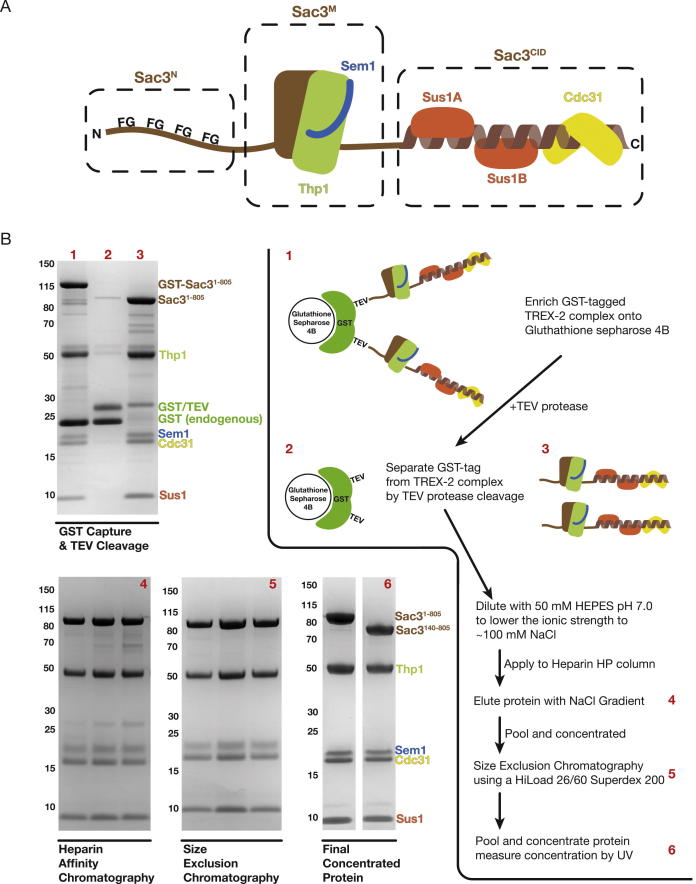
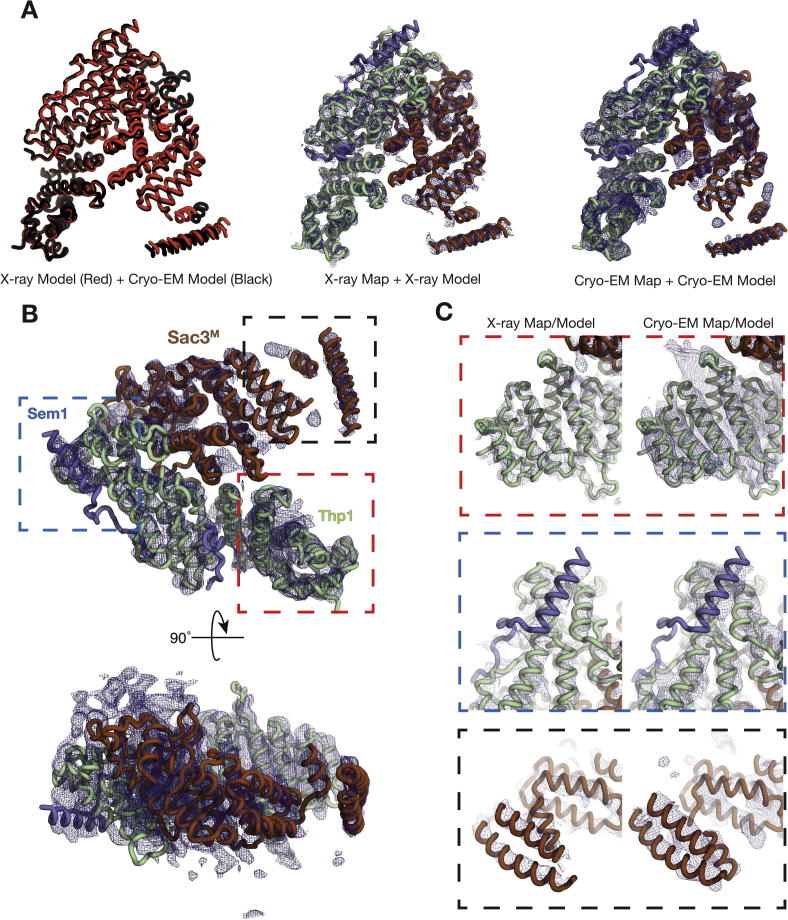
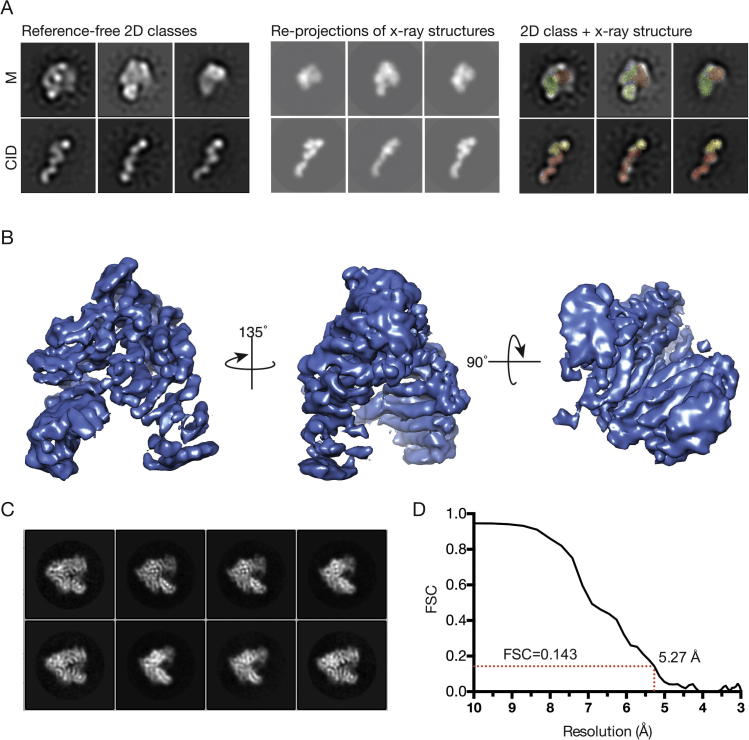
Transcription-export complex 2 (TREX-2 complex) facilitates the localization of actively transcribing genes to the nuclear periphery and also functions to contribute to the generation of export-competent mRNPs through interactions with the general mRNA nuclear export factor Mex67:Mtr2. The TREX-2 complex is based on a Sac3 scaffold to which Thp1, Sem1, Cdc31, and Sus1 bind. TREX-2 can be subdivided into two modules: one, in which Thp1 and Sem1 bind to the Sac3(M) region (residues ∼100-551), and the other in which Cdc31 and two Sus1 chains bind to the Sac3(CID) region (residues ∼710-805). Complementary structural analyses using X-ray crystallography, electron microscopy, and small-angle X-ray scattering of the Saccharomyces cerevisiae TREX-2 complex, expressed using Baculovirus-infected Sf9 cells, have indicated that the TPR-like repeats of the Sac3(M) region extend considerably further towards the N-terminus than previously thought, and also indicate that this region and Sac3(CID):Sus1:Cdc31 region of the S. cerevisiae complex are structurally independent. Although the density visible accounted for only ∼100kDa, a 5.3Å resolution cryo-EM reconstruction was obtained of the M-region of TREX-2 that showed an additional three putative α-helices extending towards the Sac3 N-terminus and these helices were also seen in a 4.9Å resolution structure obtained by X-ray crystallography.
We describe the expression, purification and structural characterization of the S. cerevisiae TREX-2 complex and demonstrate that the Sac3 TPR-like repeats are more extensive than previously thought and that the M- and CID-regions do not appear to have a defined spatial orientation.
转录输出复合体2(TREX-2复合体)促进活跃转录基因定位于核周,并且还通过与一般的mRNA核输出因子Mex67:Mtr2相互作用,在生成具备输出能力的mRNA-蛋白质复合物方面发挥作用。TREX-2复合体以Sac3为支架,Thp1、Sem1、Cdc31和Sus1与之结合。TREX-2可细分为两个模块:一个模块中,Thp1和Sem1与Sac3(M)区域(约100-551位残基)结合;另一个模块中,Cdc31和两条Sus1链与Sac3(CID)区域(约710-805位残基)结合。利用杆状病毒感染的Sf9细胞表达酿酒酵母TREX-2复合体,通过X射线晶体学、电子显微镜和小角X射线散射进行的互补结构分析表明,Sac3(M)区域的TPR样重复序列向N端延伸的程度比之前认为的要长得多,并且还表明酿酒酵母复合体的该区域与Sac3(CID):Sus1:Cdc31区域在结构上是独立的。尽管可见密度仅占约100 kDa,但获得了TREX-2 M区域的5.3Å分辨率冷冻电镜重建结果,显示有另外三个假定的α螺旋向Sac3 N端延伸,并且这些螺旋也出现在通过X射线晶体学获得的4.9Å分辨率结构中。
我们描述了酿酒酵母TREX-2复合体的表达、纯化和结构表征,并证明Sac3的TPR样重复序列比之前认为的更广泛,且M区域和CID区域似乎没有确定的空间取向。