Fuller-Rowell Thomas E, Curtis David S, El-Sheikh Mona, Duke Adrienne M, Ryff Carol D, Zgierska Aleksandra E
Department of Human Development and Family Studies, Auburn University.
Department of Psychology, University of Wisconsin-Madison.
Cultur Divers Ethnic Minor Psychol. 2017 Apr;23(2):165-173. doi: 10.1037/cdp0000104. Epub 2016 Jul 18.
To examine changes in sleep problems over a 1.5-year period among Black or African American (AA) and White or European American (EA) college students and to consider the role of racial discrimination as a mediator of race differences in sleep problems over time.
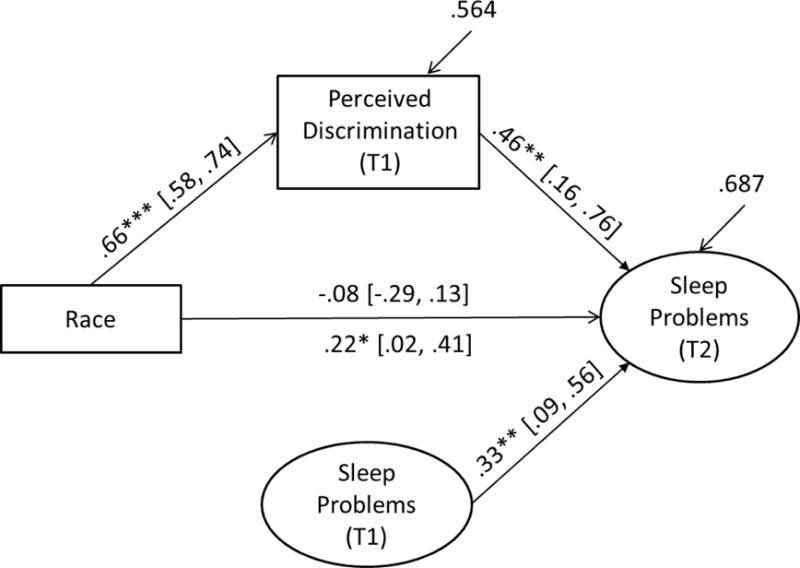
Students attending a large, predominantly White university (N = 133, 41% AA, 57% female, mean age = 18.8, SD = .90) reported on habitual sleep characteristics and experiences of racial discrimination at baseline and follow-up assessments. A latent variable for sleep problems was assessed from reports of sleep latency, duration, efficiency, and quality. Longitudinal models were used to examine race differences in sleep problems over time and the mediating role of perceived discrimination. Covariates included age, gender, parent education, parent income, body mass index, self-rated physical health, and depressive symptoms. Each of the individual sleep measures was also examined separately, and sensitivity analyses were conducted using alternative formulations of the sleep problems measure.
AAs had greater increases in sleep problems than EAs. Perceived discrimination was also associated with increases in sleep problems over time and mediated racial disparities in sleep. This pattern of findings was similar when each of the sleep indicators was considered separately and held with alternative sleep problems measures.
The findings highlight the importance of racial disparities in sleep across the college years and suggest that experiences of discrimination contribute to group disparities. (PsycINFO Database Record
研究1.5年期间黑人或非裔美国(AA)大学生与白人或欧美裔(EA)大学生睡眠问题的变化,并探讨种族歧视作为睡眠问题种族差异随时间变化的中介因素的作用。
就读于一所大型、以白人为主的大学的学生(N = 133,41%为非裔美国人,57%为女性,平均年龄 = 18.8,标准差 = 0.90)在基线和随访评估中报告了习惯性睡眠特征和种族歧视经历。根据睡眠潜伏期、持续时间、效率和质量的报告评估睡眠问题的潜在变量。使用纵向模型研究随时间变化的睡眠问题的种族差异以及感知歧视的中介作用。协变量包括年龄、性别、父母教育程度、父母收入、体重指数、自评身体健康和抑郁症状。还分别对每个个体睡眠指标进行了检查,并使用睡眠问题测量的替代公式进行了敏感性分析。
与欧美裔学生相比,非裔美国学生睡眠问题增加得更多。随着时间的推移,感知到的歧视也与睡眠问题的增加有关,并介导了睡眠方面的种族差异。当分别考虑每个睡眠指标并使用替代睡眠问题测量方法时,这种结果模式是相似的。
研究结果凸显了大学期间睡眠方面种族差异的重要性,并表明歧视经历导致了群体差异。(PsycINFO数据库记录