Animal Welfare Program , University of British Columbia , 2357 Main Mall, Vancouver, British Columbia , Canada V6T 1Z4.
R Soc Open Sci. 2016 Jun 29;3(6):160136. doi: 10.1098/rsos.160136. eCollection 2016 Jun.
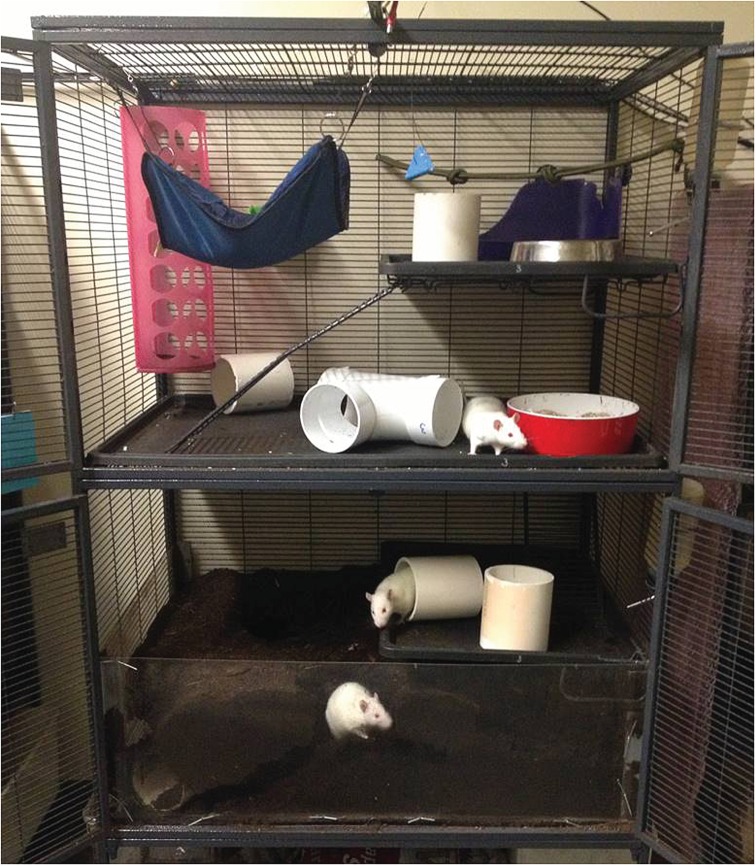
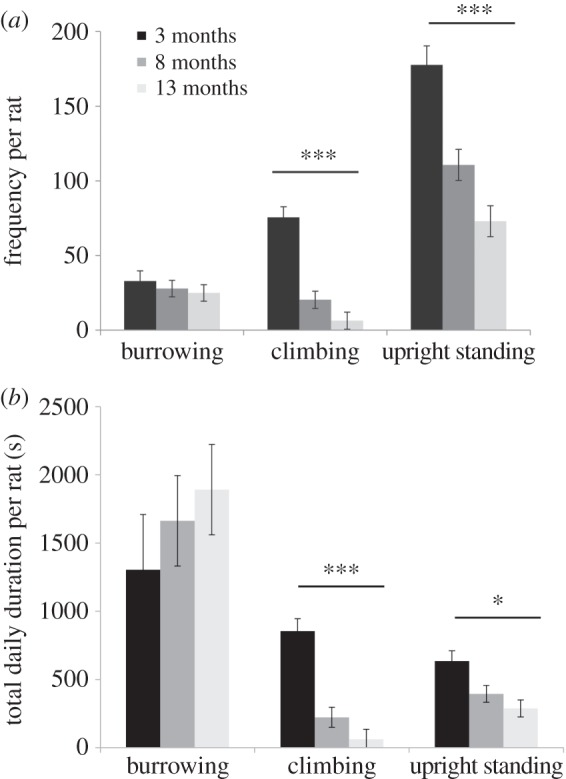
Standard laboratory cages prevent rats (Rattus norvegicus) from performing many behaviours that they perform in the wild, but little is known about how this may affect their welfare. The aims of this study were (i) to record the propensity to burrow, climb and stand upright in 3-, 8- and 13-month old laboratory rats housed in semi-naturalistic environments and (ii) to compare the frequency of lateral stretching in semi-naturalistic versus standard-housed rats; we predicted standard-housed rats would perform more lateral stretches to compensate for the inability to stretch upright. Rats' propensity to burrow remained constant as they aged (approx. 30 bouts per day totalling 20-30 min), suggesting burrowing is important to rats. Climbing decreased from 76 to 7 bouts per day at 3 versus 13 months, probably because of declining physical ability. Upright standing decreased from 178 to 73 bouts per day, but continued to be frequently expressed even in older rats. Standard-housed rats stretched much more frequently than semi-naturalistic-housed rats (53 versus 6 bouts per day at 13 months), perhaps in compensation for inability to stretch upright and to relieve stiffness caused by low mobility associated with standard housing. These findings suggest that standard laboratory cages interfere with important natural behaviours, which is likely to compromise rat welfare.
标准实验室笼具阻止了大鼠(Rattus norvegicus)进行许多在野外会进行的行为,但对于这如何影响它们的福利知之甚少。本研究的目的是(i)记录在半自然环境中饲养的 3、8 和 13 月龄实验室大鼠的挖洞、攀爬和直立的倾向,以及(ii)比较半自然和标准笼养大鼠的横向伸展频率;我们预测标准笼养大鼠会进行更多的横向伸展,以弥补无法直立伸展的能力。随着大鼠年龄的增长,它们的挖洞倾向保持不变(每天约 30 次,总计 20-30 分钟),这表明挖洞对大鼠很重要。攀爬从 3 个月时的 76 次减少到 13 个月时的 7 次,可能是由于身体能力下降。直立站立从 178 次减少到 73 次,但即使在老年大鼠中也经常表达。与半自然环境饲养的大鼠相比,标准笼养大鼠的伸展频率要高得多(13 个月时为 53 次对 6 次),这可能是为了弥补无法直立伸展和缓解因标准笼养导致的活动能力低下而引起的僵硬。这些发现表明,标准实验室笼具干扰了大鼠的重要自然行为,这可能会损害大鼠的福利。