Morhayim Jess, Rudjito Resti, van Leeuwen Johannes P, van Driel Marjolein
Department of Internal Medicine, Erasmus University Medical Center, Wytemaweg 80, 3015 CN Rotterdam, The Netherlands.
Curr Mol Biol Rep. 2016;2(1):48-55. doi: 10.1007/s40610-016-0034-6. Epub 2016 Feb 23.
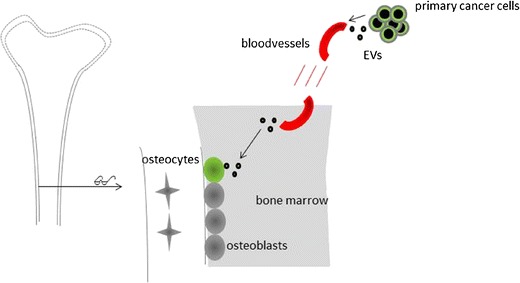
Extracellular vesicles (EVs), spherical bilayered proteolipids, behave as paracrine effectors since they are released from cells to deliver signals to other cells. They control a diverse range of biological processes by transferring proteins, lipids, and nucleic acids between cells and are secreted by a wide spectrum of cell types and are found in various biological fluids. EVs are formed at the plasma membrane or in endosomes and are heterogeneous in size and composition. Increasing understanding of the working mechanisms is promising for therapeutic and diagnostic opportunities. In this review, we will focus on the recent developments in this emerging field with special emphasis on the role of EVs in the bone microenvironment, with a central role for the osteoblasts in the communication with a diversity of cells, including bone metastases.
细胞外囊泡(EVs)是球形双层蛋白脂质体,作为旁分泌效应物发挥作用,因为它们从细胞中释放出来,将信号传递给其他细胞。它们通过在细胞间传递蛋白质、脂质和核酸来控制多种生物过程,由多种细胞类型分泌,存在于各种生物体液中。EVs在质膜或内体中形成,大小和组成各异。对其作用机制的深入了解为治疗和诊断带来了希望。在本综述中,我们将重点关注这一新兴领域的最新进展,特别强调EVs在骨微环境中的作用,其中成骨细胞在与包括骨转移瘤在内的多种细胞的通讯中起核心作用。