Wiskemann Joachim, Hummler Simone, Diepold Christina, Keil Melanie, Abel Ulrich, Steindorf Karen, Beckhove Philipp, Ulrich Cornelia M, Steins Martin, Thomas Michael
Working Group Exercise Oncology, Division of Medical Oncology, National Center for Tumor Diseases (NCT) and University Clinic Heidelberg, Heidelberg, Germany.
National Center for Tumor Diseases (NCT) and German Cancer Research Center, Heidelberg, Germany.
BMC Cancer. 2016 Jul 19;16:499. doi: 10.1186/s12885-016-2561-1.
Patients with advanced stage non-small cell lung cancer (NSCLC) or small cell lung cancer (SCLC) often experience multidimensional impairments, affecting quality of life during their course of disease. In lung cancer patients with operable disease, several studies have shown that exercise has a positive impact on quality of life and physical functioning. There is limited evidence regarding efficacy for advanced lung cancer patients undergoing palliative treatment. Therefore, the POSITIVE study aims to evaluate the benefit of a 24-week exercise intervention during palliative treatment in a randomized controlled setting.
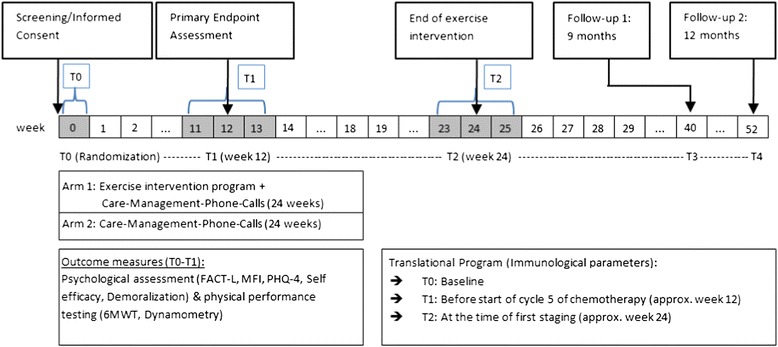
METHODS/DESIGN: The POSITIVE study is a randomized, controlled trial investigating the effects of a 24-week exercise intervention during palliative treatment on quality of life, physical performance and immune function in advanced, non-operable lung cancer patients. 250 patients will be recruited in the Clinic for Thoracic Diseases in Heidelberg, enrolment begun in November 2013. Main inclusion criterion is histologically confirmed NSCLC (stage IIIa, IIIb, IV) or SCLC (Limited Disease-SCLC, Extensive Disease-SCLC) not amenable to surgery. Patients are randomized into two groups. Both groups receive weekly care management phone calls (CMPCs) with the goal to assess symptoms and side effects. Additionally, one group receives a combined resistance and endurance training (3x/week). Primary endpoints are quality of life assessed by the Functional Assessment of Cancer Therapy for patients with lung cancer (FACT-L, subcategory Physical Well-Being) and General Fatigue measured by the Multidimensional Fatigue Inventory (MFI-20). Secondary endpoints are physical performance (maximal voluntary isometric contraction, 6-min walk distance), psychosocial (depression and anxiety) and immunological parameters and overall survival.
The aim of the POSITIVE trial is the evaluation of effects of a 24-week structured and guided exercise intervention during palliative treatment stages. Analysis of various outcomes (such as quality of life, physical performance, self-efficacy, psychosocial and immunological parameters) will contribute to a better understanding of the potential of exercise in advanced lung cancer patients. In contrast to other studies with advanced oncological patients the POSITIVE trial provides weekly phone calls to support patients both in the intervention and control group and to segregate the impact of physical activity on quality of life.
ClinicalTrials.gov NCT02055508 (Date: December 12, 2013).
晚期非小细胞肺癌(NSCLC)或小细胞肺癌(SCLC)患者常经历多维度损伤,影响其病程中的生活质量。在可手术治疗的肺癌患者中,多项研究表明运动对生活质量和身体机能有积极影响。关于晚期肺癌患者接受姑息治疗时运动疗效的证据有限。因此,“积极”研究旨在评估在随机对照环境下,姑息治疗期间进行24周运动干预的益处。
方法/设计:“积极”研究是一项随机对照试验,调查姑息治疗期间进行24周运动干预对晚期不可手术肺癌患者生活质量、身体机能和免疫功能的影响。250名患者将在海德堡胸科疾病诊所招募,招募工作于2013年11月开始。主要纳入标准是经组织学确诊的非小细胞肺癌(Ⅲa期、Ⅲb期、Ⅳ期)或小细胞肺癌(局限期小细胞肺癌、广泛期小细胞肺癌)且不适合手术。患者被随机分为两组。两组均每周接受护理管理电话(CMPC),目的是评估症状和副作用。此外,一组接受抗阻和耐力训练相结合(每周3次)。主要终点是通过肺癌患者癌症治疗功能评估(FACT-L,身体安康子类别)评估的生活质量,以及通过多维疲劳量表(MFI-20)测量的总体疲劳。次要终点是身体机能(最大自主等长收缩、6分钟步行距离)、心理社会(抑郁和焦虑)和免疫参数以及总生存期。
“积极”试验的目的是评估姑息治疗阶段进行24周结构化和有指导的运动干预的效果。对各种结果(如生活质量、身体机能、自我效能、心理社会和免疫参数)的分析将有助于更好地理解运动对晚期肺癌患者的潜在作用。与其他针对晚期肿瘤患者的研究不同,“积极”试验每周提供电话,以支持干预组和对照组的患者,并区分身体活动对生活质量的影响。
ClinicalTrials.gov NCT02055508(日期:2013年12月12日)。