Lee Sook-Hyun, Lim Sung Min
Department of Clinical Research on Rehabilitation, Korea National Rehabilitation Research Institute, 58 Samgaksan-ro, Gangbuk-gu, Seoul, 142-070, Republic of Korea.
BMC Complement Altern Med. 2016 Jul 19;16:228. doi: 10.1186/s12906-016-1220-z.
Insomnia is the common complaint among patients with stroke. Acupuncture has increasingly been used for insomnia relief after stroke. The aim of the present study was to summarize and evaluate evidence on the effectiveness of acupuncture in relieving insomnia after stroke.
Seven databases were searched from inception through October 2014 without language restrictions. Randomized controlled trials (RCTs) were included if acupuncture was compared to placebo or other conventional therapy for treatment of insomnia after stroke. Assessments were performed using the Pittsburgh sleep quality index (PSQI), the insomnia severity index (ISI), the Athens insomnia scale (AIS), and the efficacy standards of Chinese medicine.
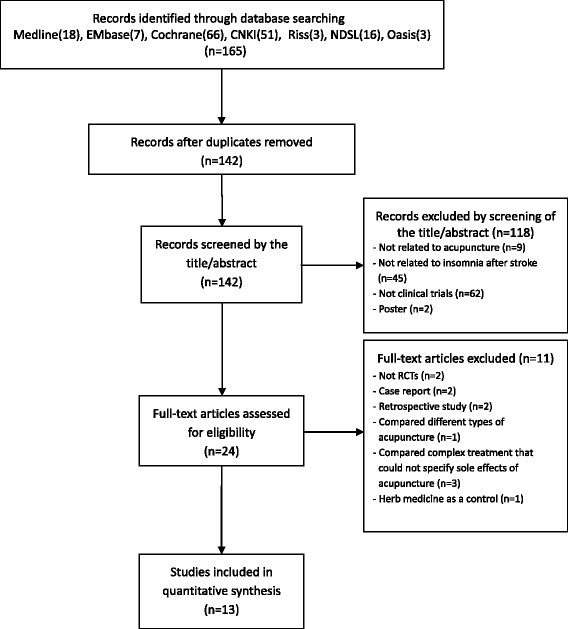
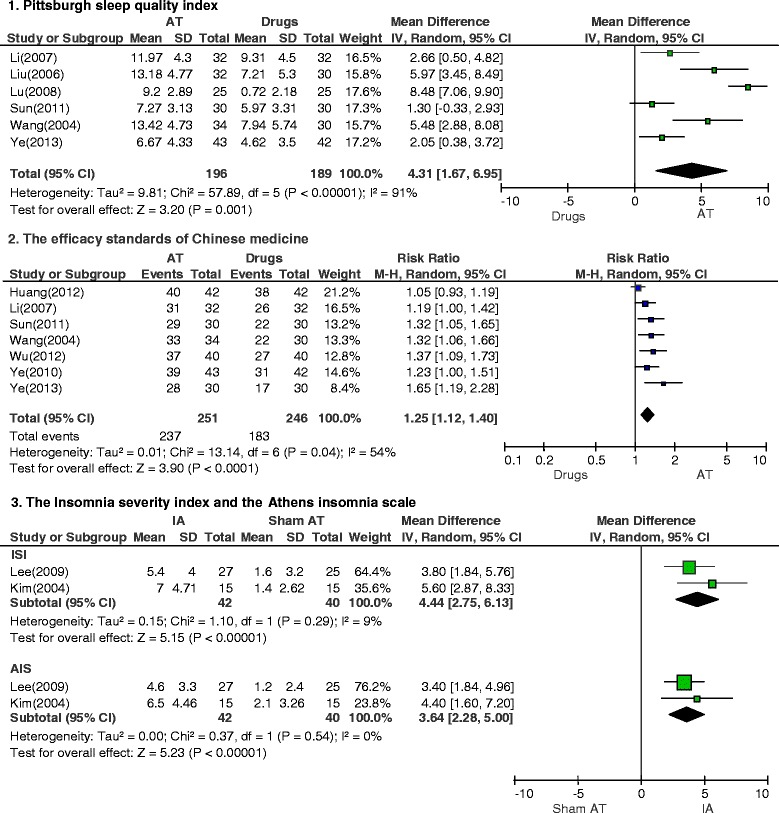
A total of 165 studies were identified; 13 RCTs met our inclusion criteria. Meta-analysis showed that acupuncture appeared to be more effective than drugs for treatment of insomnia after stroke, as assessed by the PSQI (weighted mean difference, 4.31; 95 % confidence interval [CI], 1.67-6.95; P = 0.001) and by the efficacy standards of Chinese medicine (risk ratio, 1.25; 95 % CI, 1.12-1.40; P < 0.001). Intradermal acupuncture had significant effects compared with sham acupuncture, as assessed by the ISI (weighted mean difference, 4.44; 95 % CI, 2.75-6.13; P < 0.001) and the AIS (weighted mean difference, 3.64; 95 % CI, 2.28-5.00; P < 0.001).
Our results suggest that acupuncture could be effective for treating insomnia after stroke. However, further studies are needed to confirm the role of acupuncture in the treatment of this disorder.
失眠是中风患者的常见主诉。针灸越来越多地被用于中风后缓解失眠。本研究的目的是总结和评估针灸缓解中风后失眠有效性的证据。
检索了7个数据库,时间跨度从建库至2014年10月,无语言限制。如果将针灸与安慰剂或其他传统疗法比较用于治疗中风后失眠,则纳入随机对照试验(RCT)。使用匹兹堡睡眠质量指数(PSQI)、失眠严重程度指数(ISI)、雅典失眠量表(AIS)以及中医疗效标准进行评估。
共识别出165项研究;13项RCT符合我们的纳入标准。荟萃分析表明,根据PSQI(加权平均差,4.31;95%置信区间[CI],1.67 - 6.95;P = 0.001)和中医疗效标准(风险比,1.25;95% CI,1.12 - 1.40;P < 0.001)评估,针灸治疗中风后失眠似乎比药物更有效。根据ISI(加权平均差,4.44;95% CI,2.75 - 6.13;P < 0.001)和AIS(加权平均差,3.64;95% CI,2.28 - 5.00;P < 0.001)评估,皮内针与假针刺相比有显著效果。
我们的结果表明针灸可能对治疗中风后失眠有效。然而,需要进一步研究来证实针灸在治疗这种疾病中的作用。