Kopperud Simen E, Pedersen Cecilie Gravdahl, Espelid Ivar
Department of Paediatric Dentistry and Behavioural Science, Faculty of Dentistry, University of Oslo, P.O. Box 1109, Blindern, NO-0317, Oslo, Norway.
Nordic Institute of Dental Materials (NIOM), Oslo, Norway.
BMC Oral Health. 2016 Jul 4;17(1):3. doi: 10.1186/s12903-016-0237-5.
The study aimed to explore the variability between the treatment decisions dentists make for MIH-affected teeth.
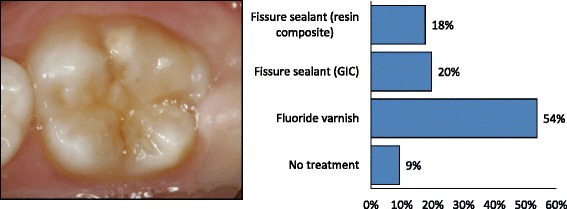
In 2009, a pre-coded questionnaire was sent electronically to all dentists employed by the Public Dental Service (PDS) in Norway (n = 1061). The questions were related to treatment of MIH-affected teeth, including three patient cases illustrated by photographs and written case descriptions.
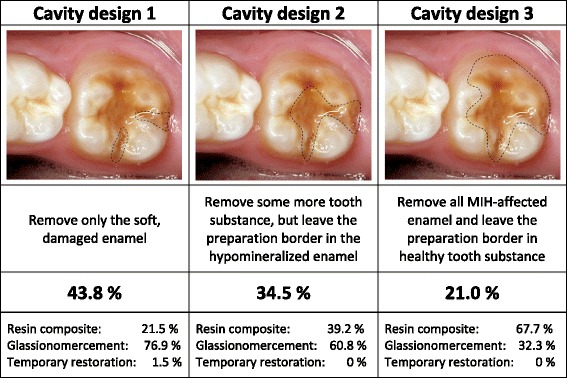
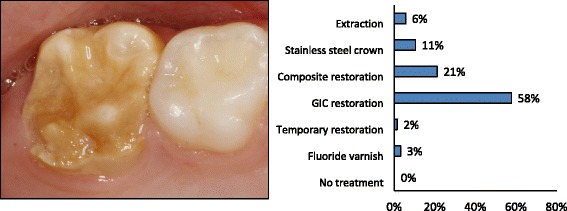
Replies were obtained from 61.5 % of the respondents after two reminders. In the first case, showing a newly erupted first permanent molar with moderate hypomineralization and no disintegration of the surface enamel, the preferred treatment among the majority of the respondents (53.5 %) was application of fluoride varnish, while 19.6 % would seal the fissure with GIC material. In the second case, showing a severely damaged first permanent molar in a six year old child, more than half of the respondents (57.5 %) would place a conventional glass ionomer restoration and 10.5 % would use a stainless steel crown (SSC). In the third case, showing a severely damaged permanent first molar in a nine year old child, 43.8 % of the dentists would remove only the parts with soft, damaged enamel; while 35.2 % would remove more and 21.0 % would remove all affected enamel and leave the cavity margins in sound enamel.
The survey shows that there is a wide disparity between clinicians' views on how MIH affected teeth should be treated. In a severely affected first permanent molar, only a minority of dentists would remove as much tooth substance as needed to get the full benefit of the acid etch pattern in sound enamel.
本研究旨在探讨牙医针对受乳牙列发育不全(MIH)影响的牙齿所做治疗决策之间的差异。
2009年,一份预编码问卷通过电子邮件发送给挪威公共牙科服务机构(PDS)雇佣的所有牙医(n = 1061)。问题涉及受MIH影响牙齿的治疗,包括三个通过照片和书面病例描述展示的患者病例。
经过两次提醒后,61.5%的受访者回复。在第一个病例中,展示一颗新萌出的第一恒磨牙,有中度矿化不全且表面釉质无崩解,大多数受访者(53.5%)首选的治疗方法是涂抹氟漆,而19.6%的人会用玻璃离子粘固剂(GIC)材料封闭窝沟。在第二个病例中,展示一名六岁儿童严重受损的第一恒磨牙,超过一半的受访者(57.5%)会进行传统玻璃离子修复,10.5%的人会使用不锈钢冠(SSC)。在第三个病例中,展示一名九岁儿童严重受损的第一恒磨牙,43.8%的牙医只会去除软的、受损的釉质部分;而35.2%的人会去除更多,21.0%的人会去除所有受影响的釉质并将洞缘留在完好的釉质中。
该调查表明,临床医生对于如何治疗受MIH影响的牙齿的观点存在很大差异。在严重受影响的第一恒磨牙中,只有少数牙医会去除足够多的牙体组织以充分利用完好釉质中的酸蚀模式。