Bagher Sara M, Alahdal Raneem E, Alzanbaki Sarah A, Abudawood Shahad N, Felemban Osama M
Pediatric Dentistry Department, Faculty of Dentistry, King Abdulaziz University, PO Box 80200, Jeddah, 21589, Saudi Arabia.
Ram Dental Clinic, Khobar, Jeddah, 23452, Saudi Arabia.
BMC Oral Health. 2025 Mar 15;25(1):388. doi: 10.1186/s12903-025-05749-1.
This electronic survey-based study aimed to explore the variations in treatment decisions made by dentists from different specialties in Saudi Arabia when treating anterior and posterior permanent teeth afflicted by molar incisor hypomineralization (MIH) of varying severity.
A cohort of dental professionals, including general dentists, pediatric dentists, and restorative dentists/prosthodontists, participated in a validated electronic survey-based study between January and March 2023. The survey consisted of the following three sections: The first section collected demographic information from the participating dentists. The second part includes case scenarios and photographs of four clinical cases (two permanent first molars and two permanent incisors) diagnosed with MIH of varying degrees of severity. Following each case, the participants were asked to choose the treatment approach and final restorative material they preferred to manage the tooth in question. In the third part, participants were asked to select factors that influenced their treatment decisions.
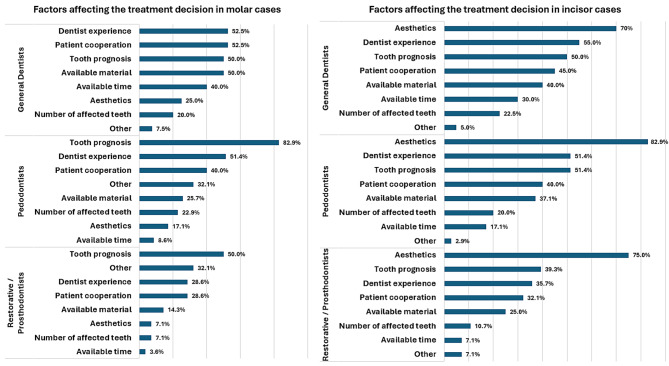
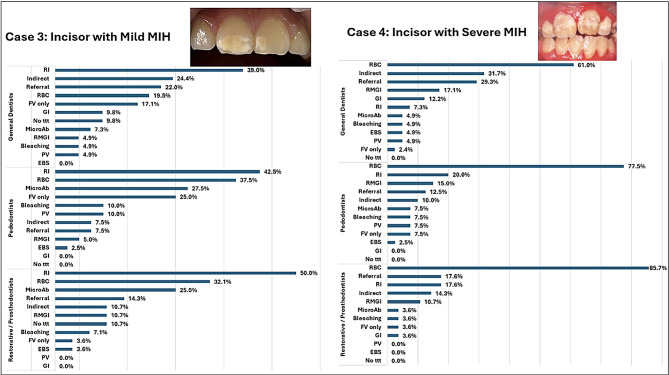
In total, 109 dentists responded to the questionnaire. For posterior permanent molars with both mild and severe MIH, general dentists and restorative dentists/prosthodontics preferred resin-based composite restoration. In contrast, pediatric dentists considered stainless steel crowns (SSCs) as the preferred modality. Resin infiltration was the most common treatment chosen for permanent anterior teeth with mild MIH. Resin-based composite restorations were predominantly chosen for severe cases. Tooth prognosis and dentist experience were among the top cited factors influencing the decision of preferred treatment in cases of permanent first molars diagnosed with MIH, and aesthetics was the most considered factor in cases of permanent incisors diagnosed with MIH.
According to the survey, different dental specialties manage MIH cases differently depending on the severity and type of permanent tooth (anterior/posterior).
这项基于电子调查的研究旨在探讨沙特阿拉伯不同专业的牙医在治疗患有不同严重程度磨牙切牙矿化不全(MIH)的恒牙前后牙时治疗决策的差异。
包括普通牙医、儿童牙医和修复牙医/口腔修复学家在内的一组牙科专业人员参与了2023年1月至3月间一项经过验证的基于电子调查的研究。该调查由以下三个部分组成:第一部分收集参与调查的牙医的人口统计学信息。第二部分包括四个临床病例(两颗恒第一磨牙和两颗恒切牙)的病例场景和照片,这些病例被诊断为不同程度的MIH。在每个病例之后,要求参与者选择他们首选的治疗方法和最终修复材料来处理相关牙齿。在第三部分中,要求参与者选择影响他们治疗决策的因素。
共有109名牙医回复了问卷。对于患有轻度和重度MIH的后牙恒牙,普通牙医和修复牙医/口腔修复学专家更喜欢树脂基复合修复。相比之下,儿童牙医认为不锈钢冠(SSC)是首选方式。树脂浸润是治疗轻度MIH的恒前牙最常用的方法。对于重度病例,主要选择树脂基复合修复。牙齿预后和牙医经验是影响诊断为MIH的恒第一磨牙首选治疗决策的最常提及因素,而美观是诊断为MIH的恒切牙病例中最受考虑的因素。
根据调查,不同牙科专业根据恒牙(前牙/后牙)的严重程度和类型对MIH病例的处理方式不同。