Bellelli Giuseppe, Morandi Alessandro, Di Santo Simona G, Mazzone Andrea, Cherubini Antonio, Mossello Enrico, Bo Mario, Bianchetti Angelo, Rozzini Renzo, Zanetti Ermellina, Musicco Massimo, Ferrari Alberto, Ferrara Nicola, Trabucchi Marco
School of Medicine and Surgery, University of Milano-Bicocca, Milano, Italy.
Geriatric Unit, San Gerardo University Hospital, Monza, Italy.
BMC Med. 2016 Jul 18;14:106. doi: 10.1186/s12916-016-0649-8.
To date, delirium prevalence in adult acute hospital populations has been estimated generally from pooled findings of single-center studies and/or among specific patient populations. Furthermore, the number of participants in these studies has not exceeded a few hundred. To overcome these limitations, we have determined, in a multicenter study, the prevalence of delirium over a single day among a large population of patients admitted to acute and rehabilitation hospital wards in Italy.
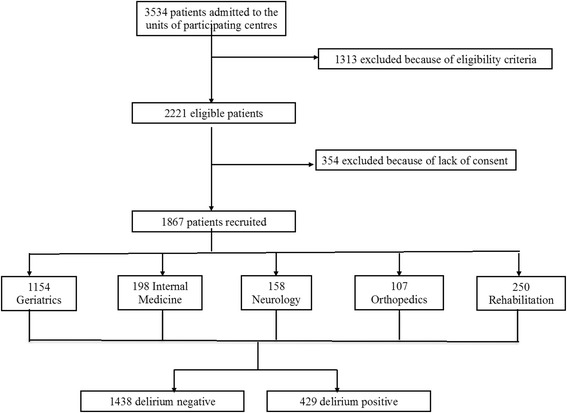
This is a point prevalence study (called "Delirium Day") including 1867 older patients (aged 65 years or more) across 108 acute and 12 rehabilitation wards in Italian hospitals. Delirium was assessed on the same day in all patients using the 4AT, a validated and briefly administered tool which does not require training. We also collected data regarding motoric subtypes of delirium, functional and nutritional status, dementia, comorbidity, medications, feeding tubes, peripheral venous and urinary catheters, and physical restraints.
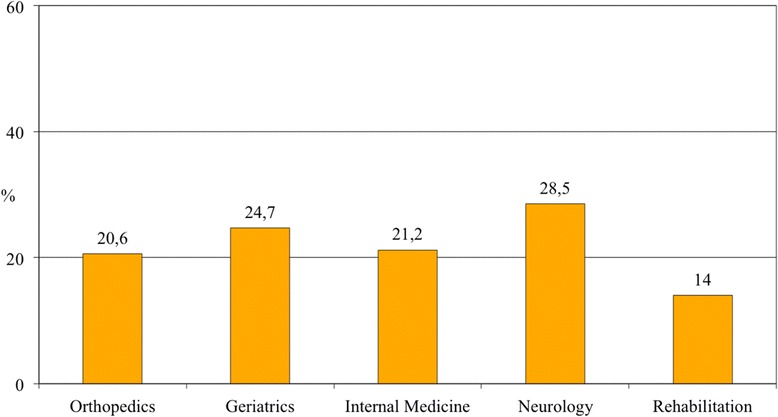
The mean sample age was 82.0 ± 7.5 years (58 % female). Overall, 429 patients (22.9 %) had delirium. Hypoactive was the commonest subtype (132/344 patients, 38.5 %), followed by mixed, hyperactive, and nonmotoric delirium. The prevalence was highest in Neurology (28.5 %) and Geriatrics (24.7 %), lowest in Rehabilitation (14.0 %), and intermediate in Orthopedic (20.6 %) and Internal Medicine wards (21.4 %). In a multivariable logistic regression, age (odds ratio [OR] 1.03, 95 % confidence interval [CI] 1.01-1.05), Activities of Daily Living dependence (OR 1.19, 95 % CI 1.12-1.27), dementia (OR 3.25, 95 % CI 2.41-4.38), malnutrition (OR 2.01, 95 % CI 1.29-3.14), and use of antipsychotics (OR 2.03, 95 % CI 1.45-2.82), feeding tubes (OR 2.51, 95 % CI 1.11-5.66), peripheral venous catheters (OR 1.41, 95 % CI 1.06-1.87), urinary catheters (OR 1.73, 95 % CI 1.30-2.29), and physical restraints (OR 1.84, 95 % CI 1.40-2.40) were associated with delirium. Admission to Neurology wards was also associated with delirium (OR 2.00, 95 % CI 1.29-3.14), while admission to other settings was not.
Delirium occurred in more than one out of five patients in acute and rehabilitation hospital wards. Prevalence was highest in Neurology and lowest in Rehabilitation divisions. The "Delirium Day" project might become a useful method to assess delirium across hospital settings and a benchmarking platform for future surveys.
迄今为止,成人急性医院患者群体中谵妄的患病率通常是根据单中心研究的汇总结果和/或特定患者群体估算得出的。此外,这些研究的参与者数量未超过几百人。为克服这些局限性,我们在一项多中心研究中确定了意大利急性和康复医院病房收治的大量患者中某一天谵妄的患病率。
这是一项现患率研究(称为“谵妄日”),纳入了意大利医院108个急性病房和12个康复病房的1867名老年患者(年龄65岁及以上)。使用4AT在同一天对所有患者进行谵妄评估,4AT是一种经过验证且无需培训即可简短实施的工具。我们还收集了有关谵妄运动亚型、功能和营养状况、痴呆、合并症、药物治疗、饲管、外周静脉导管和尿管以及身体约束的数据。
样本的平均年龄为82.0±7.5岁(58%为女性)。总体而言,429名患者(22.9%)患有谵妄。活动减少型是最常见的亚型(132/344名患者,38.5%),其次是混合型、活动增多型和无运动型谵妄。患病率在神经科最高(28.5%),在老年医学科次之(24.7%),在康复科最低(14.0%),在骨科(20.6%)和内科病房(21.4%)处于中间水平。在多变量逻辑回归分析中,年龄(比值比[OR]1.03,95%置信区间[CI]1.01 - 1.05)、日常生活活动依赖(OR 1.19,95% CI 1.12 - 1.27)、痴呆(OR 3.25,95% CI 2.41 - 4.38)、营养不良(OR 2.01,95% CI 1.29 - 3.14)、使用抗精神病药物(OR 2.03,95% CI 1.45 - 22.82)、饲管(OR 2.51,95% CI 1.11 - 5.66)、外周静脉导管(OR 1.41,95% CI 1.06 - 1.87)、尿管(OR 1.73,95% CI 1.30 - 2.29)和身体约束(OR 1.84,95% CI 1.40 - 2.40)与谵妄相关。入住神经科病房也与谵妄相关(OR 2.00,95% CI 1.29 - 3.14),而入住其他科室则不然。
急性和康复医院病房中超过五分之一的患者发生谵妄。患病率在神经科最高,在康复科最低。“谵妄日”项目可能成为评估各医院科室谵妄情况的有用方法以及未来调查的基准平台。