Ademe Beyene Wondafrash, Tebeje Bosena, Molla Ashagre
College of Health Sciences(CHS), Population and family Health Departement, Jimma University, Jimma, Ethiopia.
College of Health Sciences(CHS), Nursing Departement, Jimma University, Jimma, Ethiopia.
BMC Health Serv Res. 2016 Jul 19;16:287. doi: 10.1186/s12913-016-1523-2.
Health systems throughout the world, whether in developed or developing countries, are struggling with the challenge of how to manage health-care delivery in conditions of resource constraint. The availability and utilization of various health care equipments at all levels of the health care system has been emphasized for effective and efficient service delivery. In Ethiopia lack of proper management of medical equipment limited the capacity of health institutions to deliver adequate health care. The main objective of this study was to assess availability and utilization of medical devices and identify reported reasons that affect availability and utilization of medical devices among hospitals in Jimma Zone.
A cross-sectional multiple case-study using mixed quantitative and qualitative methods was used. Three hospitals of Jimma Zone were included in the study. Adapted and pre-tested structured English version checklist for availability and utilization of medical equipment and document review as well as interview guide for in-depth interview were used for data collection. Data were collected by observation of availability of the devices, interviewing selected professionals and document review of health care services using devices in the study hospitals. Data were analyzed using SPSS 16.0 statistical software. Descriptive analysis was made to determine the availability and functional status of medical devices. For qualitative part responses were transcribed, categorized and thematically analyzed.
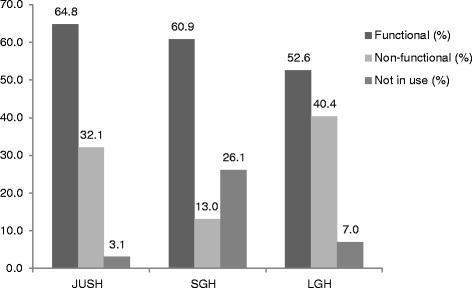
Observation and interview using checklist showed that 299 medical devices were available in the three hospitals among which, 196 (65.6 %) of them were available in Jimma University Specialized Hospital whereas, 57 (19.0 %) and 46 (15.4 %) were available in Limu Genet hospital and Shenen Gibe hospital respectively. Among 196 available medical devices in JUSH, 127 (64.8 %) were functional and the rest; 63 (32.1 %) and 6 (3.1 %) were not functional and not in use respectively. Similarly, 28 (60.9 %) and 30 (52.6 %) of the devices in Shenen Gibe hospital and LGH respectively were functional.
More than a third of medical devices in the three study hospitals were not functional. Purchasing devices with bids and preference for cheap price, lack of training on how to operate devices, less sense of accountability, power interruption, staff work overload and lack of maintenance experts, and inappropriate referral system were among the reported reasons for influencing availability and utilization of medical devices.
世界各地的卫生系统,无论在发达国家还是发展中国家,都在努力应对如何在资源有限的情况下管理医疗服务提供这一挑战。为了有效且高效地提供服务,卫生保健系统各级各类医疗设备的可获得性和利用率受到了重视。在埃塞俄比亚,医疗设备管理不善限制了卫生机构提供充分医疗服务的能力。本研究的主要目的是评估吉马地区各医院医疗设备的可获得性和利用率,并找出影响医疗设备可获得性和利用率的报告原因。
采用了一项横断面多案例研究,运用混合定量和定性方法。吉马地区的三家医院纳入了研究。使用了经过改编和预测试的关于医疗设备可获得性和利用率的结构化英文版清单、文件审查以及用于深入访谈的访谈指南来收集数据。通过观察设备的可获得性、采访选定的专业人员以及对研究医院中使用设备的医疗服务进行文件审查来收集数据。使用SPSS 16.0统计软件进行数据分析。进行描述性分析以确定医疗设备的可获得性和功能状态。对于定性部分,对回复进行转录、分类并进行主题分析。
使用清单进行的观察和访谈表明,三家医院共有299台医疗设备,其中196台(65.6%)在吉马大学专科医院,而57台(19.0%)和46台(15.4%)分别在利穆杰内特医院和谢嫩吉贝医院。在吉马大学专科医院的196台可用医疗设备中,127台(64.8%)功能正常,其余的63台(32.1%)无法正常使用,6台(3.1%)未投入使用。同样,谢嫩吉贝医院和利穆杰内特医院分别有28台(60.9%)和30台(52.6%)设备功能正常。
三家研究医院中超过三分之一的医疗设备无法正常使用。通过招标采购设备且倾向于低价设备、缺乏设备操作培训、责任感淡薄、停电、工作人员工作负担过重以及缺乏维修专家,还有转诊系统不当等,都是影响医疗设备可获得性和利用率的报告原因。