Key Laboratory of Design and Assembly of Functional Nanostructures and Fujian Provincial Key Laboratory of Nanomaterials, Fujian Institute of Research on the Structure of Matter, Chinese Academy of Sciences, Fuzhou 350002, China.
Department of Physics, Institute of Nanoscience and Nanotechnology, Central China Normal University, Wuhan 430079, China.
Nat Commun. 2016 Jul 20;7:12273. doi: 10.1038/ncomms12273.
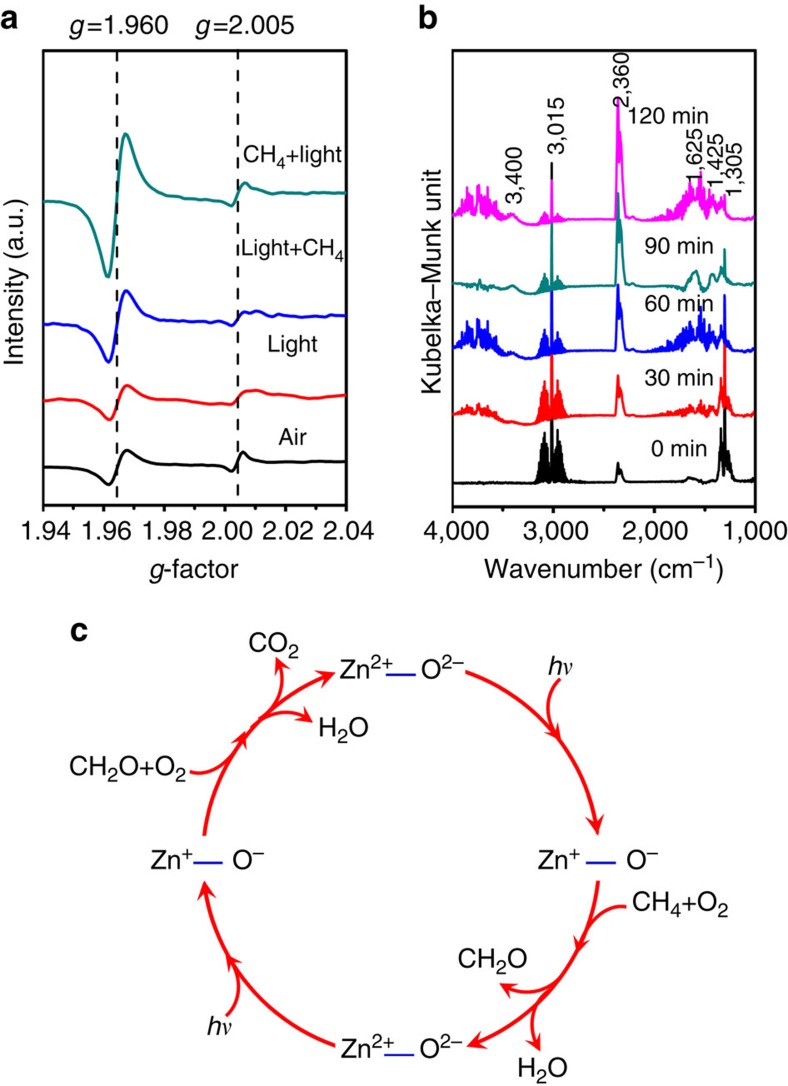
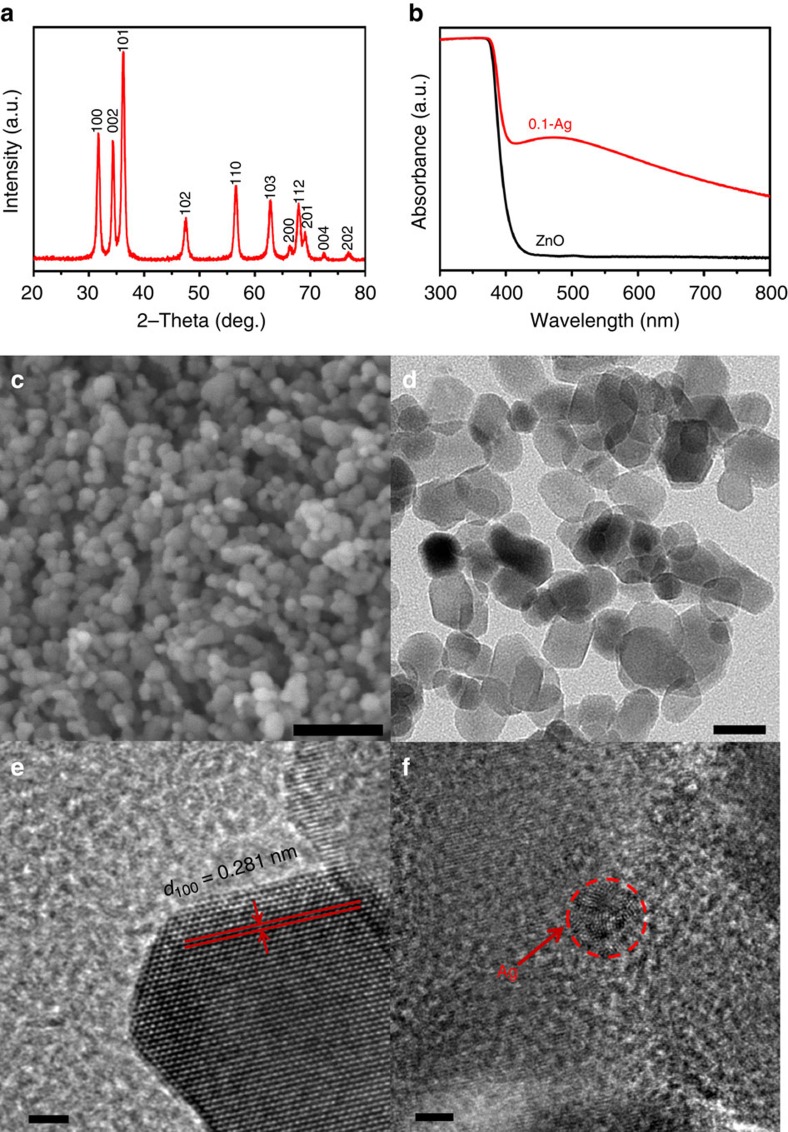
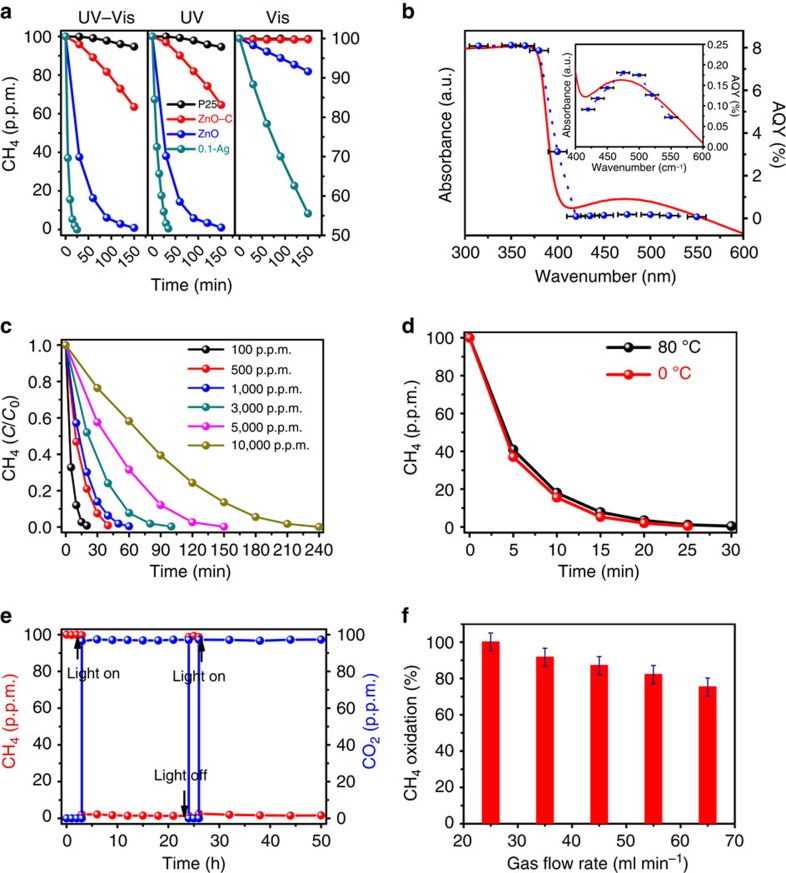
The search for active catalysts that efficiently oxidize methane under ambient conditions remains a challenging task for both C1 utilization and atmospheric cleansing. Here, we show that when the particle size of zinc oxide is reduced down to the nanoscale, it exhibits high activity for methane oxidation under simulated sunlight illumination, and nano silver decoration further enhances the photo-activity via the surface plasmon resonance. The high quantum yield of 8% at wavelengths <400 nm and over 0.1% at wavelengths ∼470 nm achieved on the silver decorated zinc oxide nanostructures shows great promise for atmospheric methane oxidation. Moreover, the nano-particulate composites can efficiently photo-oxidize other small molecular hydrocarbons such as ethane, propane and ethylene, and in particular, can dehydrogenize methane to generate ethane, ethylene and so on. On the basis of the experimental results, a two-step photocatalytic reaction process is suggested to account for the methane photo-oxidation.
在环境条件下高效氧化甲烷的活性催化剂的研究对于 C1 利用和大气净化仍然是一项具有挑战性的任务。在这里,我们表明,当氧化锌的粒径减小到纳米级时,它在模拟阳光照射下表现出很高的甲烷氧化活性,纳米银的修饰通过表面等离激元共振进一步增强了光活性。在<400nm 波长下实现了 8%的高光量子产率,在约 470nm 波长下实现了超过 0.1%的高光量子产率,这表明银修饰的氧化锌纳米结构在大气甲烷氧化方面具有很大的应用前景。此外,纳米颗粒复合材料可以有效地光氧化其他小分子烃类,如乙烷、丙烷和乙烯,特别是可以将甲烷脱氢生成乙烷、乙烯等。基于实验结果,提出了一个两步光催化反应过程来解释甲烷的光氧化。