Ionescu Michael, Yokota Kenji, Antonova Elena, Garcia Angelica, Beaulieu Ellen, Hayes Terry, Iavarone Anthony T, Lindow Steven E
Department of Plant and Microbial Biology, University of California, Berkeley, California, USA.
Department of Applied Biology and Chemistry, Tokyo University of Agriculture, Tokyo, Japan.
mBio. 2016 Jul 19;7(4):e01054-16. doi: 10.1128/mBio.01054-16.
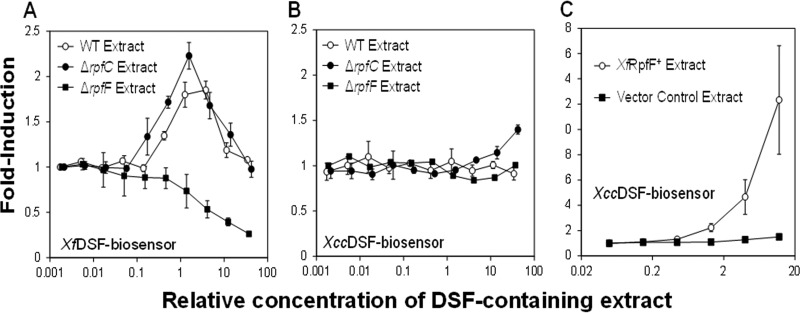
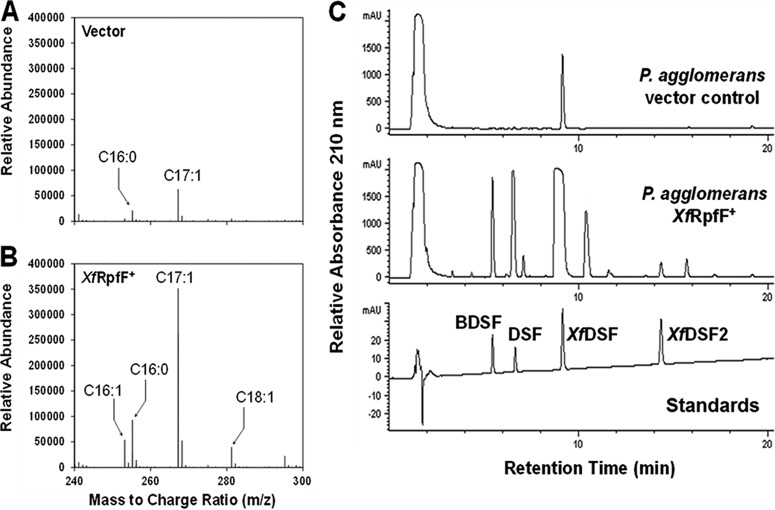
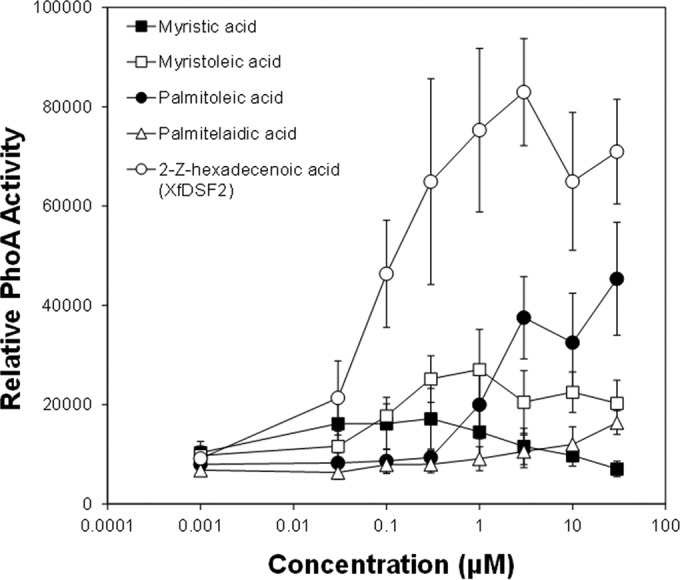
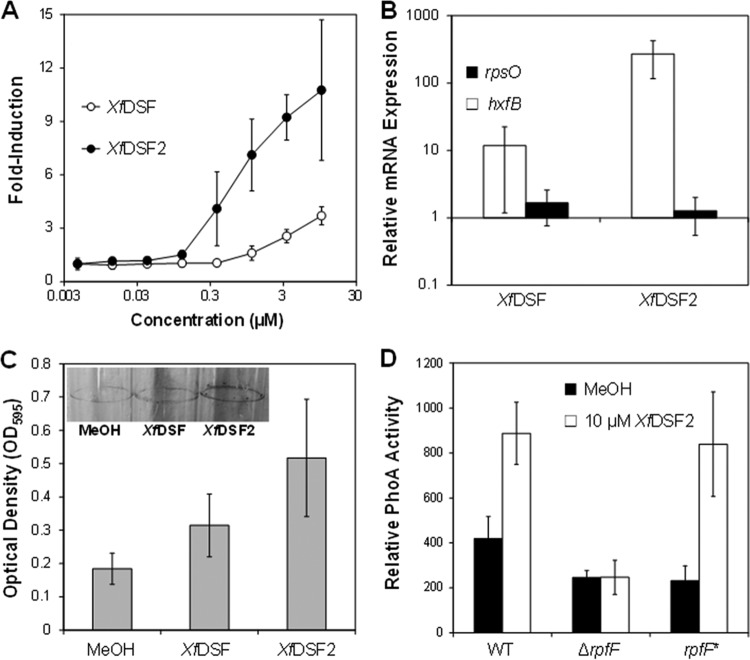
Cell density-dependent regulation of gene expression in Xylella fastidiosa that is crucial to its switching between plant hosts and insect vectors is dependent on RpfF and its production of 2-enoic acids known as diffusible signal factor (DSF). We show that X. fastidiosa produces a particularly large variety of similar, relatively long-chain-length 2-enoic acids that are active in modulating gene expression. Both X. fastidiosa itself and a Pantoea agglomerans surrogate host harboring X. fastidiosa RpfF (XfRpfF) is capable of producing a variety of both saturated and unsaturated free fatty acids. However, only 2-cis unsaturated acids were found to be biologically active in X. fastidiosa X. fastidiosa produces, and is particularly responsive to, a novel DSF species, 2-cis-hexadecanoic acid that we term XfDSF2. It is also responsive to other, even longer 2-enoic acids to which other taxa such as Xanthomonas campestris are unresponsive. The 2-enoic acids that are produced by X. fastidiosa are strongly affected by the cellular growth environment, with XfDSF2 not detected in culture media in which 2-tetradecenoic acid (XfDSF1) had previously been found. X. fastidiosa is responsive to much lower concentrations of XfDSF2 than XfDSF1. Apparently competitive interactions can occur between various saturated and unsaturated fatty acids that block the function of those agonistic 2-enoic fatty acids. By altering the particular 2-enoic acids produced and the relative balance of free enoic and saturated fatty acids, X. fastidiosa might modulate the extent of DSF-mediated quorum sensing.
X. fastidiosa, having a complicated lifestyle in which it moves and multiplies within plants but also must be vectored by insects, utilizes DSF-based quorum sensing to partition the expression of traits needed for these two processes within different cells in this population based on local cellular density. The finding that it can produce a variety of DSF species in a strongly environmentally context-dependent manner provides insight into how it coordinates the many genes under the control of DSF signaling to successfully associate with its two hosts. Since the new DSF variant XfDSF2 described here is much more active than the previously recognized DSF species, it should contribute to plant disease control, given that the susceptibility of plants can be greatly reduced by artificially elevating the levels of DSF in plants, creating "pathogen confusion," resulting in lower virulence.
在木质部难养菌中,基因表达的细胞密度依赖性调控对其在植物宿主和昆虫载体之间转换至关重要,这依赖于RpfF及其产生的被称为扩散信号因子(DSF)的2-烯酸。我们发现,木质部难养菌产生了特别多种类似的、相对长链长度的2-烯酸,它们在调节基因表达方面具有活性。木质部难养菌本身以及携带木质部难养菌RpfF(XfRpfF)的成团泛菌替代宿主都能够产生多种饱和和不饱和游离脂肪酸。然而,仅发现2-顺式不饱和酸在木质部难养菌中具有生物活性。木质部难养菌产生并对一种新型DSF物种2-顺式十六烷酸(我们称之为XfDSF2)特别敏感。它也对其他更长的2-烯酸有反应,而其他分类群如野油菜黄单胞菌对这些更长的2-烯酸无反应。木质部难养菌产生的2-烯酸受到细胞生长环境的强烈影响,在先前发现2-十四碳烯酸(XfDSF1)的培养基中未检测到XfDSF2。木质部难养菌对XfDSF2的浓度响应远低于XfDSF1。各种饱和和不饱和脂肪酸之间可能发生明显的竞争相互作用,从而阻断那些具有激动作用的2-烯酸脂肪酸的功能。通过改变产生的特定2-烯酸以及游离烯酸和饱和脂肪酸的相对平衡,木质部难养菌可能调节DSF介导的群体感应程度。
木质部难养菌具有复杂的生活方式,它在植物体内移动和繁殖,但也必须由昆虫传播,它利用基于DSF的群体感应根据局部细胞密度在该群体的不同细胞内分配这两个过程所需性状的表达。它能够以强烈依赖环境的方式产生多种DSF物种这一发现,为其如何协调DSF信号控制下的众多基因以成功与两种宿主关联提供了见解。由于这里描述的新DSF变体XfDSF2比先前认可的DSF物种活性高得多,鉴于通过人工提高植物中DSF的水平可大大降低植物的易感性,产生“病原体混淆”,从而降低毒力,它应该有助于植物病害控制。