Cuenca Argelia, Ross T Gregory, Graham Sean W, Barrett Craig F, Davis Jerrold I, Seberg Ole, Petersen Gitte
Natural History Museum of Denmark, University of Copenhagen, Copenhagen, Denmark.
Department of Botany, 6270 University Boulevard, University of British Columbia, Vancouver, British Columbia, Canada UBC Botanical Garden & Centre for Plant Research, University of British Columbia, Vancouver, British Columbia, Canada.
Genome Biol Evol. 2016 Aug 3;8(7):2176-89. doi: 10.1093/gbe/evw148.
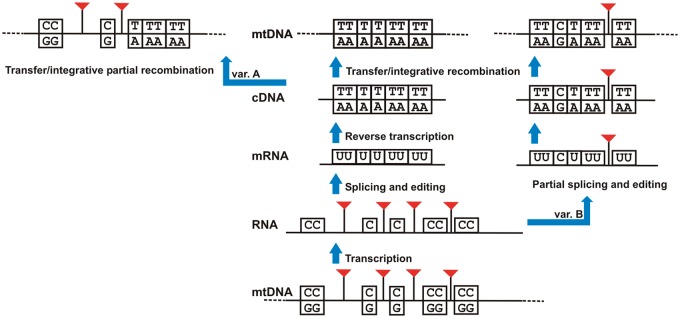
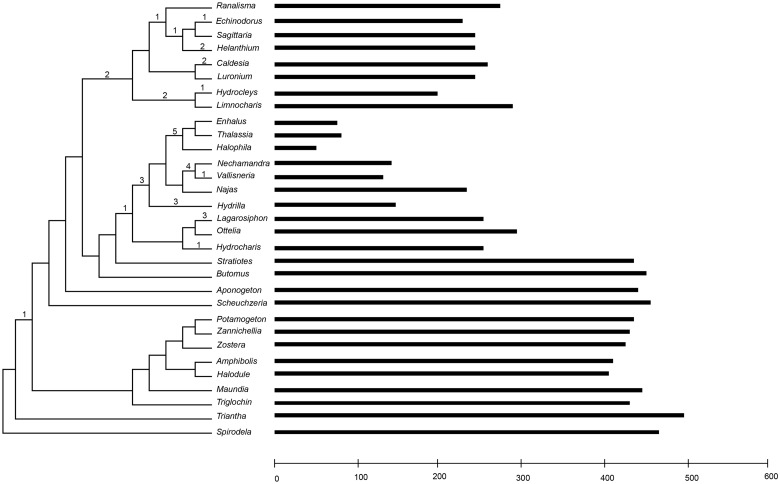
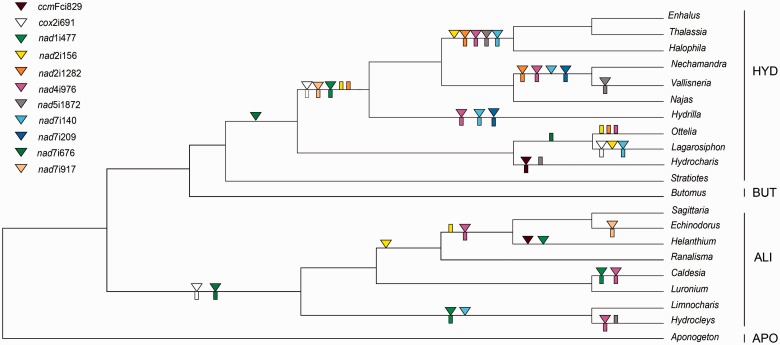
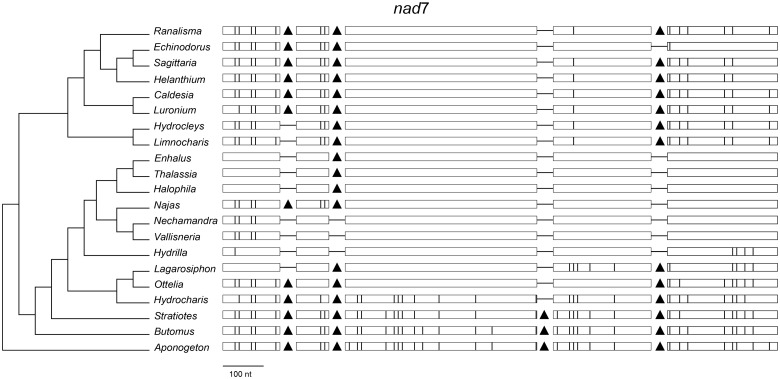
Loss of introns in plant mitochondrial genes is commonly explained by retroprocessing. Under this model, an mRNA is reverse transcribed and integrated back into the genome, simultaneously affecting the contents of introns and edited sites. To evaluate the extent to which retroprocessing explains intron loss, we analyzed patterns of intron content and predicted RNA editing for whole mitochondrial genomes of 30 species in the monocot order Alismatales. In this group, we found an unusually high degree of variation in the intron content, even expanding the hitherto known variation among angiosperms. Some species have lost some two-third of the cis-spliced introns. We found a strong correlation between intron content and editing frequency, and detected 27 events in which intron loss is consistent with the presence of nucleotides in an edited state, supporting retroprocessing. However, we also detected seven cases of intron loss not readily being explained by retroprocession. Our analyses are also not consistent with the entire length of a fully processed cDNA copy being integrated into the genome, but instead indicate that retroprocessing usually occurs for only part of the gene. In some cases, several rounds of retroprocessing may explain intron loss in genes completely devoid of introns. A number of taxa retroprocessing seem to be very common and a possibly ongoing process. It affects the entire mitochondrial genome.
植物线粒体基因中内含子的丢失通常被解释为反转录加工的结果。在这个模型中,mRNA被反转录并重新整合到基因组中,同时影响内含子和编辑位点的含量。为了评估反转录加工在多大程度上解释了内含子的丢失,我们分析了单子叶植物泽泻目30个物种的整个线粒体基因组的内含子含量模式和预测的RNA编辑。在这个类群中,我们发现内含子含量存在异常高的变异程度,甚至扩大了迄今为止被子植物中已知的变异范围。一些物种已经丢失了约三分之二的顺式剪接内含子。我们发现内含子含量与编辑频率之间存在很强的相关性,并检测到27个内含子丢失与编辑状态下核苷酸的存在一致的事件,支持反转录加工。然而,我们也检测到7例内含子丢失难以用反转录加工来解释的情况。我们的分析也与完全加工的cDNA拷贝的全长整合到基因组中不一致,而是表明反转录加工通常只发生在基因的一部分。在某些情况下,几轮反转录加工可能解释完全没有内含子的基因中的内含子丢失。一些类群的反转录加工似乎非常普遍,而且可能是一个持续的过程。它影响整个线粒体基因组。