Department of Women's and Children's Health, Karolinska Institutet, Karolinska University Hospital, Stockholm, Sweden.
Department of Physical Therapy, Movement & Rehabilitation Sciences, Bouve College of Health Sciences, Northeastern University, Boston, MA, USA.
Knee Surg Sports Traumatol Arthrosc. 2017 Nov;25(11):3378-3386. doi: 10.1007/s00167-016-4234-7. Epub 2016 Jul 19.
The current literature lacks sufficient information about improvements in gait patterns and function after total knee arthroplasty (TKA) and whether patients return to full function. This study evaluated change in gait, performance-based function, and self-reported function 1 year after TKA in patients with symptomatic knee osteoarthritis and how these aspects interrelate.
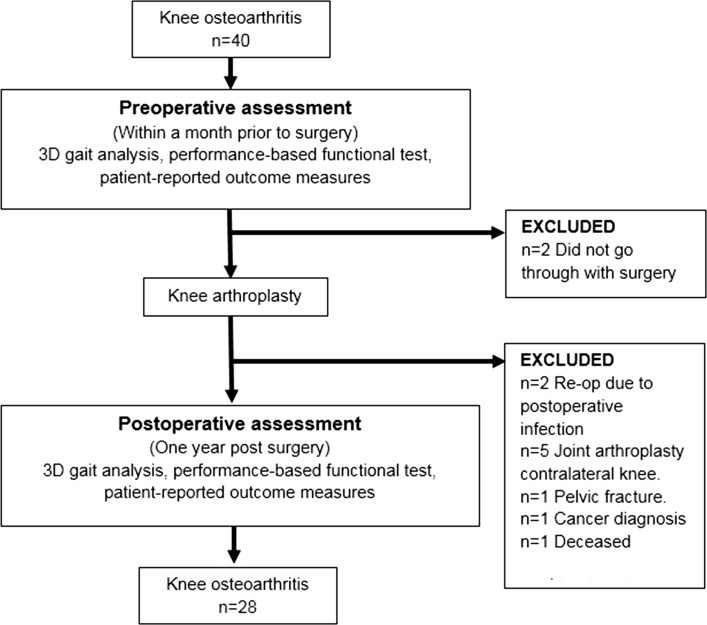
A total of 28 patients (64 % female) with knee osteoarthritis, with a mean age of 66 (±7) years, and 25 age- and gender-matched controls participated in this prospective cohort study. Three-dimensional gait analysis generated comprehensive measures of kinematic and kinetic gait deviations, respectively. Participants completed the Five Times Sit-to-Stand (5STS) test, and the self-reported questionnaire Knee Injury and Osteoarthritis Outcome Score (KOOS), at baseline prior to surgery and 1 year after TKA.
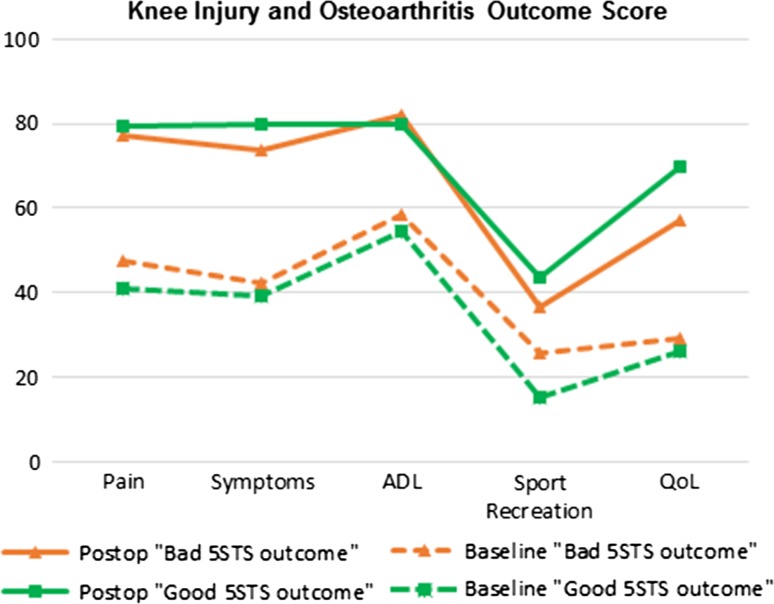
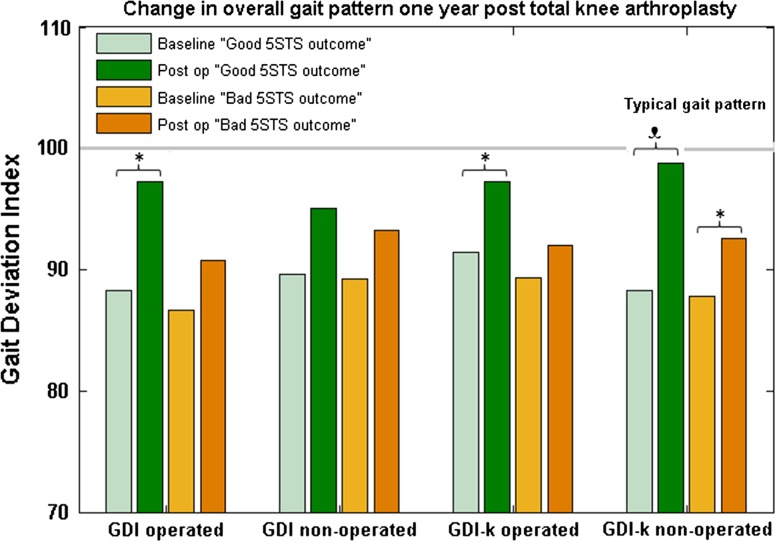
Kinetic gait deviations of both the operated and non-operated limb persisted in patients with knee osteoarthritis at 1 year after surgery, while kinematic gait patterns were comparable to controls. Performance on the 5STS and KOOS scores in patients with knee osteoarthritis improved significantly 1 year after surgery (effect size 0.5-1.5), but did not reach the level of controls. Ten patients with knee osteoarthritis (36 %) exceeded the minimally detectable change on the 5STS.
Measures of overall gait patterns and the 5STS revealed improvements in function 1 year after TKA, but were not restored to the level of healthy controls. Based on change in 5STS performance, we identified patients with substantial improvements in gait patterns. Self-reported measures of function could not detect differences between patients improving in 5STS performance and those who did not. These findings highlight the use of the 5STS in clinical practice since improvement on this test seems to follow the reduction in gait pattern deviations.
II.
目前的文献缺乏关于全膝关节置换术(TKA)后步态模式和功能改善的充分信息,也缺乏患者是否能恢复全面功能的信息。本研究评估了膝关节骨关节炎患者 TKA 后 1 年的步态变化、基于表现的功能和自我报告的功能,以及这些方面如何相互关联。
本前瞻性队列研究共纳入 28 名(64%为女性)膝关节骨关节炎患者,平均年龄 66(±7)岁,以及 25 名年龄和性别匹配的对照者。三维步态分析分别生成运动学和动力学步态偏差的综合测量值。参与者在手术前和 TKA 后 1 年分别完成五次坐站测试(5STS)和自我报告的膝关节损伤和骨关节炎结果评分(KOOS)问卷。
膝关节骨关节炎患者在手术后 1 年时,患侧和非患侧的动力学步态偏差仍然存在,而运动学步态模式与对照者相似。膝关节骨关节炎患者的 5STS 和 KOOS 评分在手术后 1 年显著提高(效应量 0.5-1.5),但未达到对照者的水平。10 名膝关节骨关节炎患者(36%)在 5STS 上的最小可检测变化超过了该值。
整体步态模式和 5STS 的测量结果显示 TKA 后 1 年功能得到改善,但仍未恢复到健康对照者的水平。根据 5STS 表现的变化,我们确定了在步态模式方面有显著改善的患者。自我报告的功能测量无法检测到在 5STS 表现上有所改善的患者和没有改善的患者之间的差异。这些发现强调了 5STS 在临床实践中的应用,因为该测试的改善似乎与步态模式偏差的减少有关。
II 级。