Department of Biochemistry, University of Lausanne, Epalinges, 1066 Switzerland.
J Immunother Cancer. 2016 Jul 19;4:39. doi: 10.1186/s40425-016-0143-z. eCollection 2016.
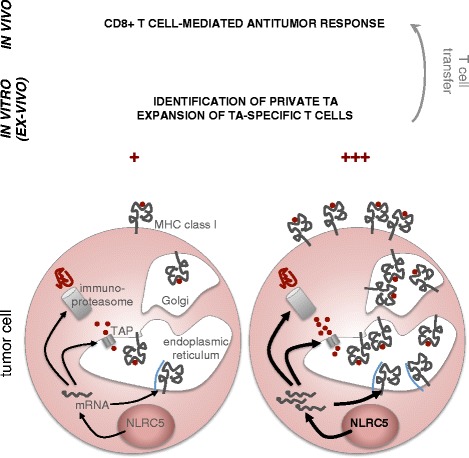
The recent use of T cell-based cancer immunotherapies, such as adoptive T-cell transfer and checkpoint blockade, yields increasing clinical benefit to patients with different cancer types. However, decrease of MHC class I expression is a common mechanism transformed cells take advantage of to evade CD8(+) T cell-mediated antitumor responses, negatively impacting on the outcome of immunotherapies. Hence, there is an urgent need to develop novel approaches to overcome this limitation. NLRC5 has been recently described as a key transcriptional regulator controlling expression of MHC class I molecules. In this commentary, we summarize and put into perspective a study by Rodriguez and colleagues recently published in Oncoimmunology, addressing the role of NLRC5 in melanoma. The authors demonstrate that NLRC5 overexpression in B16 melanoma allows to recover MHC class I expression, rising tumor immunogenicity and counteracting immune evasion. Possible ways of manipulating NLRC5 activity in tumors will be discussed. Highlighting the therapeutic potential of modulating NLRC5 levels, this publication also encourages evaluation of NLRC5, and by extension MHC class I pathway, as clinical biomarker to select personalized immunotherapeutic strategies.
近年来,T 细胞为基础的癌症免疫疗法,如过继性 T 细胞转移和检查点阻断,为不同类型的癌症患者带来了越来越多的临床获益。然而,MHC I 类表达的降低是转化细胞利用的一种常见机制,逃避 CD8(+) T 细胞介导的抗肿瘤反应,对免疫治疗的结果产生负面影响。因此,迫切需要开发新的方法来克服这一限制。NLRC5 最近被描述为一个关键的转录调节因子,控制 MHC I 类分子的表达。在这篇评论中,我们总结并阐述了 Rodriguez 及其同事最近在 Oncoimmunology 上发表的一项研究,该研究探讨了 NLRC5 在黑色素瘤中的作用。作者证明,B16 黑色素瘤中 NLRC5 的过表达可以恢复 MHC I 类的表达,提高肿瘤的免疫原性,并对抗免疫逃逸。还将讨论在肿瘤中操纵 NLRC5 活性的可能途径。强调调节 NLRC5 水平的治疗潜力,这一出版物也鼓励评估 NLRC5,以及 MHC I 类途径作为临床生物标志物,以选择个性化的免疫治疗策略。