Cao Zhen, Dou Ce, Li Jianmei, Tang Xiangyu, Xiang Junyu, Zhao Chunrong, Zhu Lingyu, Bai Yun, Xiang Qiang, Dong Shiwu
Department of Anatomy, Third Military Medical University and National & Regional United Engineering Laboratory of Tissue Engineering, Department of Biomedical Materials Science, School of Biomedical Engineering, Third Military Medical University, Chongqing 400038, China.
National & Regional United Engineering Laboratory of Tissue Engineering, Department of Biomedical Materials Science, School of Biomedical Engineering, Third Military Medical University, Chongqing 400038, China.
BMB Rep. 2016 Oct;49(10):548-553. doi: 10.5483/bmbrep.2016.49.10.071.
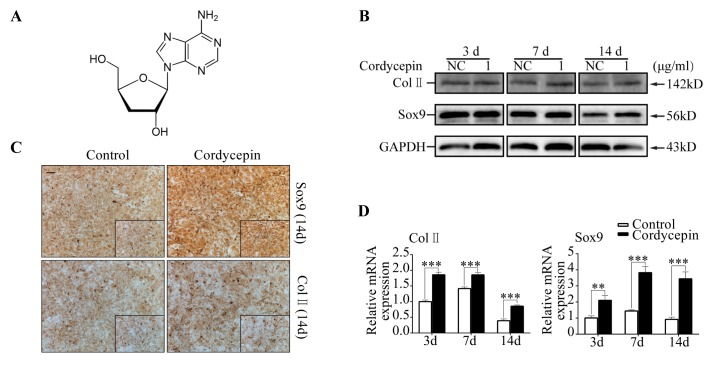
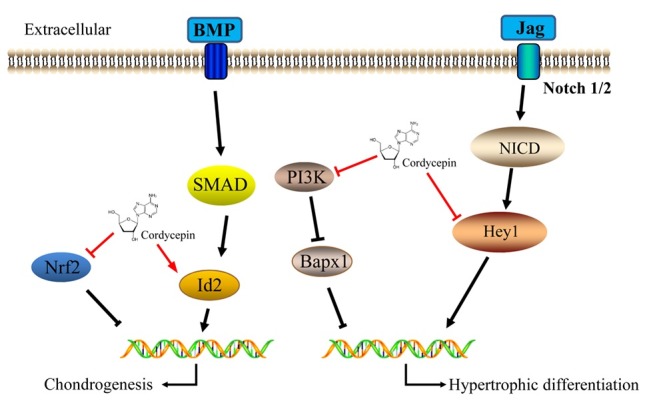
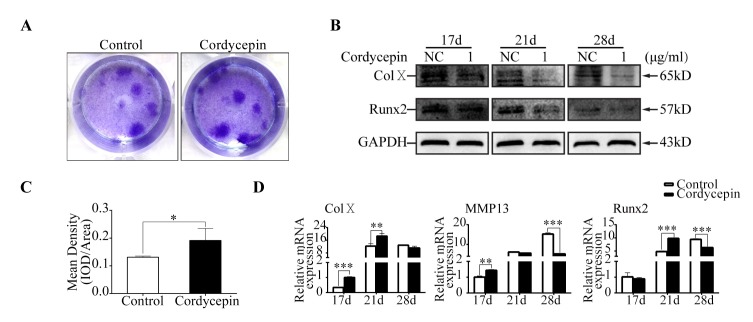
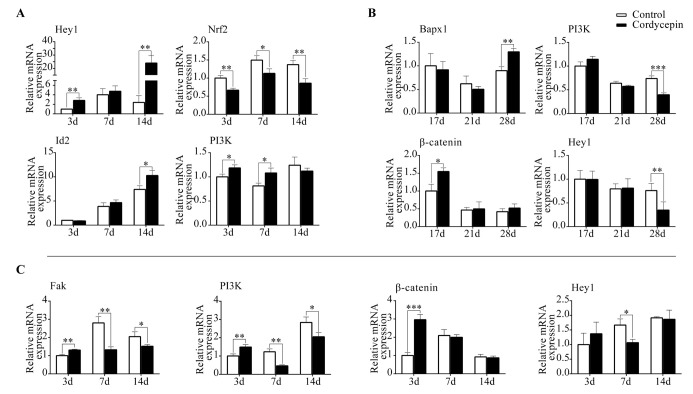
Mesenchymal stem cells (MSCs) are widely used in cartilage tissue engineering to repair articular cartilage defects. However, hypertrophy of chondrocytes derived from MSCs might hinder the stabilization of hyaline cartilage. Thus, it is very important to find a suitable way to maintain the chondrogenic phenotype of chondrocytes. It has been reported that cordycepin has anti-inflammatory and anti-tumor functions. However, the role of cordycepin in chondrocyte hypertrophy remains unclear. Therefore, the objective of this study was to determine the effect of cordycepin on chondrogenesis and chondrocyte hypertrophy in MSCs and ATDC5 cells. Cordycepin upregulated chondrogenic markers including Sox9 and collagen type II while down-regulated hypertrophic markers including Runx2 and collagen type X. Further exploration showed that cordycepin promoted chondrogenesis through inhibiting Nrf2 while activating BMP signaling. Besides, cordycepin suppressed chondrocyte hypertrophy through PI3K/Bapx1 pathway and Notch signaling. Our results indicated cordycepin had the potential to maintain chondrocyte phenotype and reconstruct engineered cartilage. [BMB Reports 2016; 49(10): 548-553].
间充质干细胞(MSCs)被广泛应用于软骨组织工程,以修复关节软骨缺损。然而,源自MSCs的软骨细胞肥大可能会阻碍透明软骨的稳定性。因此,找到一种合适的方法来维持软骨细胞的软骨生成表型非常重要。据报道,虫草素具有抗炎和抗肿瘤功能。然而,虫草素在软骨细胞肥大中的作用仍不清楚。因此,本研究的目的是确定虫草素对MSCs和ATDC5细胞软骨生成和软骨细胞肥大的影响。虫草素上调了包括Sox9和II型胶原蛋白在内的软骨生成标志物,同时下调了包括Runx2和X型胶原蛋白在内的肥大标志物。进一步的研究表明,虫草素通过抑制Nrf2同时激活BMP信号通路促进软骨生成。此外,虫草素通过PI3K/Bapx1途径和Notch信号通路抑制软骨细胞肥大。我们的结果表明,虫草素具有维持软骨细胞表型和重建工程软骨的潜力。[《BMB报告》2016年;49(10):548 - 553]