Bae Ye Seul, Im Sun-Wha, Kang Mi So, Kim Jin Hee, Lee Soon Hang, Cho Be Long, Park Jin Ho, Nam You-Seon, Son Ho-Young, Yang San Deok, Sung Joohon, Oh Kwang Ho, Yun Jae Moon, Kim Jong Il
Department of Family Medicine, Seoul National University Hospital, Seoul National University College of Medicine, Seoul 03080, Korea.
Neuro-Immune Information Storage Network Research Center, Seoul National University College of Medicine, Seoul 03080, Korea.
Genomics Inform. 2016 Jun;14(2):62-8. doi: 10.5808/GI.2016.14.2.62. Epub 2016 Jun 30.
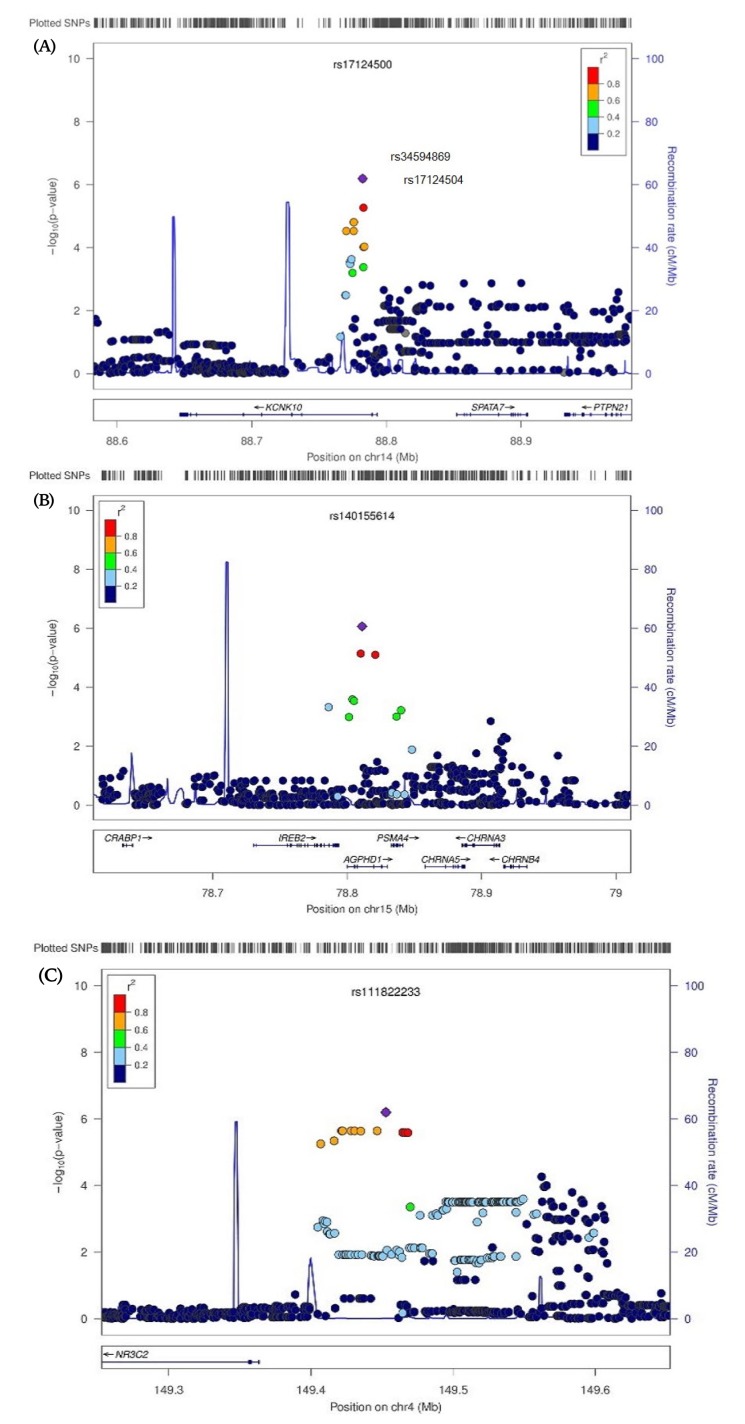
Osteoporosis is a medical condition of global concern, with increasing incidence in both sexes. Bone mineral density (BMD), a highly heritable trait, has been proven a useful diagnostic factor in predicting fracture. Because medical information is lacking about male osteoporotic genetics, we conducted a genome-wide association study of BMD in Korean men. With 1,176 participants, we analyzed 4,414,664 single nucleotide polymorphisms (SNPs) after genomic imputation, and identified five SNPs and three loci correlated with bone density and strength. Multivariate linear regression models were applied to adjust for age and body mass index interference. Rs17124500 (p = 6.42 × 10(-7)), rs34594869 (p = 6.53 × 10(-7)) and rs17124504 (p = 6.53 × 10(-7)) in 14q31.3 and rs140155614 (p = 8.64 × 10(-7)) in 15q25.1 were significantly associated with lumbar spine BMD (LS-BMD), while rs111822233 (p = 6.35 × 10(-7)) was linked with the femur total BMD (FT-BMD). Additionally, we analyzed the relationship between BMD and five genes previously identified in Korean men. Rs61382873 (p = 0.0009) in LRP5, rs9567003 (p = 0.0033) in TNFSF11 and rs9935828 (p = 0.0248) in FOXL1 were observed for LS-BMD. Furthermore, rs33997547 (p = 0.0057) in ZBTB and rs1664496 (p = 0.0012) in MEF2C were found to influence FT-BMD and rs61769193 (p = 0.0114) in ZBTB to influence femur neck BMD. We identified five SNPs and three genomic regions, associated with BMD. The significance of our results lies in the discovery of new loci, while also affirming a previously significant locus, as potential osteoporotic factors in the Korean male population.
骨质疏松症是一个全球关注的医学问题,男女发病率均在上升。骨矿物质密度(BMD)是一种高度可遗传的性状,已被证明是预测骨折的有用诊断因素。由于缺乏关于男性骨质疏松症遗传学的医学信息,我们对韩国男性的BMD进行了全基因组关联研究。我们选取了1176名参与者,在基因组填充后分析了4414664个单核苷酸多态性(SNP),并确定了5个SNP和3个与骨密度和强度相关的基因座。应用多元线性回归模型来调整年龄和体重指数的干扰。14q31.3中的Rs17124500(p = 6.42×10⁻⁷)、rs34594869(p = 6.53×10⁻⁷)和rs17124504(p = 6.53×10⁻⁷)以及15q25.1中的rs140155614(p = 8.64×10⁻⁷)与腰椎BMD(LS - BMD)显著相关,而rs111822233(p = 6.35×10⁻⁷)与股骨总BMD(FT - BMD)相关。此外,我们分析了BMD与之前在韩国男性中鉴定出的五个基因之间的关系。观察到LRP5中的Rs61382873(p = 0.0009)、TNFSF11中的rs9567003(p = 0.0033)和FOXL1中的rs9935828(p = 0.0248)与LS - BMD有关。此外,发现ZBTB中的rs33997547(p = 0.0057)和MEF2C中的rs1664496(p = 0.0012)影响FT - BMD,ZBTB中的rs61769193(p = 0.0114)影响股骨颈BMD。我们鉴定出了5个SNP和3个与BMD相关的基因组区域。我们结果的意义在于发现了新的基因座,同时也确认了一个先前已确定的基因座,作为韩国男性人群中潜在的骨质疏松症因素。