Sivakumar Siddharth S, Namath Amalia G, Galán Roberto F
Department of Electrical Engineering and Computer Science, School of Engineering, Case Western Reserve University Cleveland, OH, USA.
Front Comput Neurosci. 2016 Jun 22;10:59. doi: 10.3389/fncom.2016.00059. eCollection 2016.
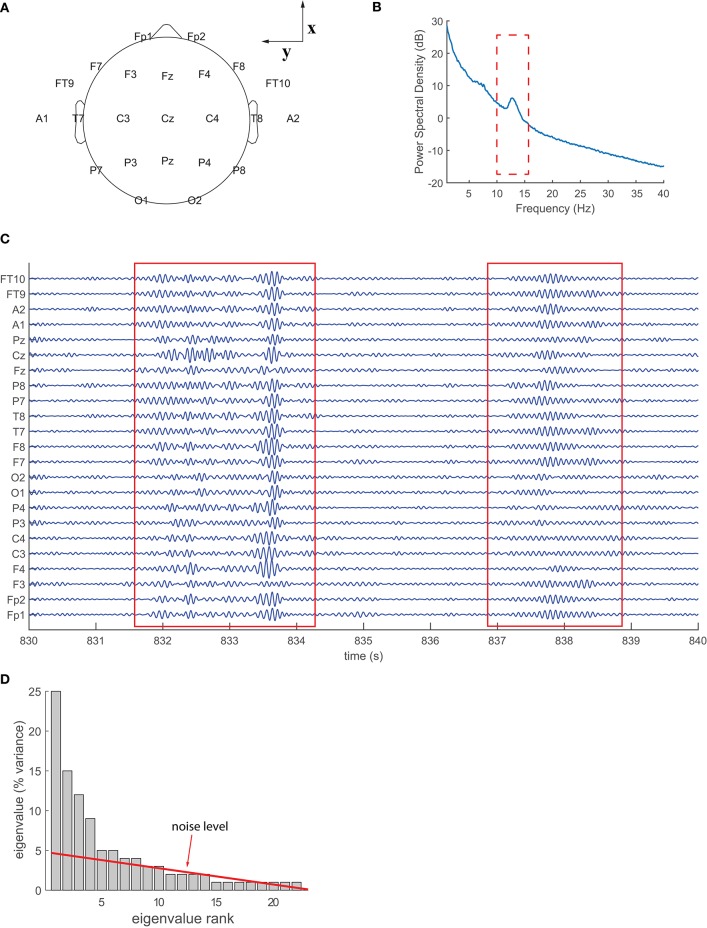
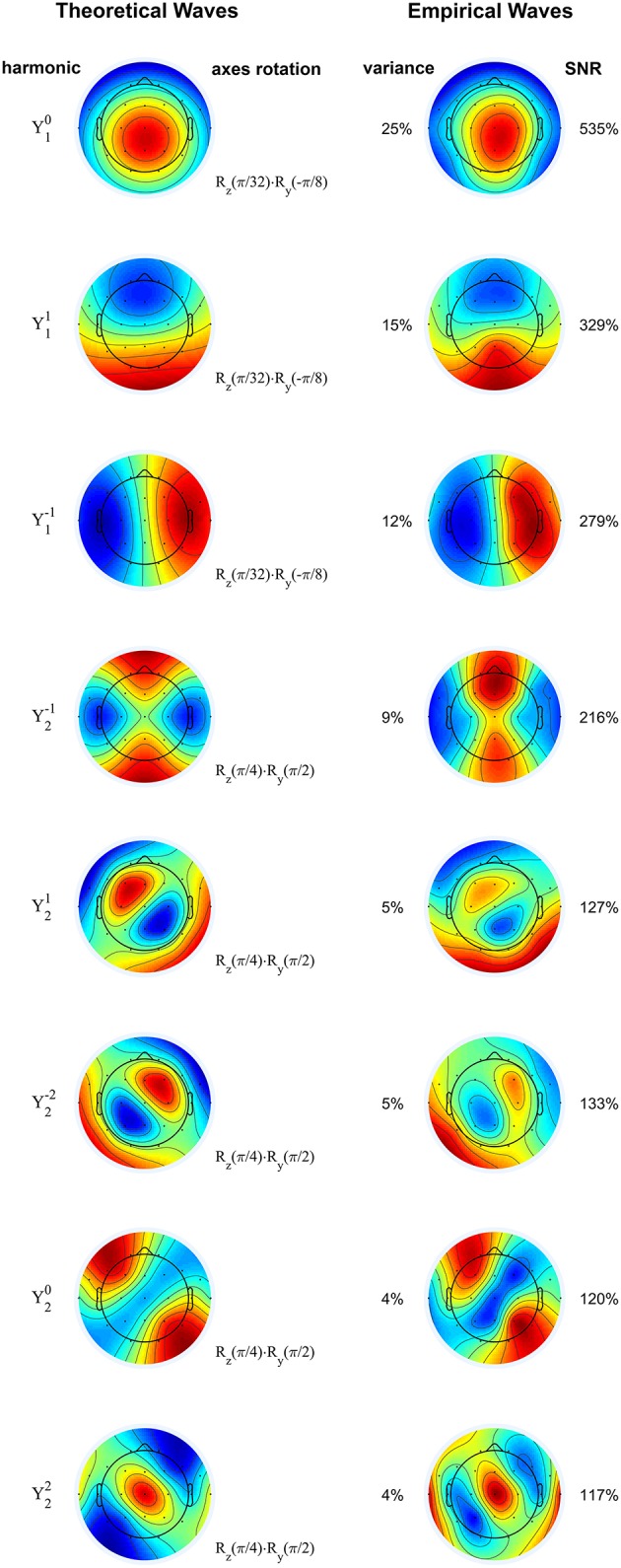
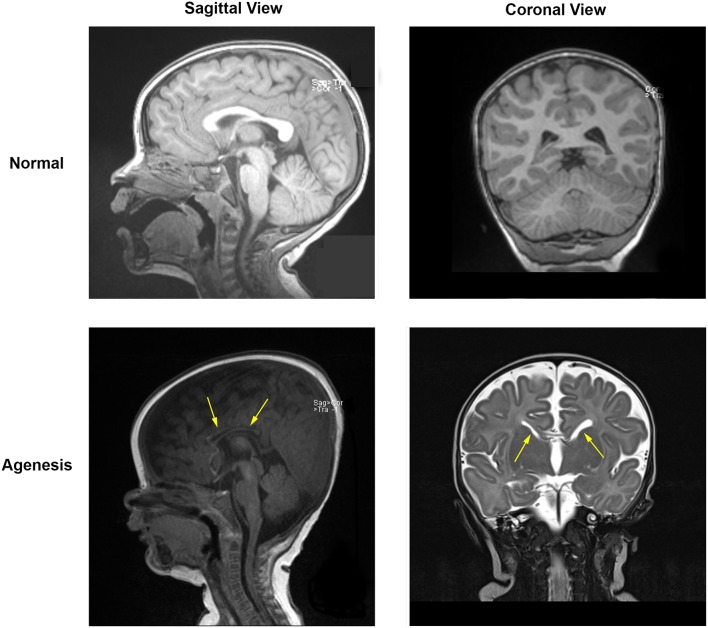
Previous work from our lab has demonstrated how the connectivity of brain circuits constrains the repertoire of activity patterns that those circuits can display. Specifically, we have shown that the principal components of spontaneous neural activity are uniquely determined by the underlying circuit connections, and that although the principal components do not uniquely resolve the circuit structure, they do reveal important features about it. Expanding upon this framework on a larger scale of neural dynamics, we have analyzed EEG data recorded with the standard 10-20 electrode system from 41 neurologically normal children and adolescents during stage 2, non-REM sleep. We show that the principal components of EEG spindles, or sigma waves (10-16 Hz), reveal non-propagating, standing waves in the form of spherical harmonics. We mathematically demonstrate that standing EEG waves exist when the spatial covariance and the Laplacian operator on the head's surface commute. This in turn implies that the covariance between two EEG channels decreases as the inverse of their relative distance; a relationship that we corroborate with empirical data. Using volume conduction theory, we then demonstrate that superficial current sources are more synchronized at larger distances, and determine the characteristic length of large-scale neural synchronization as 1.31 times the head radius, on average. Moreover, consistent with the hypothesis that EEG spindles are driven by thalamo-cortical rather than cortico-cortical loops, we also show that 8 additional patients with hypoplasia or complete agenesis of the corpus callosum, i.e., with deficient or no connectivity between cortical hemispheres, similarly exhibit standing EEG waves in the form of spherical harmonics. We conclude that spherical harmonics are a hallmark of spontaneous, large-scale synchronization of neural activity in the brain, which are associated with unconscious, light sleep. The analogy with spherical harmonics in quantum mechanics suggests that the variances (eigenvalues) of the principal components follow a Boltzmann distribution, or equivalently, that standing waves are in a sort of "thermodynamic" equilibrium during non-REM sleep. By extension, we speculate that consciousness emerges as the brain dynamics deviate from such equilibrium.
我们实验室之前的研究已经证明了大脑回路的连通性如何限制这些回路能够展现的活动模式范围。具体而言,我们已经表明,自发神经活动的主成分由潜在的回路连接唯一确定,并且虽然主成分不能唯一解析回路结构,但它们确实揭示了关于回路结构的重要特征。在更大规模的神经动力学框架下扩展这一研究,我们分析了41名神经功能正常的儿童和青少年在非快速眼动睡眠第二阶段使用标准10 - 20电极系统记录的脑电图(EEG)数据。我们发现,脑电图纺锤波或西格玛波(10 - 16赫兹)的主成分呈现出以球谐函数形式存在的非传播驻波。我们通过数学证明,当头部表面的空间协方差和拉普拉斯算子可交换时,脑电图驻波存在。这反过来意味着两个脑电图通道之间的协方差随着它们相对距离的倒数而减小;我们用实验数据证实了这种关系。利用容积传导理论,我们接着证明,浅表电流源在更大距离处更同步,并确定大规模神经同步的特征长度平均为头部半径的1.31倍。此外,与脑电图纺锤波由丘脑 - 皮质而非皮质 - 皮质环路驱动这一假设一致,我们还表明,另外8名胼胝体发育不全或完全缺失(即皮质半球之间连接不足或没有连接)的患者同样呈现出球谐函数形式的脑电图驻波。我们得出结论,球谐函数是大脑中神经活动自发大规模同步的标志,这与无意识的浅睡眠相关。与量子力学中球谐函数的类比表明,主成分的方差(特征值)遵循玻尔兹曼分布,或者等效地说,驻波在非快速眼动睡眠期间处于一种“热力学”平衡状态。由此推断,我们推测意识是在大脑动力学偏离这种平衡时出现的。