Davison Gareth W
Sport and Exercise Science Research Institute, Ulster University Belfast, UK.
Front Physiol. 2016 Jun 22;7:249. doi: 10.3389/fphys.2016.00249. eCollection 2016.
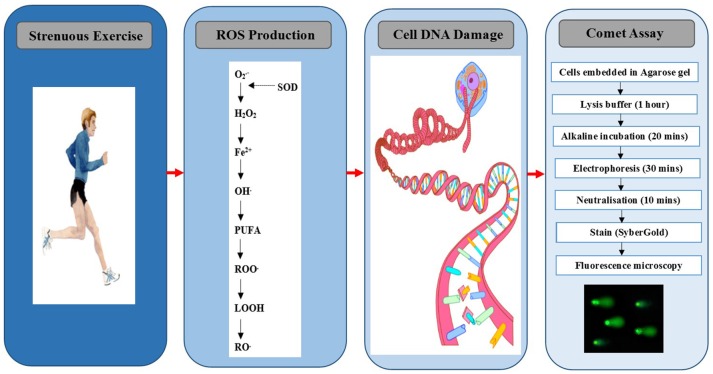
High intensity exercise can enhance the production of reactive oxygen and nitrogen free radical species, which may cause a number of perturbations to cellular integrity, including deoxyribonucleic acid (DNA) modification. In the absence of adequate DNA repair, it is theoretically possible that several biological disorders may ensue, in addition to premature aging. This striking hypothesis and supposition can only be realized in the presence of sound methodology for the quantification of DNA damage and repair. The alkaline single-cell gel electrophoresis or "comet assay" is a simple and reliable method for measuring the components of DNA stability in eukaryotic cells. The assay is commonly used in research associated with genotoxicology and in human bio-monitoring studies concerned with gene-environment interactions; but is currently less appreciated and under-utilized in the domain of exercise science. No exercise related study for example, has incorporated the comet assay combined with fluorescent in situ hybridization methodology to detect and investigate whole genome, telomeric DNA, or gene region-specific DNA damage and repair in cells. Our laboratory and others have used the comet assay in conjunction with lesion-specific endonucleases to measure DNA strand breaks and oxidized bases to confirm that high intensity exercise can damage and destabilize DNA. Thus, the primary function of this review is to highlight recent advances and innovation with the comet assay, in order to enhance our future understanding of the complex interrelationship between exercise and DNA modification in eukaryotic cells. A brief synopsis of the current literature addressing DNA stability as a function of continuous aerobic exercise is also included.
高强度运动可增强活性氧和氮自由基的产生,这可能会对细胞完整性造成多种干扰,包括脱氧核糖核酸(DNA)修饰。在缺乏足够的DNA修复的情况下,理论上除了过早衰老外,还可能引发一些生物紊乱。只有在具备用于量化DNA损伤和修复的可靠方法时,这一引人注目的假设才能实现。碱性单细胞凝胶电泳或“彗星试验”是一种测量真核细胞中DNA稳定性成分的简单可靠方法。该试验常用于与遗传毒理学相关的研究以及涉及基因-环境相互作用的人类生物监测研究;但目前在运动科学领域中却较少受到重视且未得到充分利用。例如,尚无运动相关研究将彗星试验与荧光原位杂交方法结合起来,以检测和研究细胞中的全基因组、端粒DNA或基因区域特异性DNA损伤及修复情况。我们实验室和其他机构已将彗星试验与损伤特异性核酸内切酶结合使用,以测量DNA链断裂和氧化碱基,从而证实高强度运动可损伤并破坏DNA的稳定性。因此,本综述的主要功能是突出彗星试验的最新进展和创新,以便增进我们未来对真核细胞中运动与DNA修饰之间复杂相互关系的理解。本文还简要概述了当前将DNA稳定性作为持续有氧运动函数的相关文献。