Fovet Thomas, Orlov Natasza, Dyck Miriam, Allen Paul, Mathiak Klaus, Jardri Renaud
Univ Lille, CNRS, UMR-9193, psyCHIC team & CHU Lille, Psychiatry Dpt (CURE), Fontan Hospital , Lille , France.
Department of Psychosis Studies, Institute of Psychiatry Psychology and Neuroscience, King's College London , London , UK.
Front Psychiatry. 2016 Jun 27;7:103. doi: 10.3389/fpsyt.2016.00103. eCollection 2016.
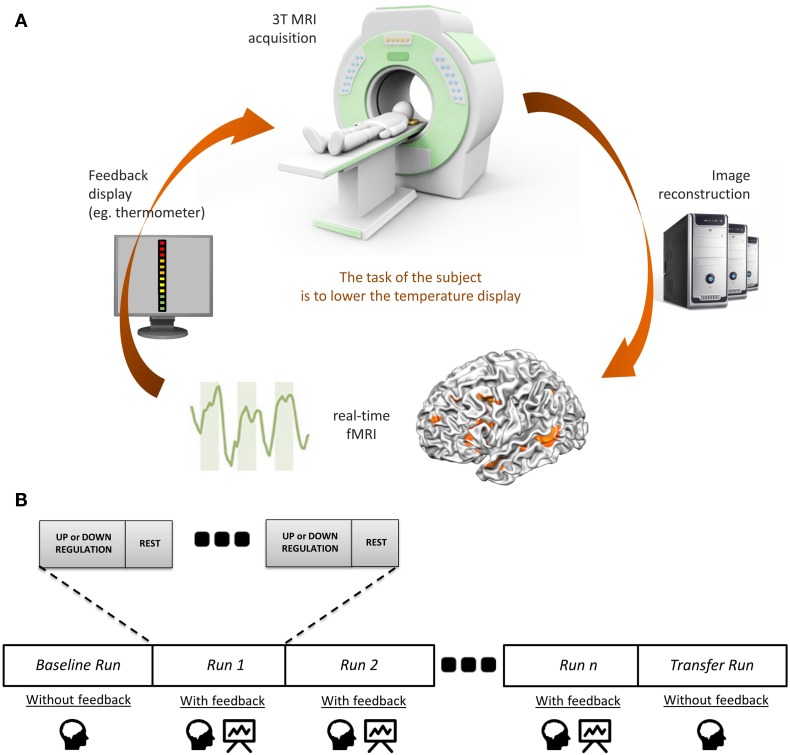
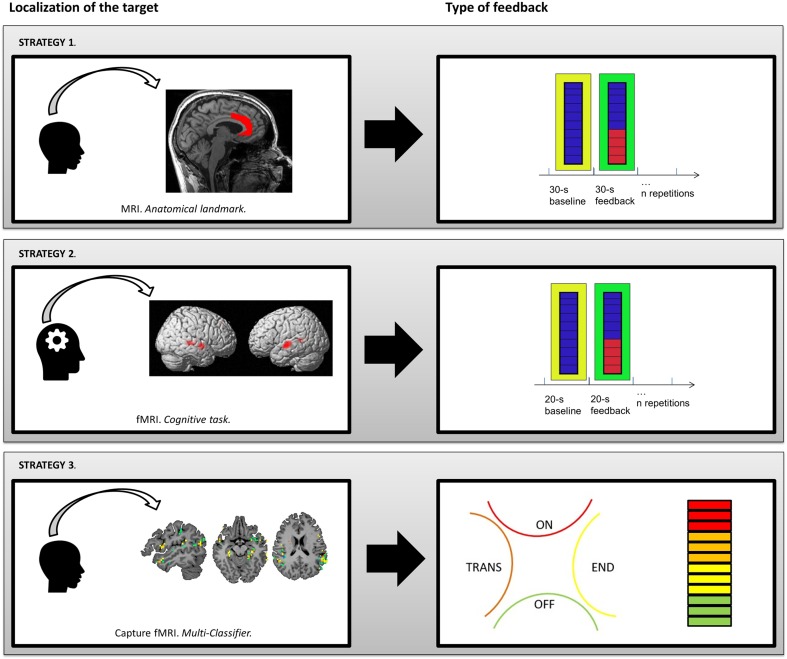
Auditory-verbal hallucinations (AVHs) are frequent and disabling symptoms, which can be refractory to conventional psychopharmacological treatment in more than 25% of the cases. Recent advances in brain imaging allow for a better understanding of the neural underpinnings of AVHs. These findings strengthened transdiagnostic neurocognitive models that characterize these frequent and disabling experiences. At the same time, technical improvements in real-time functional magnetic resonance imaging (fMRI) enabled the development of innovative and non-invasive methods with the potential to relieve psychiatric symptoms, such as fMRI-based neurofeedback (fMRI-NF). During fMRI-NF, brain activity is measured and fed back in real time to the participant in order to help subjects to progressively achieve voluntary control over their own neural activity. Precisely defining the target brain area/network(s) appears critical in fMRI-NF protocols. After reviewing the available neurocognitive models for AVHs, we elaborate on how recent findings in the field may help to develop strong a priori strategies for fMRI-NF target localization. The first approach relies on imaging-based "trait markers" (i.e., persistent traits or vulnerability markers that can also be detected in the presymptomatic and remitted phases of AVHs). The goal of such strategies is to target areas that show aberrant activations during AVHs or are known to be involved in compensatory activation (or resilience processes). Brain regions, from which the NF signal is derived, can be based on structural MRI and neurocognitive knowledge, or functional MRI information collected during specific cognitive tasks. Because hallucinations are acute and intrusive symptoms, a second strategy focuses more on "state markers." In this case, the signal of interest relies on fMRI capture of the neural networks exhibiting increased activity during AVHs occurrences, by means of multivariate pattern recognition methods. The fine-grained activity patterns concomitant to hallucinations can then be fed back to the patients for therapeutic purpose. Considering the potential cost necessary to implement fMRI-NF, proof-of-concept studies are urgently required to define the optimal strategy for application in patients with AVHs. This technique has the potential to establish a new brain imaging-guided psychotherapy for patients that do not respond to conventional treatments and take functional neuroimaging to therapeutic applications.
听幻觉(AVHs)是常见且使人衰弱的症状,超过25%的病例对传统精神药物治疗无效。脑成像技术的最新进展有助于更好地理解听幻觉的神经基础。这些发现强化了跨诊断神经认知模型,这些模型描述了这些常见且使人衰弱的体验。与此同时,实时功能磁共振成像(fMRI)技术的改进使得开发具有缓解精神症状潜力的创新型非侵入性方法成为可能,如基于fMRI的神经反馈(fMRI-NF)。在fMRI-NF过程中,测量大脑活动并实时反馈给参与者,以帮助受试者逐渐实现对自身神经活动的自主控制。在fMRI-NF方案中,精确界定目标脑区/网络似乎至关重要。在回顾了现有的听幻觉神经认知模型后,我们阐述了该领域的最新发现如何有助于制定强有力的fMRI-NF靶点定位先验策略。第一种方法依赖于基于成像的“特质标记”(即在听幻觉的症状前和缓解期也能检测到的持久特质或易感性标记)。此类策略的目标是针对在听幻觉期间显示异常激活或已知参与代偿性激活(或恢复过程)的区域。从中获取NF信号的脑区可以基于结构MRI和神经认知知识,或在特定认知任务期间收集的功能MRI信息。由于幻觉是急性且侵扰性的症状,第二种策略更多地关注“状态标记”。在这种情况下,感兴趣的信号依赖于通过多变量模式识别方法对听幻觉发作期间显示活动增加的神经网络进行fMRI捕捉。然后,可以将与幻觉相关的精细活动模式反馈给患者用于治疗目的。考虑到实施fMRI-NF所需的潜在成本,迫切需要进行概念验证研究以确定在听幻觉患者中应用的最佳策略。该技术有可能为对传统治疗无反应的患者建立一种新的脑成像引导心理治疗方法,并将功能神经成像应用于治疗。