Zhang Miaozhi, Brons Jolanda K, van Elsas Jan Dirk
Department of Microbial Ecology, Center for Ecological and Evolutionary Studies, University of Groningen Groningen, Netherlands.
Front Microbiol. 2016 Jun 21;7:909. doi: 10.3389/fmicb.2016.00909. eCollection 2016.
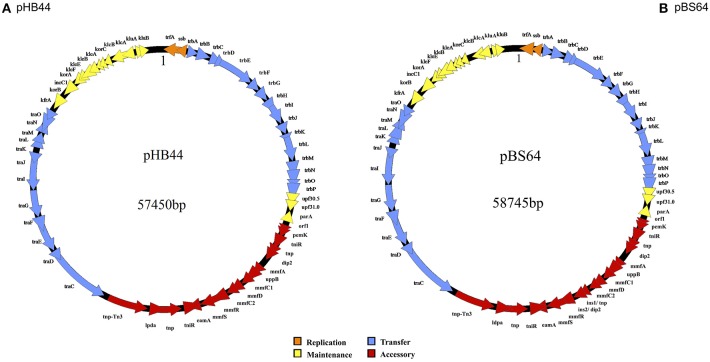
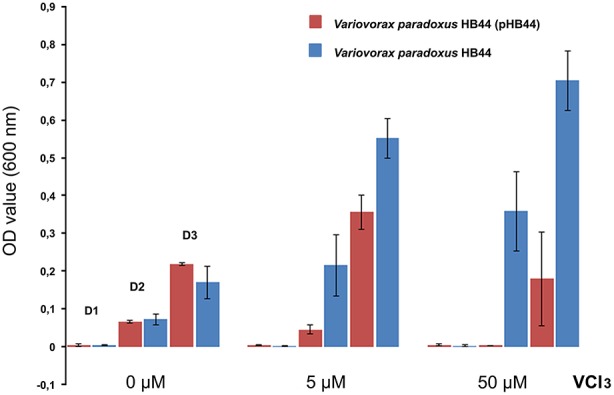
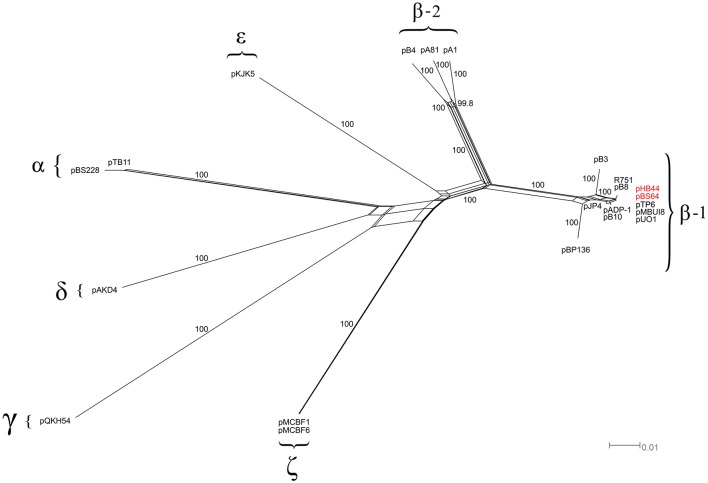
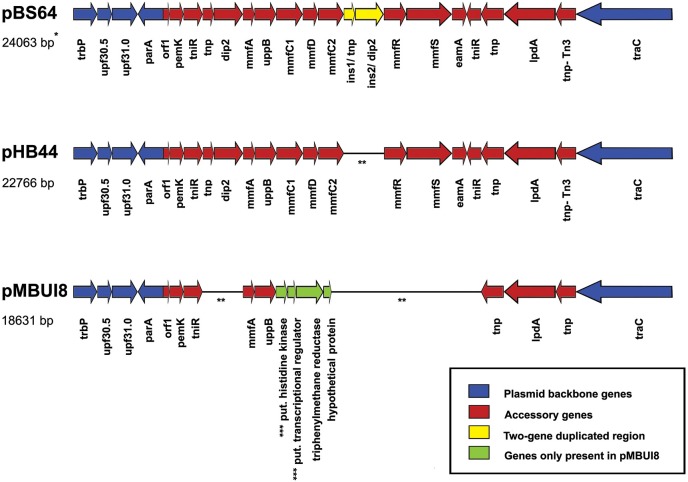
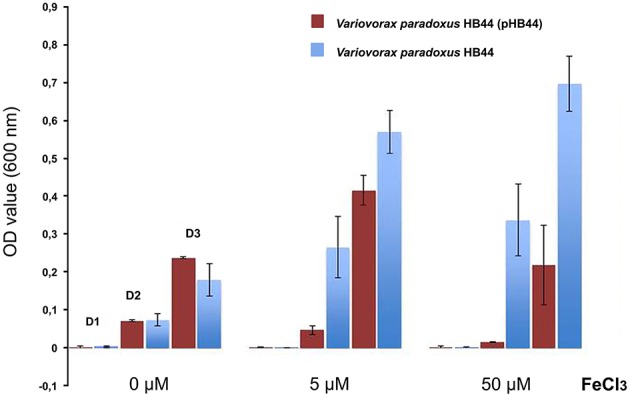
Two novel plasmids, coined pHB44 and pBS64, were recently found in Variovorax paradoxus strains HB44 and BS64 isolated from the mycosphere of Laccaria proxima, on two different sampling occasions. We here describe the full sequences of pHB44 and pBS64 and establish their evolutionary placement and ecological function. Both plasmids, unique for mycospheric V. paradoxus, were around 58 kb in size. They possessed, in a very similar fashion, three main plasmid backbone regions, which were predicted to be involved in plasmid replication, central control of maintenance, and conjugational transfer. Phylogenetic inference on the basis of seven selected and concatenated plasmid backbone genes provided solid evidence for the placement of the two plasmids in the IncP-1β1 group, with the recently isolated IncP-1β1 plasmid pMBUI8 as the closest relative. A comparative analysis of the sequences present in each of the recombinational hot spots (RHS) I to III across plasmids pHB44, pBS64, and pMBUI8 revealed the insertions found in plasmids pHB44 and pBS64 to be different from those of pMBUI8. Whereas, in the former two plasmids, RHS I and III were devoid of any major inserts, their RHS II regions contained inserts of 15,043 (pHB44) and 16,406 kb (pBS64), against about 9,3 kb for pMBUI8. Interestingly, these regions were highly similar across plasmids pHB44 and pBS64, and differed from that of pMBUI8. Closer inspection revealed the insert in the former plasmids to contain, next to transposases, an "mmf" gene cassette previously reported to encode metal "responsiveness" in the PromA plasmid pMOL98. Whereas the plasmid pHB44 RHS II contained the canonical mmf sequence, that in pBS64 contained, in addition, a "two-gene duplicated region" flanking the mmf C2 gene. In vitro experiments on the growth and survival of strains with or without plasmid pHB44 suggested this plasmid was involved in the binding and import of Fe(3+) as well as V(3+) ions into the host cells, thus yielding a growth advantage under "metal ion-limiting" conditions. In addition, pHB44 was found to confer a bacitracin resistance phenotype to its host strain HB44. The metal import and bacitracin resistance traits were tentatively attributed to specific genes present in the RHS II inserts.
最近,在两次不同的采样中,从近红绒盖牛肝菌的菌围中分离出的食酸代尔夫特菌菌株HB44和BS64中发现了两种新型质粒,分别命名为pHB44和pBS64。我们在此描述了pHB44和pBS64的完整序列,并确定了它们的进化位置和生态功能。这两种质粒是食酸代尔夫特菌菌围所特有的,大小约为58 kb。它们以非常相似的方式拥有三个主要的质粒骨干区域,预计这些区域参与质粒复制、维持的中央控制和接合转移。基于七个选定并串联的质粒骨干基因的系统发育推断为这两种质粒在IncP-1β1组中的位置提供了确凿证据,最近分离出的IncP-1β1质粒pMBUI8是其最接近的亲缘种。对质粒pHB44、pBS64和pMBUI8中每个重组热点(RHS)I至III中存在的序列进行的比较分析表明,在质粒pHB44和pBS64中发现的插入片段与pMBUI8的不同。在前两种质粒中,RHS I和III没有任何主要插入片段,而它们的RHS II区域包含15043(pHB44)和16406 kb(pBS64)的插入片段,而pMBUI8约为9.3 kb。有趣的是,这些区域在质粒pHB4和pBS64中高度相似,与pMBUI8的不同。进一步检查发现,前两种质粒中的插入片段除转座酶外,还包含一个先前报道在PromA质粒pMOL98中编码金属“反应性”的“mmf ”基因盒。虽然质粒pHB44的RHS II包含典型的mmf序列,但pBS64中的RHS II除mmf C2基因外还包含一个“双基因重复区域”。对携带或不携带质粒pHB44的菌株的生长和存活进行的体外实验表明,该质粒参与了Fe(3+)以及V(3+)离子与宿主细胞的结合和导入,从而在“金属离子限制”条件下产生生长优势。此外,发现pHB44赋予其宿主菌株HB44杆菌肽抗性表型。金属导入和杆菌肽抗性性状初步归因于RHS II插入片段中存在的特定基因。