Tian Jian-Ying, Chen Wei-Wei, Cui Jing, Wang Hao, Chao Ci, Lu Zhi-Yan, Bi Yong-Yi
Department of Health, Labor Health and Environment, School of Public Health, Wuhan University, Wuhan, Hubei 430072, P.R. China; Department of Anatomy, Basic Medical School, Ningxia Medical University, Yinchuan, Ningxia 750004, P.R. China.
Department of Health, Labor Health and Environment, School of Public Health, Wuhan University, Wuhan, Hubei 430072, P.R. China.
Exp Ther Med. 2016 Aug;12(2):683-689. doi: 10.3892/etm.2016.3415. Epub 2016 Jun 2.
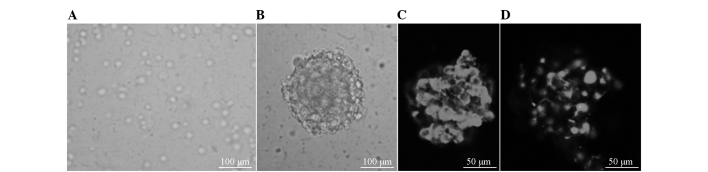
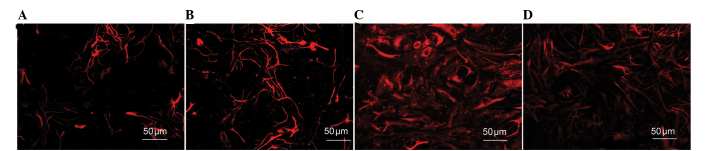
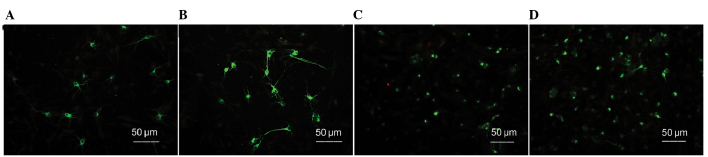
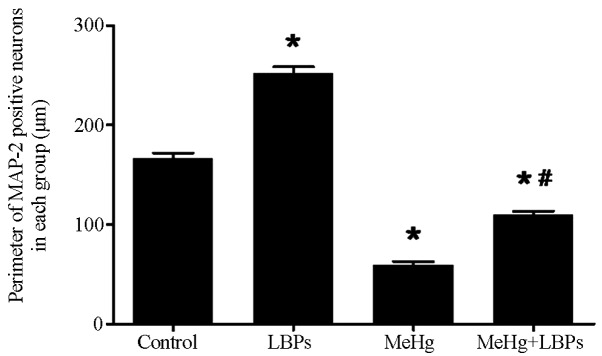
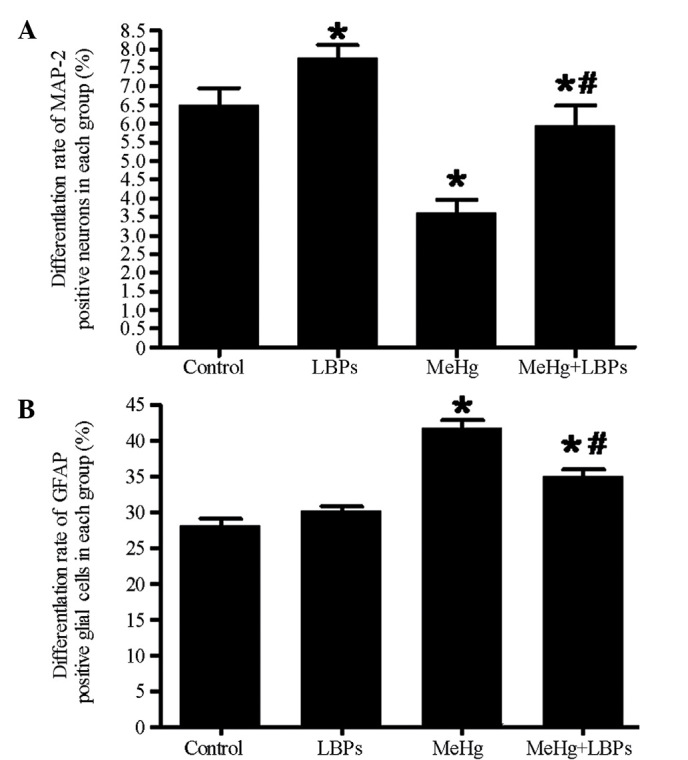
The aim of the present study was to observe the effects of a general extract of polysaccharides (LBPs) on methylmercury (MeHg)-induced damage in hippocampus neural stem cells (hNSCs). The hippocampal tissues of embryonic day 16 Sprague-Dawley rats were extracted for the isolation, purification and cloning of hNSCs. Following passage and proliferation for 10 days, the cells were allocated at random into the following groups: Control, LBPs, MeHg and MeHg + LBPs. MTT and microtubule-associated protein 2 (MAP-2)/glial fibrillary acidic protein/Hoechst immunofluorescence tests were performed to detect the differentiation and growth of hNSCs in the various groups. The differentiation rate of MeHg-treated hNSCs and the perimeter of MAP-2-positive neurons were 3.632±0.63% and 62.36±5.58 µm, respectively, significantly lower compared with the control group values of 6.500±0.81% and 166±8.16 µm (P<0.05). Furthermore, the differentiation rate and the perimeter of MAP-2-positive neurons in LBPs groups cells was 7.75±0.59% and 253.3±11.21 µm, respectively, significantly higher compared with the control group (P<0.05). The same parameters in the MeHg + LBPs group were 5.92±0.98% and 111.9±6.07 µm, respectively, significantly higher than the MeHg group (P<0.05). The astrocyte differentiation rates in the MeHg and MeHg + LBPs group were 41.19±2.14 and 34.58±1.70, respectively (P<0.05). These results suggest that LBPs may promote the generation and development of new neurons and inhibit the MeHg-induced abnormal differentiation of astrocytes. Thus, LBPs may be considered to be a potential new treatment for MeHg-induced neurotoxicity in hNSCs.
本研究的目的是观察枸杞多糖(LBPs)的总提取物对甲基汞(MeHg)诱导的海马神经干细胞(hNSCs)损伤的影响。提取胚胎第16天的Sprague-Dawley大鼠的海马组织,用于hNSCs的分离、纯化和克隆。传代并增殖10天后,将细胞随机分为以下几组:对照组、LBPs组、MeHg组和MeHg + LBPs组。进行MTT和微管相关蛋白2(MAP-2)/胶质纤维酸性蛋白/Hoechst免疫荧光试验,以检测各组hNSCs的分化和生长情况。MeHg处理的hNSCs的分化率和MAP-2阳性神经元的周长分别为3.632±0.63%和62.36±5.58 µm,与对照组的6.500±0.81%和166±8.16 µm相比,显著降低(P<0.05)。此外,LBPs组细胞中MAP-2阳性神经元的分化率和周长分别为7.75±0.59%和253.3±11.21 µm,与对照组相比显著更高(P<0.05)。MeHg + LBPs组的相同参数分别为5.92±0.98%和111.9±6.07 µm,显著高于MeHg组(P<0.05)。MeHg组和MeHg + LBPs组的星形胶质细胞分化率分别为41.19±2.14和34.58±1.70(P<0.05)。这些结果表明,LBPs可能促进新神经元的生成和发育,并抑制MeHg诱导的星形胶质细胞异常分化。因此,LBPs可被认为是治疗MeHg诱导的hNSCs神经毒性的一种潜在新疗法。