Jiang Shulong, Gao Yebo, Hou Wei, Liu Rui, Qi Xin, Xu Xia, Li Jie, Bao Yanju, Zheng Honggang, Hua Baojin
Department of Oncology, Guang'anmen Hospital, China Academy of Chinese Medical Sciences, Beijing 100053, P.R. China; Department of Oncology, Jining First People's Hospital, Jining, Shandong 272111, P.R. China.
Department of Oncology, Guang'anmen Hospital, China Academy of Chinese Medical Sciences, Beijing 100053, P.R. China; Beijing University of Chinese Medicine, Beijing 100029, P.R. China.
Oncol Lett. 2016 Aug;12(2):1380-1386. doi: 10.3892/ol.2016.4768. Epub 2016 Jun 23.
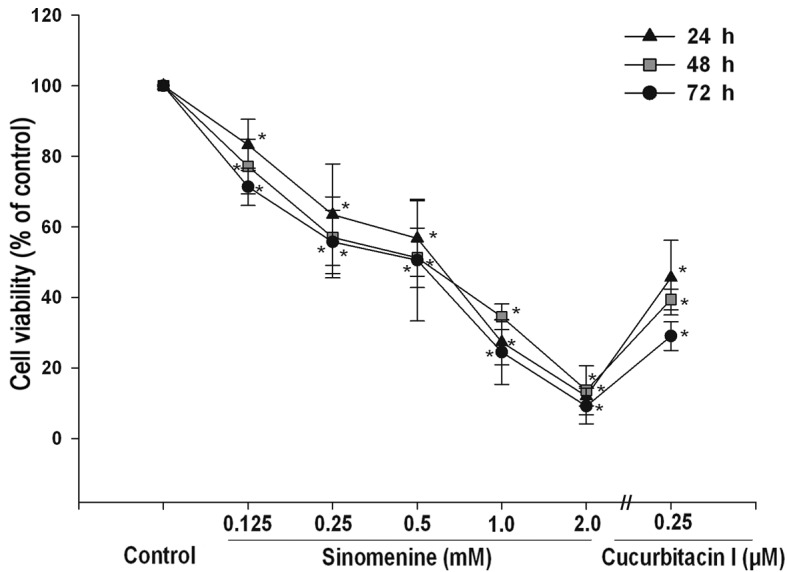
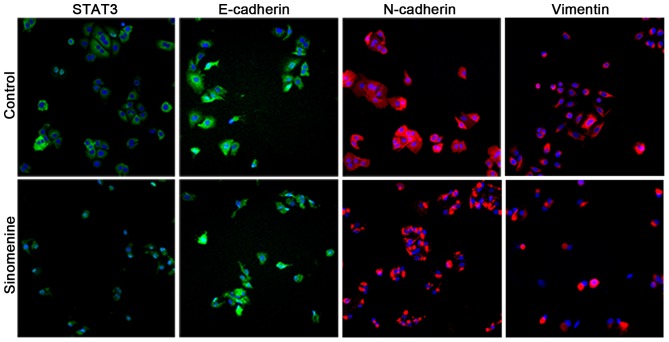
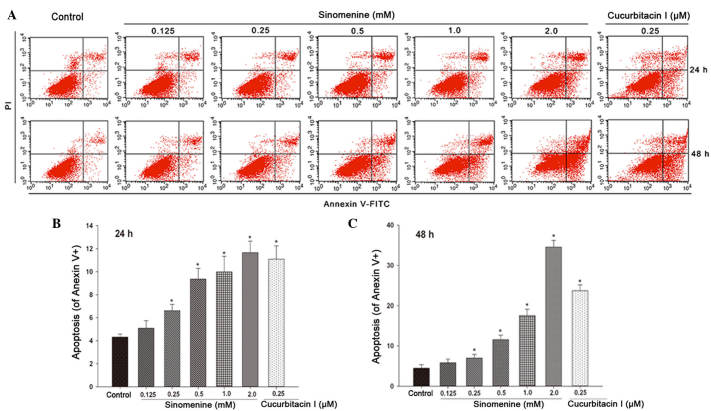
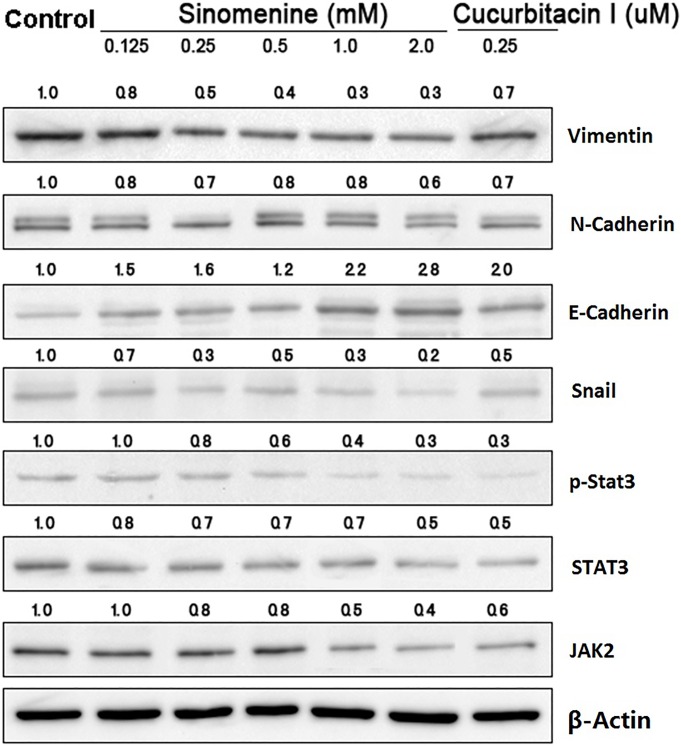
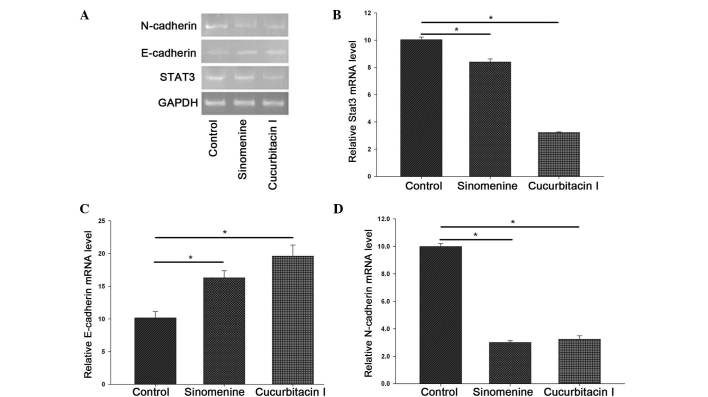
Increasing evidence suggests that the failure of lung cancer treatment may occur as a result of tumor invasion and metastasis. Signal transducer and activator of transcription 3 (STAT3), an epithelial-mesenchymal transition-inducing transcription factor, is a key signaling molecule involved in the proliferation, apoptosis, invasion and metastasis of tumor cells. Sinomenine is an alkaloid compound with an antineoplastic potential against a variety of cancer cells. The aim of the present study was to assess the antitumor mechanisms of sinomenine in the A549 human lung cancer cell line. The results demonstrated that sinomenine manifested dose-dependent cytotoxicity and induced apoptosis in A549 cells. The protein expression of Janus kinase 2, STAT3, phosphorylated-STAT3, Snail, N-cadherin and vimentin decreased in sinomenine-treated cells, while E-cadherin protein expression increased. The regulation of STAT3, N-cadherin and E-cadherin by sinomenine was further confirmed by reverse transcription-quantitative polymerase chain reaction and immunofluorescent staining. It was demonstrated that sinomenine exerts inhibitory effects on A549 human lung cancer cell invasion, possibly through the inhibition of STAT3 signaling. These results provide a novel insight into the role of sinomenine in the treatment of non-small cell lung cancer.
越来越多的证据表明,肺癌治疗失败可能是肿瘤侵袭和转移所致。信号转导子和转录激活子3(STAT3)是一种诱导上皮-间质转化的转录因子,是参与肿瘤细胞增殖、凋亡、侵袭和转移的关键信号分子。青藤碱是一种对多种癌细胞具有抗肿瘤潜力的生物碱化合物。本研究的目的是评估青藤碱在A549人肺癌细胞系中的抗肿瘤机制。结果表明,青藤碱对A549细胞表现出剂量依赖性细胞毒性并诱导其凋亡。在经青藤碱处理的细胞中,Janus激酶2、STAT3、磷酸化STAT3、Snail、N-钙黏蛋白和波形蛋白的蛋白表达降低,而E-钙黏蛋白的蛋白表达增加。通过逆转录-定量聚合酶链反应和免疫荧光染色进一步证实了青藤碱对STAT3、N-钙黏蛋白和E-钙黏蛋白的调控作用。结果表明,青藤碱可能通过抑制STAT3信号传导对A549人肺癌细胞侵袭发挥抑制作用。这些结果为青藤碱在非小细胞肺癌治疗中的作用提供了新的见解。