Maletzki Claudia, Beyrich Franziska, Hühns Maja, Klar Ernst, Linnebacher Michael
Molecular Oncology and Immunotherapy, Department of General Surgery, University of Rostock, 18057 Rostock, Germany.
Institute of Pathology, University of Rostock, 18057 Rostock, Germany.
Oncotarget. 2016 Aug 16;7(33):53583-53598. doi: 10.18632/oncotarget.10677.
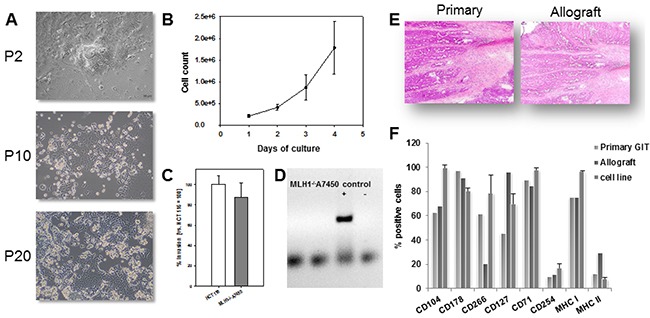
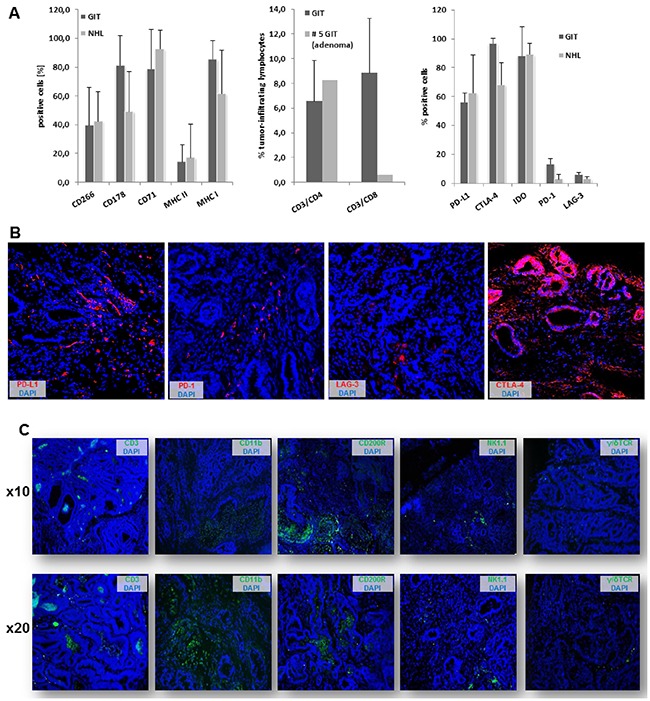
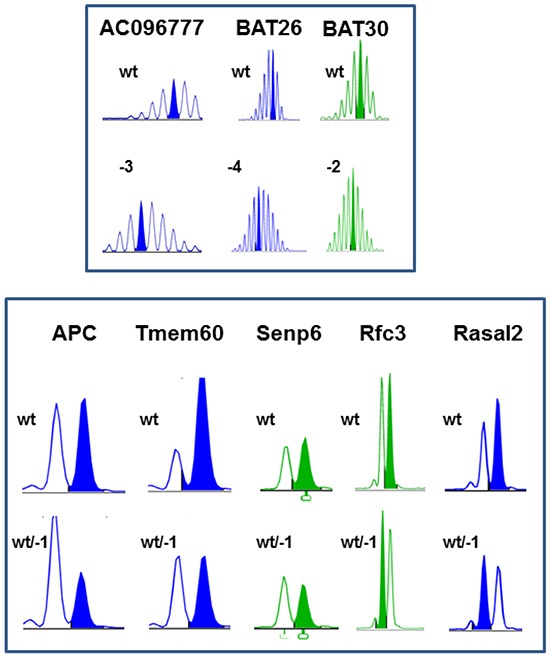
Mice lines homozygous negative for one of the four DNA mismatch repair (MMR) genes (MLH1, MSH2, PMS2, MSH6) were generated as models for MMR deficient (MMR-D) diseases. Clinically, hereditary forms of MMR-D include Lynch syndrome (characterized by a germline MMR gene defect) and constitutional MMR-D, the biallelic form. MMR-D knockout mice may be representative for both diseases. Here, we aimed at characterizing the MLH1-/- model focusing on tumor-immune microenvironment and identification of coding microsatellite mutations in lymphomas and gastrointestinal tumors (GIT).All tumors showed microsatellite instability (MSI) in non-coding mononucleotide markers. Mutational profiling of 26 coding loci in MSI+ GIT and lymphomas revealed instability in half of the microsatellites, two of them (Rfc3 and Rasal2) shared between both entities. MLH1-/- tumors of both entities displayed a similar phenotype (high CD71, FasL, PD-L1 and CTLA-4 expression). Additional immunofluorescence verified the tumors' natural immunosuppressive character (marked CD11b/CD200R infiltration). Vice versa, CD3+ T cells as well as immune checkpoints molecules were detectable, indicative for an active immune microenvironment. For functional analysis, a permanent cell line from an MLH1-/- GIT was established. The newly developed MLH1-/- A7450 cells exhibit stable in vitro growth, strong invasive potential and heterogeneous drug response. Moreover, four additional MSI target genes (Nktr1, C8a, Taf1b, and Lig4) not recognized in the primary were identified in this cell line.Summing up, molecular and immunological mechanisms of MLH1-/- driven carcinogenesis correlate well with clinical features of MMR-D. MLH1-/- knockout mice combine characteristics of Lynch syndrome and constitutional MMR-D, making them suitable models for preclinical research aiming at MMR-D related diseases.
构建了四个DNA错配修复(MMR)基因(MLH1、MSH2、PMS2、MSH6)中某一个基因纯合阴性的小鼠品系,作为错配修复缺陷(MMR-D)疾病的模型。临床上,MMR-D的遗传形式包括林奇综合征(以生殖系MMR基因缺陷为特征)和双等位基因形式的体质性MMR-D。MMR-D基因敲除小鼠可能代表这两种疾病。在此,我们旨在对MLH1-/-模型进行表征,重点关注肿瘤免疫微环境以及淋巴瘤和胃肠道肿瘤(GIT)中编码微卫星突变的鉴定。所有肿瘤在非编码单核苷酸标记中均表现出微卫星不稳定性(MSI)。对MSI+GIT和淋巴瘤中26个编码位点的突变分析显示,一半的微卫星存在不稳定性,其中两个(Rfc3和Rasal2)在两个实体中共有。两个实体的MLH1-/-肿瘤表现出相似的表型(高CD71、FasL、PD-L1和CTLA-4表达)。额外的免疫荧光证实了肿瘤的天然免疫抑制特性(显著的CD11b/CD200R浸润)。反之,可检测到CD3+T细胞以及免疫检查点分子,表明存在活跃的免疫微环境。为了进行功能分析,建立了来自MLH1-/- GIT的永久细胞系。新开发的MLH1-/- A7450细胞在体外生长稳定,具有很强的侵袭潜力和异质性药物反应。此外,在该细胞系中还鉴定出另外四个在原代细胞中未被识别的MSI靶基因(Nktr1、C8a、Taf1b和Lig4)。总之,MLH1-/-驱动的致癌作用的分子和免疫机制与MMR-D的临床特征密切相关。MLH1-/-基因敲除小鼠兼具林奇综合征和体质性MMR-D的特征,使其成为针对MMR-D相关疾病的临床前研究的合适模型。