Department of Medicine Clinic III - Hematology, Oncology, Palliative Medicine, Rostock University Medical Center, Ernst-Heydemann-Str. 6, 18057, Rostock, Germany.
Department of Internal Medicine B, Cardiology, University Medicine Greifswald, Greifswald, Germany.
Cancer Immunol Immunother. 2021 Dec;70(12):3405-3419. doi: 10.1007/s00262-021-02933-4. Epub 2021 Apr 18.
Mlh1-knock-out-driven mismatch-repair-deficient (dMMR) tumors can be targeted immunologically. By applying therapeutic tumor vaccination, tumor growth is delayed but escape mechanisms evolve, including upregulation of immune-checkpoint molecules (LAG-3, PD-L1). To counteract immune escape, we investigated the therapeutic activity of a combined tumor vaccine-immune-checkpoint inhibitor therapy using α-PD-L1.
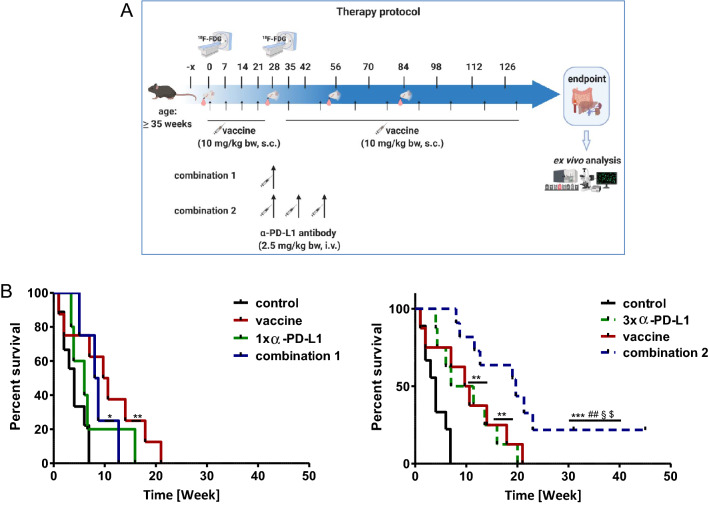
In this trial, Mlh1-knock-out mice with established gastrointestinal tumors received single or thrice injections of α-PD-L1 monoclonal antibody clone 6E11 (2.5 mg/kg bw, q2w, i.v.) either alone or in combination with the vaccine. Longitudinal flow cytometry and PET/CT imaging studies were followed by ex vivo functional immunological and gene expression assays.
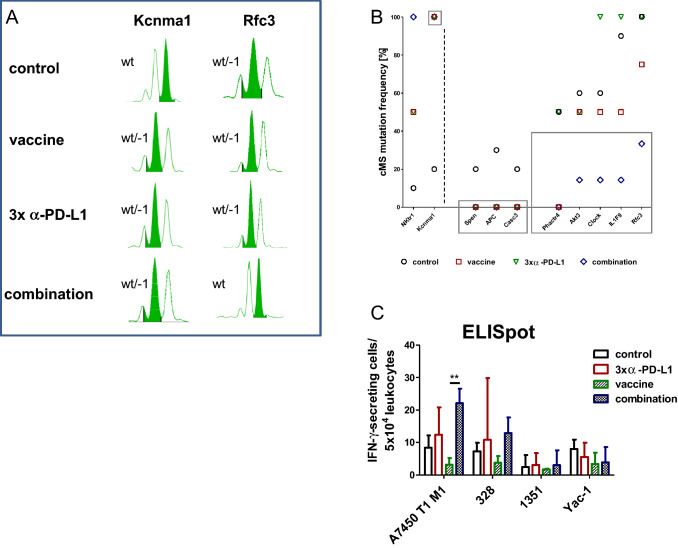
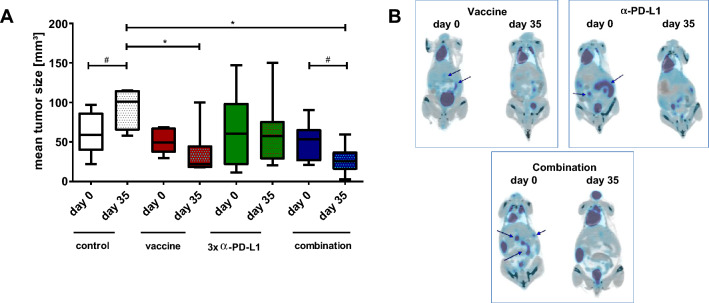
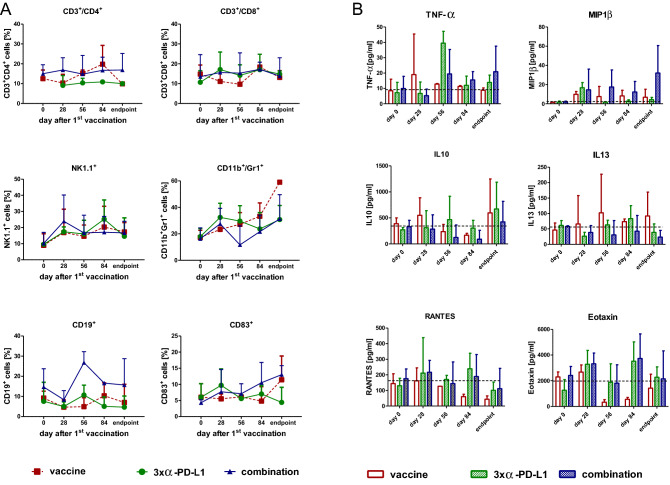
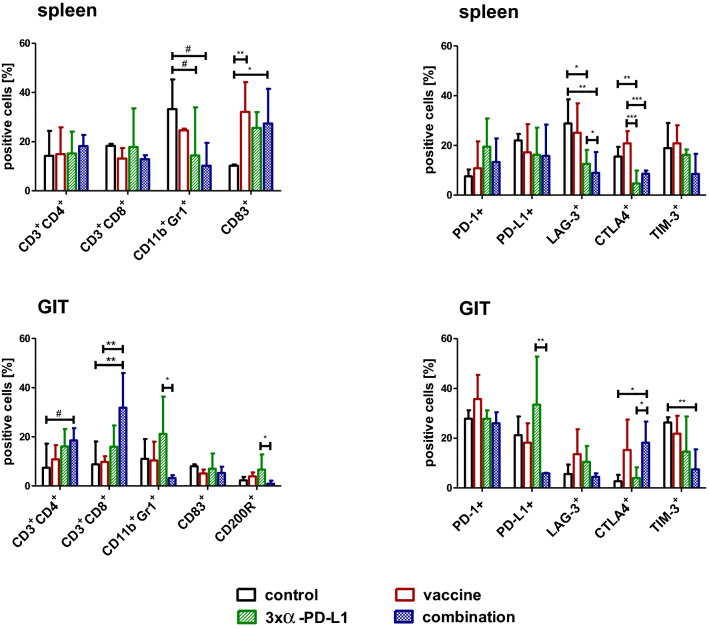
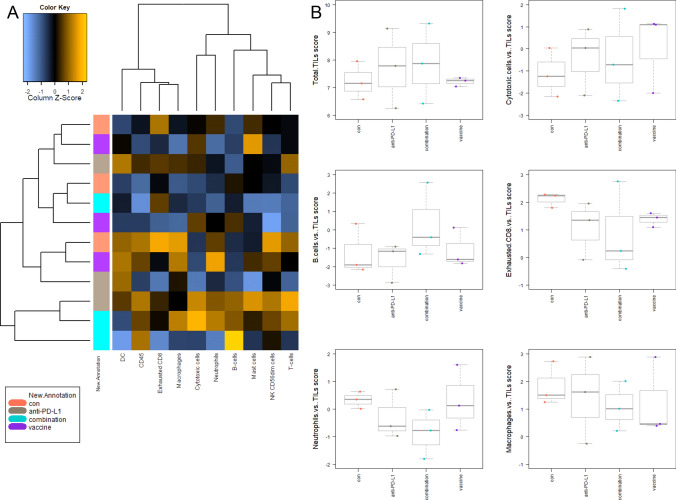
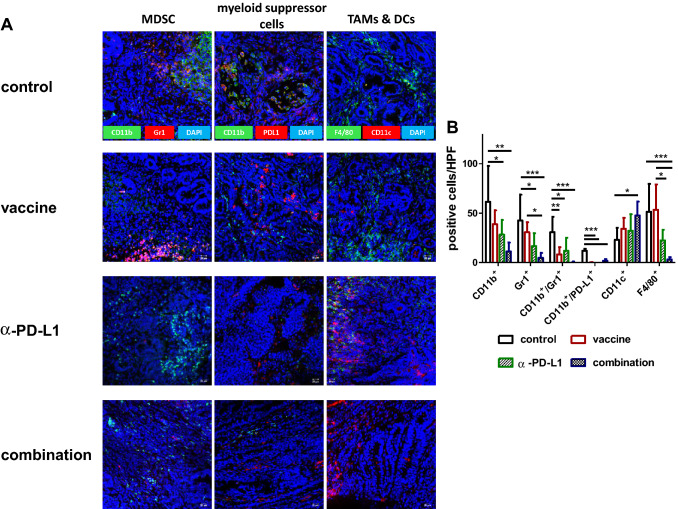
6E11 monotherapy slightly increased median overall survival (mOS: 6.0 weeks vs. control 4.0 weeks). Increasing the number of injections (n = 3) improved therapy outcome (mOS: 9.2 weeks) and was significantly boosted by combining 6E11 with the vaccine (mOS: 19.4 weeks vs. 10.2 weeks vaccine monotherapy). Accompanying PET/CT imaging confirmed treatment-induced tumor growth control, with the strongest inhibition in the combination group. Three mice (30%) achieved a complete remission and showed long-term survival. Decreased levels of circulating splenic and intratumoral myeloid-derived suppressor cells (MDSC) and decreased numbers of immune-checkpoint-expressing splenic T cells (LAG-3, CTLA-4) accompanied therapeutic effects. Gene expression and protein analysis of residual tumors revealed downregulation of PI3K/Akt/Wnt-and TGF-signaling, leading to T cell infiltration, reduced numbers of macrophages, neutrophils and MDSC.
By successful uncoupling of the PD-1/PD-L1 axis, we provide further evidence for the safe and successful application of immunotherapies to combat dMMR-driven malignancies that warrants further investigation.
Mlh1 敲除驱动的错配修复缺陷(dMMR)肿瘤可以进行免疫靶向治疗。通过应用治疗性肿瘤疫苗接种,肿瘤生长会被延迟,但会出现逃逸机制,包括免疫检查点分子(LAG-3、PD-L1)的上调。为了对抗免疫逃逸,我们研究了使用α-PD-L1 的联合肿瘤疫苗-免疫检查点抑制剂治疗的治疗活性。
在这项试验中,患有已建立的胃肠道肿瘤的 Mlh1 敲除小鼠接受了单次或三次注射α-PD-L1 单克隆抗体克隆 6E11(2.5mg/kg bw,q2w,iv),单独或与疫苗联合使用。进行了纵向流式细胞术和 PET/CT 成像研究,随后进行了体外功能免疫和基因表达分析。
6E11 单药治疗仅略微增加了中位总生存期(mOS:6.0 周比对照 4.0 周)。增加注射次数(n=3)改善了治疗效果(mOS:9.2 周),并通过将 6E11 与疫苗联合使用显著增强(mOS:19.4 周比疫苗单药治疗 10.2 周)。伴随的 PET/CT 成像证实了治疗诱导的肿瘤生长控制,联合组的抑制作用最强。三只小鼠(30%)达到完全缓解并表现出长期生存。循环脾脏和肿瘤内髓源性抑制细胞(MDSC)水平降低,表达免疫检查点的脾脏 T 细胞(LAG-3、CTLA-4)数量减少,伴随着治疗效果。残留肿瘤的基因表达和蛋白分析显示,PI3K/Akt/Wnt 和 TGF 信号通路下调,导致 T 细胞浸润,巨噬细胞、中性粒细胞和 MDSC 数量减少。
通过成功地解开 PD-1/PD-L1 轴,我们为进一步研究安全有效地应用免疫疗法来对抗 dMMR 驱动的恶性肿瘤提供了进一步的证据。