Department of Forestry and Landscape Architecture, Anhui Agricultural University, Hefei 230036, P. R. China.
Faculty of Natural Management, Lakehead University, 955 Oliver Road, Thunder Bay, Ontario P7B 5E1, Canada.
Sci Rep. 2016 Jul 25;6:30087. doi: 10.1038/srep30087.
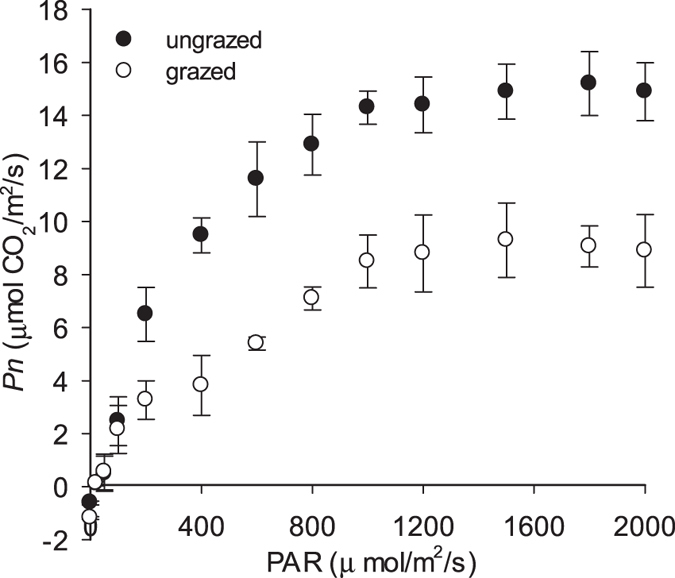
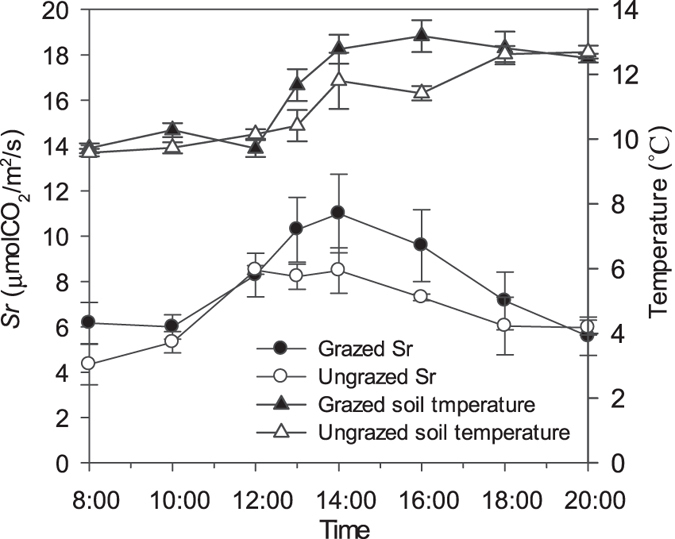
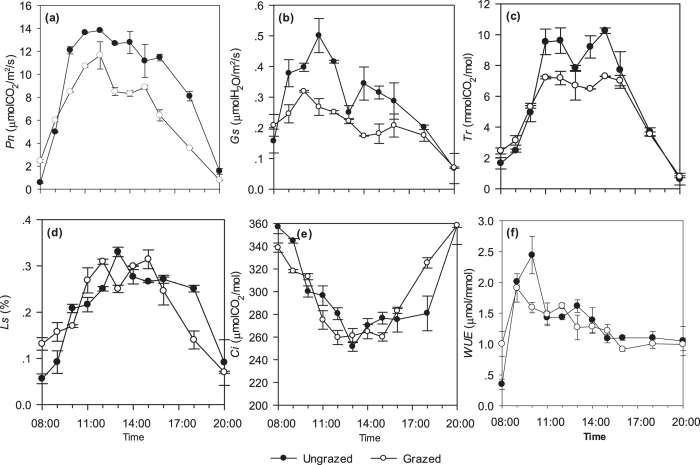
Rangelands play a critical role in the global carbon cycle. However, the eco-physiological mechanisms associated with the effects of grazing on leaf photosynthesis and soil respiration remain poorly understood. To examine the impacts of grazing on leaf photosynthesis and soil respiration, we measured the photosynthetic parameters of the dominant species (Trifolium repens) and the soil respiration in grazed and ungrazed rangelands in the Tianshan Mountains of China. We found that grazing reduced the daily maximum net photosynthetic rate and soil respiration rates by 35% and 15%, respectively. The photosynthetic quantum yield, dark respiratory rate, and water use efficiency of T. repens leaves were reduced in grazed plots by 33.3%, 69.2%, and 21.5%, respectively. Our results demonstrated that grazing reduced carbon assimilation while increasing soil respiration within the rangelands in the Tianshan Mountains.
草原在全球碳循环中起着至关重要的作用。然而,有关放牧对叶片光合作用和土壤呼吸影响的生态生理学机制仍知之甚少。为了研究放牧对叶片光合作用和土壤呼吸的影响,我们在中国天山的放牧和未放牧草原上测量了优势物种(三叶草)的光合作用参数和土壤呼吸。我们发现,放牧分别降低了每日最大净光合速率和土壤呼吸速率 35%和 15%。放牧样地三叶草叶片的光合量子产量、暗呼吸速率和水分利用效率分别降低了 33.3%、69.2%和 21.5%。我们的研究结果表明,放牧降低了天山草原的碳同化量,同时增加了土壤呼吸。