Dulamea A, Solomon E
"Carol Davila" University of Medicine and Pharmacy, Bucharest, Romania; Department of Neurology, Fundeni Clinical Institute, Bucharest, Romania.
Department of Neurology, Fundeni Clinical Institute, Bucharest, Romania.
J Med Life. 2016 Apr-Jun;9(2):211-5.
Sporadic Creutzfeldt-Jakob disease (CJD) is a human prion disease, rapidly progressive and fatal, characterized by spongiform encephalopathy. The characteristic triad of signs - rapidly progressive dementia, myoclonus and periodic sharp wave complexes (PSWC) on electroencephalography (EEG) - usually appear in the late stages of the disease. The clinical diagnosis of CJD ante-mortem involves the exclusion of the rapidly progressive non-prionic dementias, the definitive diagnosis requiring brain tissue confirmation. Authors evaluated the methods of clinical diagnosis for sporadic CJD.
This study retrospectively reviewed the medical records of patients diagnosed with probable sporadic CJD, based on brain magnetic resonance imaging (MRI), EEG, cerebrospinal fluid (CSF) analysis and extensive laboratory work-up.
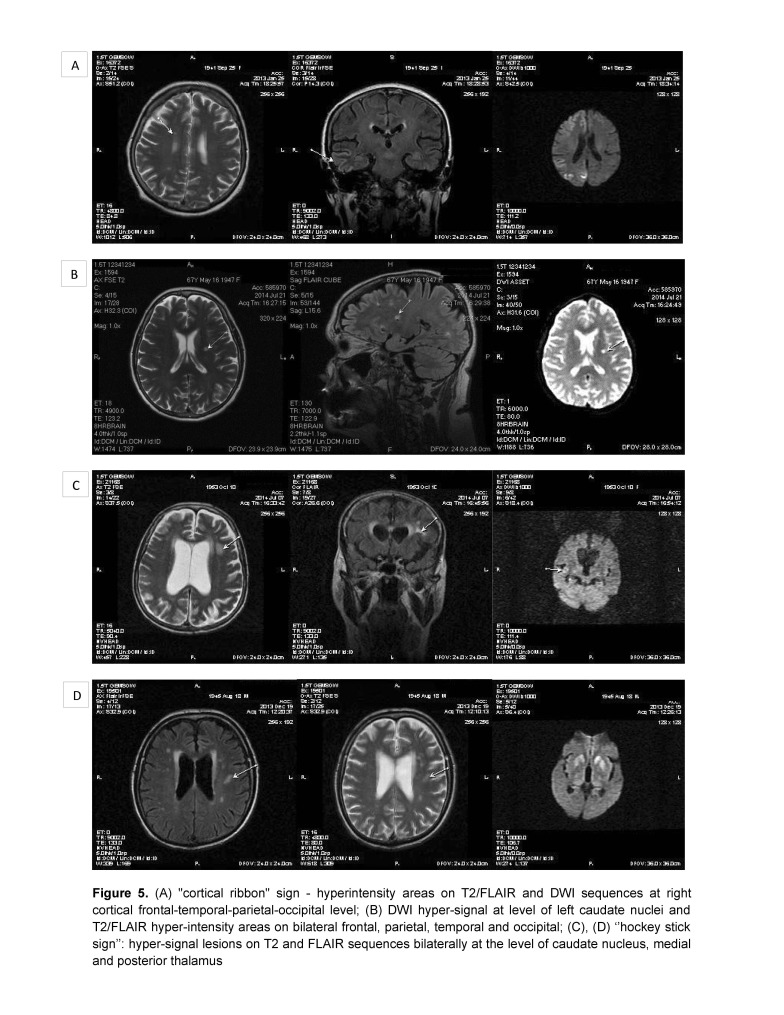
Four patients with a mean age of 67 years were included in our study. The mean duration from diagnosis until death was of 3.2 weeks. The clinical features of the disease at onset were atypical. In the final stage of the disease, all patients presented rapidly progressive dementia and myoclonus. High levels of 14-3-3 protein and tau protein and normal levels of amyloid β1-42 were found at CSF analysis, in all patients. PSWC on EEG were present in 3 out of 4 patients at different moments of the disease. MRI showed hyperintense lesions in brain cortex, caudate nucleus, and putamen on T2, FLAIR, and DWI.
CJD may present various clinical features and, since brain biopsy is usually difficult to perform, a combination of biomarkers is useful in order to establish the diagnosis in the early phase of the disease.
散发性克雅氏病(CJD)是一种人类朊病毒病,病情迅速进展且致命,以海绵状脑病为特征。其典型的三联征——迅速进展的痴呆、肌阵挛以及脑电图(EEG)上的周期性锐波复合波(PSWC)——通常出现在疾病晚期。CJD的生前临床诊断需要排除迅速进展的非朊病毒痴呆,确诊需要脑组织证实。作者评估了散发性CJD的临床诊断方法。
本研究回顾性分析了基于脑磁共振成像(MRI)、EEG、脑脊液(CSF)分析及广泛实验室检查确诊为可能散发性CJD患者的病历。
我们的研究纳入了4名平均年龄67岁的患者。从诊断到死亡的平均时长为3.2周。疾病起病时的临床特征不典型。在疾病末期,所有患者均出现迅速进展的痴呆和肌阵挛。所有患者的CSF分析均发现14-3-3蛋白和tau蛋白水平升高,而淀粉样β1-42蛋白水平正常。4名患者中有3名在疾病不同阶段的EEG上出现PSWC。MRI在T2、FLAIR和DWI序列上显示大脑皮质、尾状核和壳核有高信号病变。
CJD可能呈现多种临床特征,且由于脑活检通常难以实施,生物标志物的联合应用有助于在疾病早期确立诊断。