Mitchell Center for Alzheimer's Disease and Related Brain Disorders, Department of Neurology, The University of Texas Medical school at Houston, 6431 Fannin St, Houston, TX 77030, USA.
Trends Biochem Sci. 2011 Mar;36(3):151-8. doi: 10.1016/j.tibs.2010.11.001. Epub 2010 Dec 3.
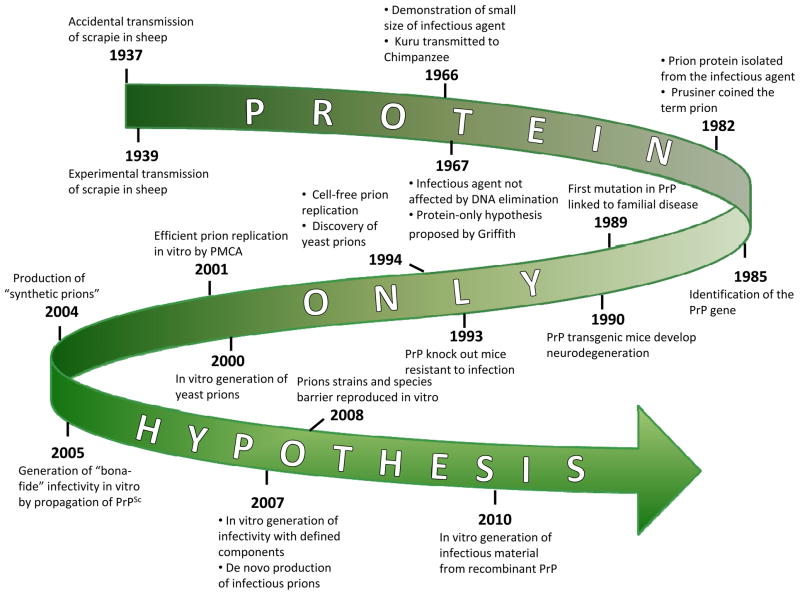
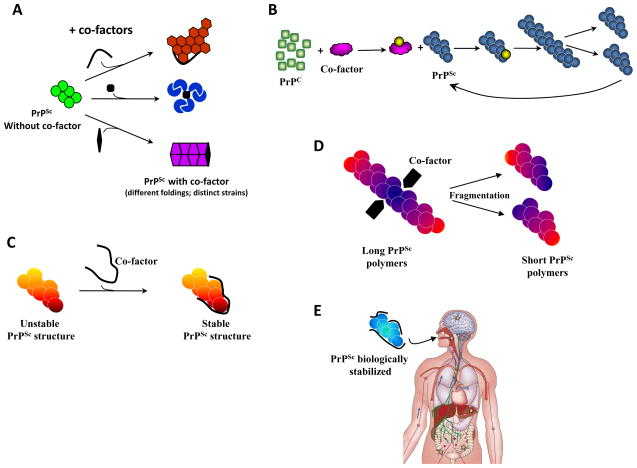
Forty-three years have passed since it was first proposed that a protein could be the sole component of the infectious agent responsible for the enigmatic prion diseases. Many discoveries have strongly supported the prion hypothesis, but only recently has this once heretical hypothesis been widely accepted by the scientific community. In the past 3 years, researchers have achieved the 'Holy Grail' demonstration that infectious material can be generated in vitro using completely defined components. These breakthroughs have proven that a misfolded protein is the active component of the infectious agent, and that propagation of the disease and its unique features depend on the self-replication of the infectious folding of the prion protein. In spite of these important discoveries, it remains unclear whether another molecule besides the misfolded prion protein might be an essential element of the infectious agent. Future research promises to reveal many more intriguing features about the rogue prions.
自首次提出蛋白质可能是导致神秘朊病毒疾病的传染性病原体的唯一成分以来,已经过去了 43 年。许多发现强烈支持朊病毒假说,但直到最近,这一曾经异端邪说的假说才被科学界广泛接受。在过去的 3 年中,研究人员已经实现了使用完全定义的成分在体外产生传染性物质的“圣杯”演示。这些突破证明了错误折叠的蛋白质是传染性病原体的活性成分,并且疾病的传播及其独特特征取决于朊病毒蛋白的传染性折叠的自我复制。尽管有这些重要的发现,但仍不清楚除了错误折叠的朊病毒蛋白之外,是否还有其他分子可能是传染性病原体的必需元素。未来的研究有望揭示更多关于流氓朊病毒的有趣特征。