Gilardini Luisa, Redaelli Gabriella, Croci Marina, Conti Antonio, Pasqualinotto Lucia, Invitti Cecilia
Department of Medical Sciences and Rehabilitation, IRCCS, Istituto Auxologico Italiano, Milan, Italy.
Obes Facts. 2016;9(4):251-8. doi: 10.1159/000445504. Epub 2016 Jul 26.
To assess the effect of a lifestyle intervention in lowering/normalizing blood pressure (BP) levels in hypertensive (controlled or not) obese patients.
In this prospective observational study, 490 obese hypertensive patients, 389 controlled (BP < 140/90 mm Hg; CH) and 101 uncontrolled (BP ≥ 140/90 mm Hg; UH) attended a 3-month lifestyle intervention. Before and after the intervention we assessed weight, waist circumference, fat mass, BP, metabolic and renal variables, and physical activity. A multivariate regression model was used to determine the predictors of BP changes.
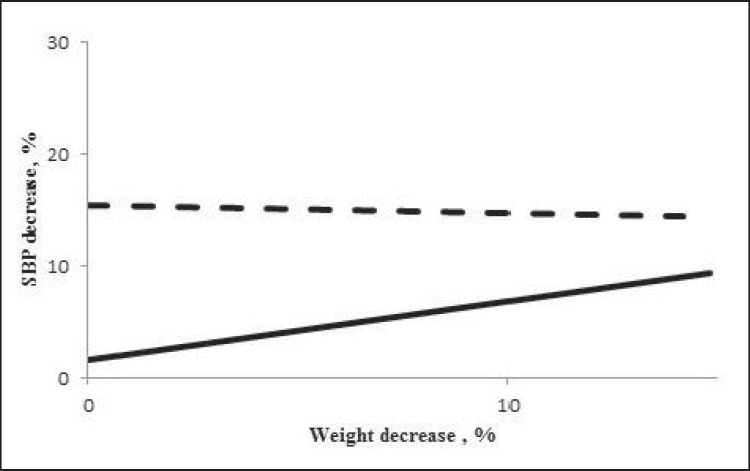
18.9% of CH and 20.0% of UH were on ≥ 3 antihypertensive drugs. Weight change (average -4.9 ± 2.7%) was independent of the antihypertensive drugs employed. Systolic BP (SBP) decreased by 23 mm Hg and diastolic BP (DBP) by 9 mm Hg, in patients with UH most of whom (89%) normalized BP levels (in 49% after a weight loss < 5%). Age, gender, whole and central obesity, concomitance of type 2 diabetes, chronic renal disease, physical activity intensification, and pharmacological therapy did not affect BP lowering. In the regression analysis with SBP change as dependent variable, weight reduction (β = 0.523, p = 0.005) and group (UH vs. CH, β = -19.40, p = 0.0005) remained associated with SBP reduction. When DBP change was entered as dependent variable, baseline uric acid remained associated with DBP reduction (β = 0.824, p < 0.05).
Lifestyle interventions are useful for all obese hypertensive patients in most of whom a modest weight loss is sufficient to normalize BP levels avoiding the aggressive use of multiple antihypertensive drugs.
评估生活方式干预对高血压(血压控制与否)肥胖患者降低血压水平/使血压恢复正常的效果。
在这项前瞻性观察研究中,490例肥胖高血压患者,其中389例血压得到控制(血压<140/90 mmHg;CH组),101例血压未得到控制(血压≥140/90 mmHg;UH组),接受了为期3个月的生活方式干预。在干预前后,我们评估了体重、腰围、脂肪量、血压、代谢和肾脏变量以及身体活动情况。使用多元回归模型来确定血压变化的预测因素。
CH组中18.9%和UH组中20.0%的患者服用≥3种抗高血压药物。体重变化(平均-4.9±2.7%)与所使用的抗高血压药物无关。收缩压(SBP)下降了23 mmHg,舒张压(DBP)下降了9 mmHg,在UH组患者中,大多数(89%)血压恢复正常(49%的患者体重减轻<5%后血压恢复正常)。年龄、性别、全身和中心性肥胖、2型糖尿病合并症、慢性肾病、身体活动增强以及药物治疗均未影响血压降低。在以SBP变化作为因变量的回归分析中,体重减轻(β = 0.523,p = 0.005)和分组(UH组与CH组,β = -19.40,p = 0.0005)仍然与SBP降低相关。当以DBP变化作为因变量时,基线尿酸水平仍然与DBP降低相关(β = 0.824,p < 0.05)。
生活方式干预对所有肥胖高血压患者均有用,大多数患者适度减轻体重足以使血压恢复正常,避免过度使用多种抗高血压药物。