Biddle Stuart J H, Bennie Jason A, Bauman Adrian E, Chau Josephine Y, Dunstan David, Owen Neville, Stamatakis Emmanuel, van Uffelen Jannique G Z
Active Living & Public Health, Institute of Sport, Exercise & Active Living (ISEAL), Victoria University, Footscray Park, Melbourne, VIC, 8001, Australia.
Baker IDI Heart and Diabetes Institute, Melbourne, Australia.
BMC Public Health. 2016 Jul 26;16:635. doi: 10.1186/s12889-016-3307-3.
Sedentary behaviours (time spent sitting, with low energy expenditure) are associated with deleterious health outcomes, including all-cause mortality. Whether this association can be considered causal has yet to be established. Using systematic reviews and primary studies from those reviews, we drew upon Bradford Hill's criteria to consider the likelihood that sedentary behaviour in epidemiological studies is likely to be causally related to all-cause (premature) mortality.
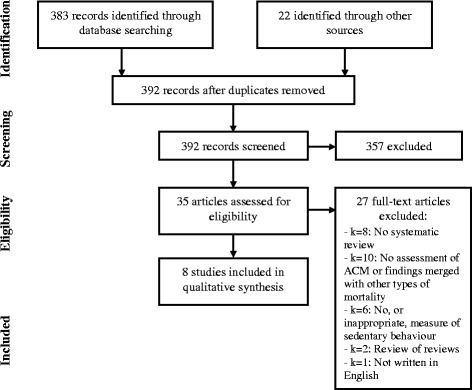
Searches for systematic reviews on sedentary behaviours and all-cause mortality yielded 386 records which, when judged against eligibility criteria, left eight reviews (addressing 17 primary studies) for analysis. Exposure measures included self-reported total sitting time, TV viewing time, and screen time. Studies included comparisons of a low-sedentary reference group with several higher sedentary categories, or compared the highest versus lowest sedentary behaviour groups. We employed four Bradford Hill criteria: strength of association, consistency, temporality, and dose-response. Evidence supporting causality at the level of each systematic review and primary study was judged using a traffic light system depicting green for causal evidence, amber for mixed or inconclusive evidence, and red for no evidence for causality (either evidence of no effect or no evidence reported).
The eight systematic reviews showed evidence for consistency (7 green) and temporality (6 green), and some evidence for strength of association (4 green). There was no evidence for a dose-response relationship (5 red). Five reviews were rated green overall. Twelve (67 %) of the primary studies were rated green, with evidence for strength and temporality.
There is reasonable evidence for a likely causal relationship between sedentary behaviour and all-cause mortality based on the epidemiological criteria of strength of association, consistency of effect, and temporality.
久坐行为(花费时间坐着,能量消耗低)与有害健康后果相关,包括全因死亡率。这种关联是否可被视为因果关系尚未确定。利用系统评价以及这些评价中的原始研究,我们依据布拉德福德·希尔标准来考量流行病学研究中久坐行为与全因(过早)死亡率存在因果关系的可能性。
检索关于久坐行为和全因死亡率的系统评价,得到386条记录,根据纳入标准进行判断后,留下8篇评价(涉及17项原始研究)用于分析。暴露测量包括自我报告的总久坐时间、看电视时间和屏幕使用时间。研究包括将低久坐参考组与几个较高久坐类别进行比较,或将最高与最低久坐行为组进行比较。我们采用了四项布拉德福德·希尔标准:关联强度、一致性、时间顺序和剂量反应。使用交通灯系统判断每项系统评价和原始研究层面支持因果关系的证据,绿色表示因果证据,琥珀色表示混合或不确定证据,红色表示无因果关系证据(即无效应证据或未报告证据)。
八项系统评价显示出一致性证据(7项为绿色)和时间顺序证据(6项为绿色),以及一些关联强度证据(4项为绿色)。没有剂量反应关系的证据(5项为红色)。五项评价总体评为绿色。十二项(67%)原始研究评为绿色,有强度和时间顺序的证据。
基于关联强度、效应一致性和时间顺序的流行病学标准,有合理证据表明久坐行为与全因死亡率之间可能存在因果关系。