Obirikorang Yaa, Obirikorang Christian, Anto Enoch Odame, Acheampong Emmanuel, Batu Emmanuella Nsenbah, Stella Agyemang Duah, Constance Omerige, Brenya Peter Kojo
Department of Nursing, Faculty of Health and Allied Sciences, Garden City University College (GCUC), Kenyasi, Kumasi, Ghana.
Department of Molecular Medicine, School of Medical Science, Kwame Nkrumah University of Science and Technology (KNUST), Kumasi, Ghana.
BMC Public Health. 2016 Jul 26;16:637. doi: 10.1186/s12889-016-3311-7.
Diabetes mellitus (DM) appears to be a global epidemic and an increasingly major non-communicable disease threatening both affluent and non-affluent society. The study aimed to determine the knowledge of diabetic complications among diabetes mellitus clients visiting the Diabetic Clinical at Sampa Government Hospital, Ghana.
This questionnaire-based descriptive study recruited a total 630 patients visiting the Diabetes Clinic at the Sampa Government Hospital. Structured questionnaire was used to obtain information such as socio-demographic and knowledge on complications of diabetes.
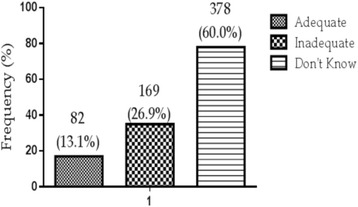
Out of a total of 630 participants, 325 (51.5 %) knew diabetic foot as the most common complication followed by hypertension 223(35.4 %), neuropathy 184 (29.2 %), hypoactive sexual arousal 160(25.4 %), arousal disorder 135(21.5 %), eye diseases 112(17.7 %), heart disease 58(9.2 %), and renal disease 34(5.4 %). Comprehensive assessment of level of knowledge on the complications showed that majority 378(60.0 %) of T2D patients did not have knowledge on diabetes complications, 169(26.9 %) had inadequate knowledge on diabetics complication while 82(13.1 %) had adequate knowledge. The risk factors associated with the level of knowledge of diabetic complications were female gender adjusted odd ratio (AOR) =2.31 (1.56-3.41) married participants AOR = 3.37 (1.44-7.93), widowed AOR = 2.98 (1.10-8.08), basic level of education AOR =0.18 (0.082-0.50), Junior High School (JHS) and above of education level AOR = 0.035(0.017-0.75), 5-9 years of T2D duration AOR = 0.31(0.018-0.57), ≥10 years T2D duration AOR = 0.042 (0.02-0.10) and urban dwellers AOR = 0.36 (0.22-0.68) respectively.
Participants knew the individual complication of diabetic mellitus but lack an in-depth knowledge on the complications. Further expansion of diabetic educative programs like using mass media and involving national curriculum of education can improve self-regulatory awareness of diabetic complications which may reduce the morbidity and mortality of diabetic patients.
糖尿病似乎已成为一种全球性流行病,且日益成为威胁富裕和非富裕社会的主要非传染性疾病。本研究旨在确定加纳桑帕政府医院糖尿病诊所就诊的糖尿病患者对糖尿病并发症的了解情况。
这项基于问卷调查的描述性研究共招募了630名前往桑帕政府医院糖尿病诊所就诊的患者。使用结构化问卷获取社会人口统计学信息以及糖尿病并发症相关知识等信息。
在总共630名参与者中,325人(51.5%)知道糖尿病足是最常见的并发症,其次是高血压223人(35.4%)、神经病变184人(29.2%)、性唤起减退160人(25.4%)、性唤起障碍135人(21.5%)、眼部疾病112人(17.7%)、心脏病58人(9.2%)和肾脏疾病34人(5.4%)。对并发症知识水平的综合评估显示,大多数2型糖尿病患者378人(60.0%)对糖尿病并发症不了解,169人(26.9%)对糖尿病并发症知识了解不足,而82人(13.1%)知识充足。与糖尿病并发症知识水平相关的风险因素分别为女性调整比值比(AOR)=2.31(1.56 - 3.41)、已婚参与者AOR = 3.37(1.44 - 7.93)、丧偶AOR = 2.98(1.10 - 8.08)、基础教育水平AOR = 0.18(0.082 - (此处原文有误,应改为0.50))、初中及以上教育水平AOR = 0.035(0.017 - 0.75)、2型糖尿病病程5 - 9年AOR = 0.31(0.018 - 0.57)、2型糖尿病病程≥10年AOR = 0.042(0.02 - 0.10)以及城市居民AOR = 0.36(0.22 - 0.68)。
参与者了解糖尿病的个别并发症,但对并发症缺乏深入了解。进一步扩大糖尿病教育项目,如利用大众媒体并纳入国家教育课程,可提高对糖尿病并发症的自我管理意识,这可能降低糖尿病患者的发病率和死亡率。