Wang Jing-Hung, Endsley Aaron N, Green Carol E, Matin A C
Department of Microbiology and Immunology, Stanford University School of Medicine, Sherman Fairchild Science Building, 299 Campus Drive, Stanford, CA, 94305, USA.
Bioanalytical Assays and Pharmacokinetics, Bayer HealthCare LLC, 455 Mission Bay Boulevard South, San Francisco, CA, 94158, USA.
BMC Cancer. 2016 Jul 25;16:524. doi: 10.1186/s12885-016-2508-6.
Success of cancer prodrugs relying on a foreign gene requires specific delivery of the gene to the cancer, and improvements such as higher level gene transfer and expression. Attaining these objectives will be facilitated in preclinical studies using our newly discovered CNOB-GDEPT, consisting of the produrg: 6-chloro-9-nitro-5-oxo-5H-benzo-(a)-phenoxazine (CNOB) and its activating enzyme ChrR6, which generates the cytotoxic product 9-amino-6-chloro-5H-benzo[a]phenoxazine-5-one (MCHB). MCHB is fluorescent and can be noninvasively imaged in mice, and here we investigated whether MCHB fluorescence quantitatively reflects its concentration, as this would enhance its reporter value in further development of the CNOB-GDEPT therapeutic regimen. PK parameters were estimated and used to predict more effective CNOB administration schedules.
CNOB (3.3 mg/kg) was injected iv in mice implanted with humanized ChrR6 (HChrR6)-expressing 4T1 tumors. Fluorescence was imaged in live mice using IVIS Spectrum, and quantified by Living Image 3.2 software. MCHB and CNOB were quantified also by LC/MS/MS analysis. We used non-compartmental model to estimate PK parameters. Phoenix WinNonlin software was used for simulations to predict a more effective CNOB dosage regimen.
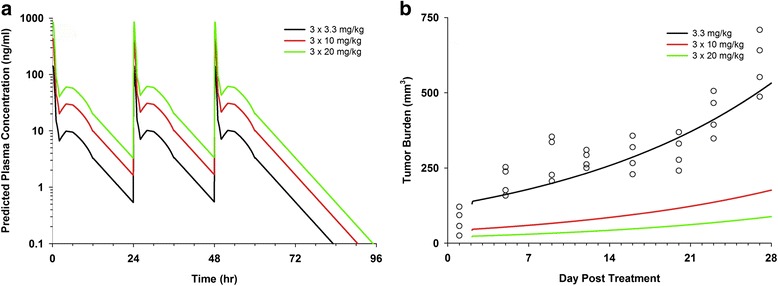
CNOB administration significantly prolonged mice survival. MCHB fluorescence quantitatively reflected its exposure levels to the tumor and the plasma, as verified by LC/MS/MS analysis at various time points, including at a low concentration of 2 ng/g tumor. The LC/MS/MS data were used to estimate peak plasma concentrations, exposure (AUC0-24), volume of distribution, clearance and half-life in plasma and the tumor. Simulations suggested that the CNOB-GDEPT can be a successful therapy without large increases in the prodrug dosage.
MCHB fluorescence quantifies this drug, and CNOB can be effective at relatively low doses. MCHB fluorescence characteristics will expedite further development of CNOB-GDEPT by, for example, facilitating specific gene delivery to the tumor, its prolonged expression, as well as other attributes necessary for successful gene-delivered enzyme prodrug therapy.
依赖外源基因的癌症前体药物的成功需要将该基因特异性递送至癌症部位,并实现更高水平的基因转移和表达等改进。在临床前研究中,使用我们新发现的CNOB - GDEPT(由前体药物6 - 氯 - 9 - 硝基 - 5 - 氧代 - 5H - 苯并[a]吩恶嗪(CNOB)及其激活酶ChrR6组成,ChrR6可生成细胞毒性产物9 - 氨基 - 6 - 氯 - 5H - 苯并[a]吩恶嗪 - 5 - 酮(MCHB))将有助于实现这些目标。MCHB具有荧光性,可在小鼠体内进行无创成像,在此我们研究了MCHB荧光是否能定量反映其浓度,因为这将提高其在CNOB - GDEPT治疗方案进一步开发中的报告价值。估算了药代动力学(PK)参数,并用于预测更有效的CNOB给药方案。
将CNOB(3.3 mg/kg)静脉注射到植入了表达人源化ChrR6(HChrR6)的4T1肿瘤的小鼠体内。使用IVIS Spectrum对活体小鼠进行荧光成像,并通过Living Image 3.2软件进行定量分析。还通过液相色谱 - 串联质谱(LC/MS/MS)分析对MCHB和CNOB进行定量。我们使用非房室模型估算PK参数。使用Phoenix WinNonlin软件进行模拟,以预测更有效的CNOB给药方案。
给予CNOB可显著延长小鼠生存期。MCHB荧光定量反映了其在肿瘤和血浆中的暴露水平,这在各个时间点通过LC/MS/MS分析得到了验证,包括在肿瘤低浓度为2 ng/g时。LC/MS/MS数据用于估算血浆峰浓度、暴露量(AUC0 - 24)、分布容积、清除率以及血浆和肿瘤中的半衰期。模拟结果表明,CNOB - GDEPT可以成为一种成功的治疗方法,而无需大幅增加前体药物剂量。
MCHB荧光可对这种药物进行定量,并且CNOB在相对低剂量时即可有效。MCHB荧光特性将加快CNOB - GDEPT的进一步开发,例如,有助于将特定基因递送至肿瘤、延长其表达以及实现成功的基因递送酶前体药物治疗所需的其他特性。