Norton Philipp, Scharff Constance
AG Verhaltensbiologie, Freie Universität Berlin Berlin, Germany.
Front Neurosci. 2016 Jul 6;10:309. doi: 10.3389/fnins.2016.00309. eCollection 2016.
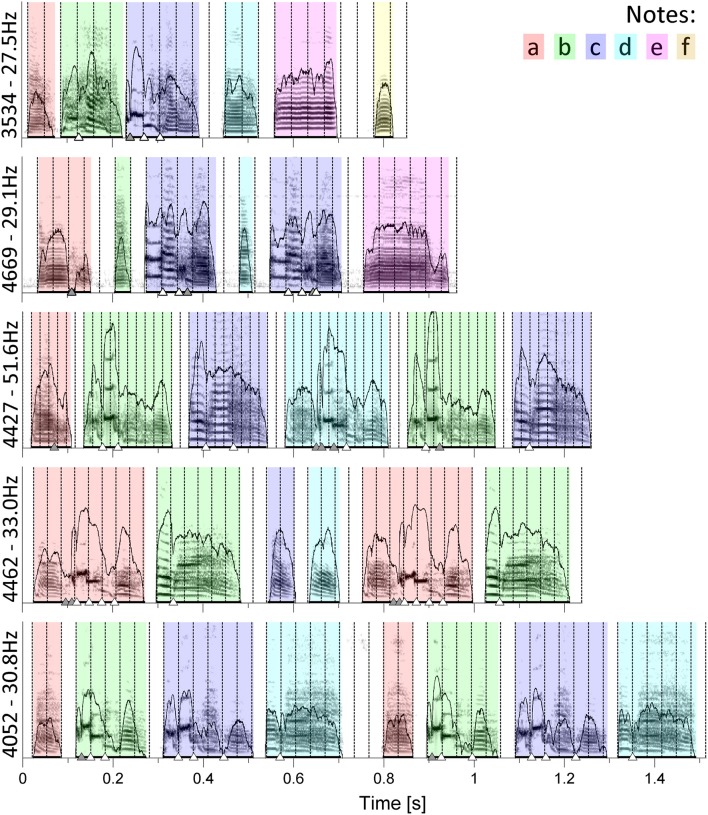
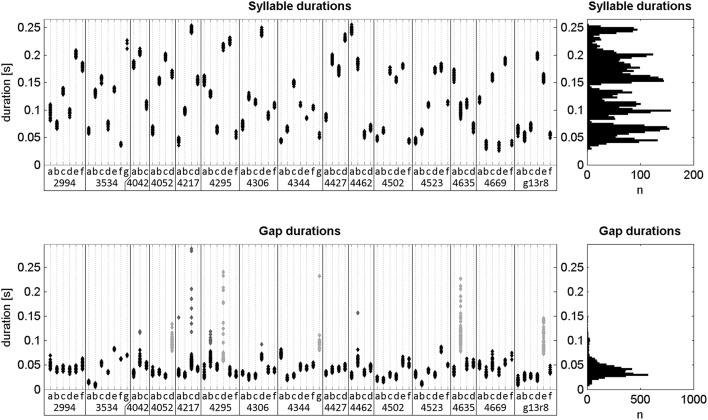
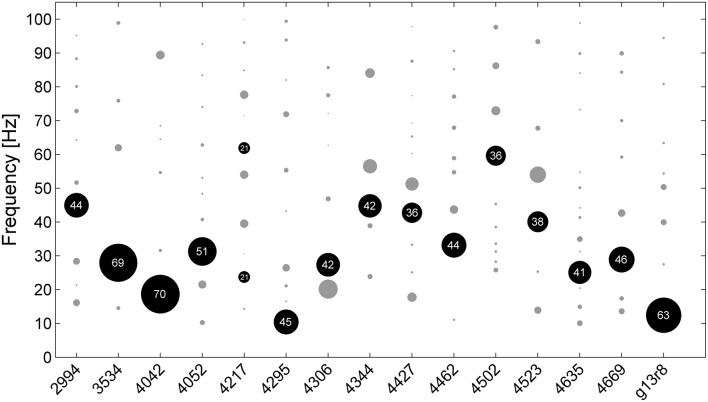
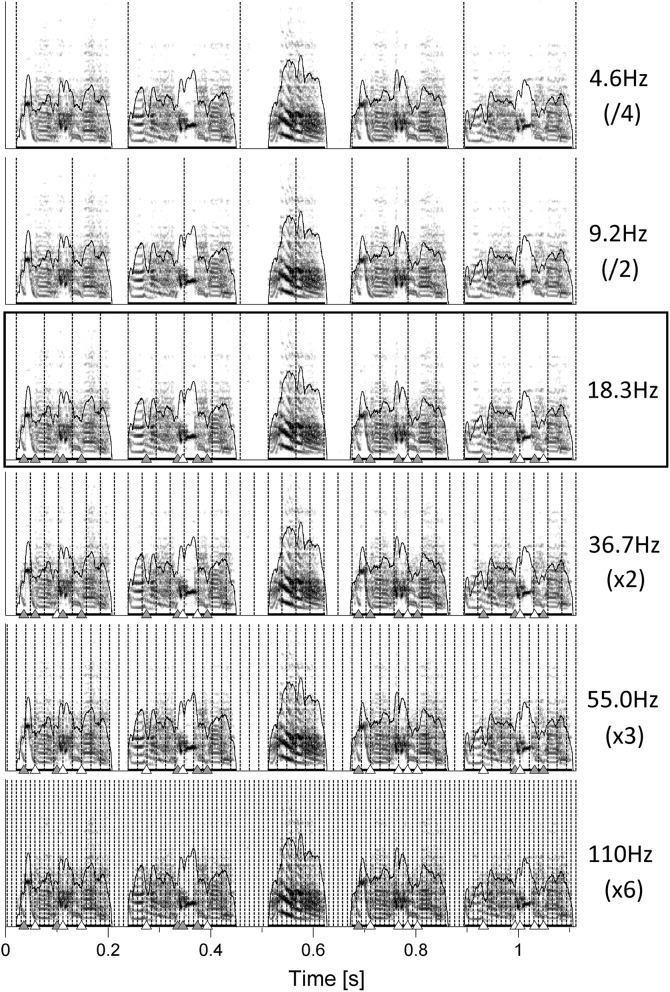
The human capacity for speech and vocal music depends on vocal imitation. Songbirds, in contrast to non-human primates, share this vocal production learning with humans. The process through which birds and humans learn many of their vocalizations as well as the underlying neural system exhibit a number of striking parallels and have been widely researched. In contrast, rhythm, a key feature of language, and music, has received surprisingly little attention in songbirds. Investigating temporal periodicity in bird song has the potential to inform the relationship between neural mechanisms and behavioral output and can also provide insight into the biology and evolution of musicality. Here we present a method to analyze birdsong for an underlying rhythmic regularity. Using the intervals from one note onset to the next as input, we found for each bird an isochronous sequence of time stamps, a "signal-derived pulse," or pulse(S), of which a subset aligned with all note onsets of the bird's song. Fourier analysis corroborated these results. To determine whether this finding was just a byproduct of the duration of notes and intervals typical for zebra finches but not dependent on the individual duration of elements and the sequence in which they are sung, we compared natural songs to models of artificial songs. Note onsets of natural song deviated from the pulse(S) significantly less than those of artificial songs with randomized note and gap durations. Thus, male zebra finch song has the regularity required for a listener to extract a perceived pulse (pulse(P)), as yet untested. Strikingly, in our study, pulses(S) that best fit note onsets often also coincided with the transitions between sub-note elements within complex notes, corresponding to neuromuscular gestures. Gesture durations often equaled one or more pulse(S) periods. This suggests that gesture duration constitutes the basic element of the temporal hierarchy of zebra finch song rhythm, an interesting parallel to the hierarchically structured components of regular rhythms in human music.
人类的言语和声乐能力依赖于声音模仿。与非人类灵长类动物不同,鸣禽与人类一样具备这种发声学习能力。鸟类和人类学习许多发声的过程以及潜在的神经系统展现出诸多显著的相似之处,并且已得到广泛研究。相比之下,节奏作为语言和音乐的一个关键特征,在鸣禽中却出人意料地很少受到关注。研究鸟鸣中的时间周期性有可能揭示神经机制与行为输出之间的关系,还能为音乐性的生物学和进化提供见解。在此,我们提出一种分析鸟鸣以探寻潜在节奏规律的方法。以一个音符起始到下一个音符起始的间隔作为输入,我们为每只鸟找到了一个等时的时间戳序列,即一个“信号衍生脉冲”,或简称脉冲(S),其中一部分与该鸟歌声的所有音符起始对齐。傅里叶分析证实了这些结果。为了确定这一发现是否只是斑胸草雀典型音符和间隔时长的副产品,而不依赖于各个元素的具体时长及其演唱顺序,我们将自然歌声与人工歌曲模型进行了比较。自然歌声的音符起始与脉冲(S)的偏差显著小于音符和间隔时长随机化的人工歌曲。因此,雄性斑胸草雀的歌声具有让听众提取感知脉冲(脉冲(P))所需的规律性,不过这一点尚未经过测试。引人注目的是,在我们的研究中,最符合音符起始的脉冲(S)往往也与复杂音符内子音符元素之间的过渡相重合,这与神经肌肉动作相对应。动作时长通常等于一个或多个脉冲(S)周期。这表明动作时长构成了斑胸草雀歌声节奏时间层次的基本元素,这与人类音乐中规则节奏的层次结构组成部分存在有趣的相似之处。