Zhou Hong-Sheng, Carter Bing Z, Andreeff Michael
Section of Molecular Hematology and Therapy, Department of Leukemia, The University of Texas M.D. Anderson Cancer Center, Houston, TX 77030, USA; Department of Hematology, Nanfang Hospital, Southern Medical University, Guangzhou 510515, China.
Section of Molecular Hematology and Therapy, Department of Leukemia, The University of Texas M.D. Anderson Cancer Center, Houston, TX 77030, USA.
Cancer Biol Med. 2016 Jun;13(2):248-59. doi: 10.20892/j.issn.2095-3941.2016.0023.
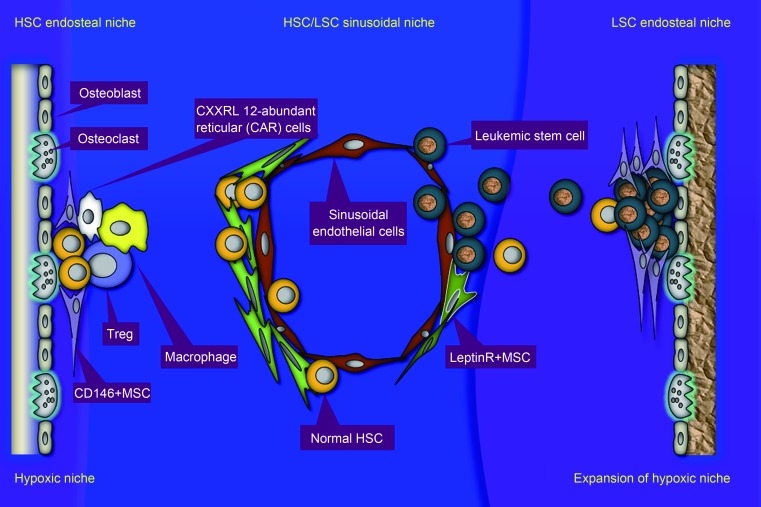
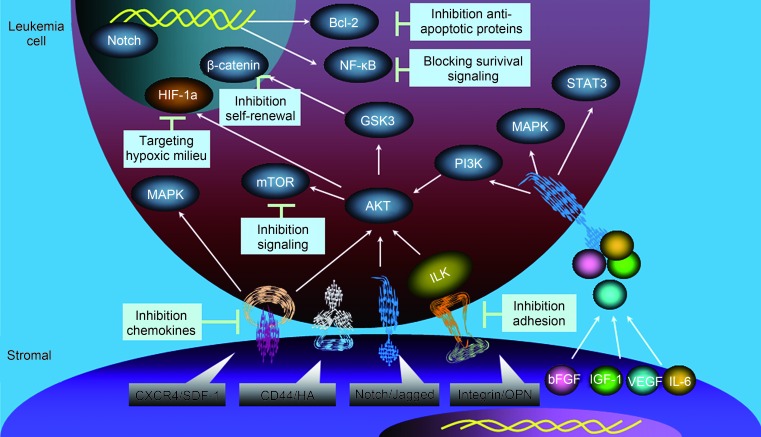
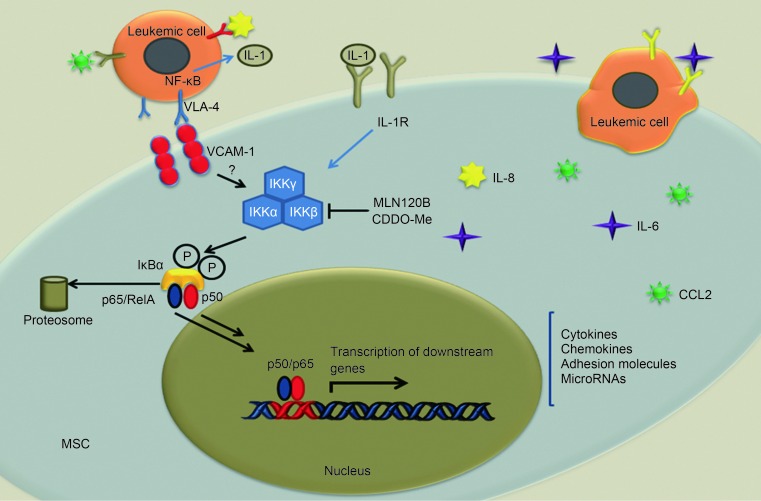
Acute myeloid leukemia (AML) is characterized by the accumulation of circulating immature blasts that exhibit uncontrolled growth, lack the ability to undergo normal differentiation, and have decreased sensitivity to apoptosis. Accumulating evidence shows the bone marrow (BM) niche is critical to the maintenance and retention of hematopoietic stem cells (HSC), including leukemia stem cells (LSC), and an increasing number of studies have demonstrated that crosstalk between LSC and the stromal cells associated with this niche greatly influences leukemia initiation, progression, and response to therapy. Undeniably, stromal cells in the BM niche provide a sanctuary in which LSC can acquire a drug-resistant phenotype and thereby evade chemotherapy-induced death. Yin and Yang, the ancient Chinese philosophical concept, vividly portrays the intricate and dynamic interactions between LSC and the BM niche. In fact, LSC-induced microenvironmental reprogramming contributes significantly to leukemogenesis. Thus, identifying the critical signaling pathways involved in these interactions will contribute to target optimization and combinatorial drug treatment strategies to overcome acquired drug resistance and prevent relapse following therapy. In this review, we describe some of the critical signaling pathways mediating BM niche-LSC interaction, including SDF1/CXCL12, Wnt/β-catenin, VCAM/VLA-4/NF-κB, CD44, and hypoxia as a newly-recognized physical determinant of resistance, and outline therapeutic strategies for overcoming these resistance factors.
急性髓系白血病(AML)的特征是循环中未成熟母细胞的积累,这些母细胞表现出不受控制的生长,缺乏进行正常分化的能力,并且对细胞凋亡的敏感性降低。越来越多的证据表明,骨髓(BM)微环境对于包括白血病干细胞(LSC)在内的造血干细胞(HSC)的维持和保留至关重要,并且越来越多的研究表明,LSC与该微环境相关的基质细胞之间的相互作用极大地影响白血病的起始、进展和对治疗的反应。不可否认,BM微环境中的基质细胞提供了一个庇护所,LSC可以在其中获得耐药表型,从而逃避化疗诱导的死亡。阴阳,这一古老的中国哲学概念,生动地描绘了LSC与BM微环境之间复杂而动态的相互作用。事实上,LSC诱导的微环境重编程对白血病发生有显著贡献。因此,确定这些相互作用中涉及的关键信号通路将有助于优化靶点和联合药物治疗策略,以克服获得性耐药并防止治疗后复发。在本综述中,我们描述了一些介导BM微环境-LSC相互作用的关键信号通路,包括SDF1/CXCL12、Wnt/β-连环蛋白、VCAM/VLA-4/NF-κB、CD44,以及缺氧作为一种新认识的耐药物理决定因素,并概述了克服这些耐药因素的治疗策略。